FTTH lead generation • Educating buyers
How to Educate Complex Buyers Without Overwhelming Them
Your engineers know more than a buyer can absorb in one sitting, and that is the problem. A planner who is sent everything about PON architecture, route diversity, ROI, SLAs and capacity planning does not learn all of it. They close the tab. The fix is not less expertise. It is a repeatable way to slice it.
Quick answer: To educate complex buyers without overwhelming them, give each technical topic its own lesson built from four parts: one question the buyer already has, one sourced number, one worked example and one task that takes under ten minutes. Park everything else on a reference page, linked and not deleted. The need is real: 77% of B2B buyers call their latest purchase very complex or difficult (Gartner), and a meta-analysis of 56 investigations found learners did better, with lower cognitive load, when instruction was split into segments (Rey et al., 2019). This page applies the method to five fiber topics and turns it into a five-day email course.
The page is for FTTH vendors, contractors, equipment suppliers, consultants and wholesale providers whose buyers are not all engineers. We say where a source is a vendor or a blog, where a page gives no date, and where we are applying a general finding to fiber without a fiber-specific test.
Why do complex buyers get overwhelmed?
Because they collect and reconcile more information than they can use, and they decide as a group. The table lists five sources. Only one is about learning, and none tests an email course for fiber buyers, so the last column shows how far each one stretches.
| Source | What it says | Read this carefully |
|---|---|---|
| Gartner, “Customer Confidence” (web page, undated) | 77% of B2B buyers say their latest purchase was “very complex or difficult.” Buyers spend about two-thirds of the journey collecting, processing and reconciling information, and are “overwhelmed by the amount of high-quality information” they meet. Gartner links information that helps customers advance to 2.8x and 3x multipliers in the likelihood of an easy purchase and a high-value, low-regret deal. | The page gives no sample size or date and does not name the study behind the figures. General B2B. |
| Gartner sales survey (press release, 9 March 2026) | “Confident buyers are twice as likely to report a high-quality deal” than buyers with low decision confidence. 67% prefer a rep-free experience. | 646 B2B buyers, surveyed August to September 2025. General B2B, not telecom. |
| Rey et al., “A meta-analysis of the segmenting effect,” Educational Psychology Review (2019) | Across 56 investigations and 88 comparisons, learners performed better when multimedia instruction came in learner-paced segments than as one continuous unit. Segmenting reduced overall cognitive load. The effects on retention and transfer were small to medium, and learners with high prior knowledge gained more in retention. | Classroom-style multimedia learning, not B2B buying or email. We apply the principle by analogy. |
| Forrester, The State of Business Buying, 2026 (press release, 21 January 2026) | The typical decision includes 13 internal stakeholders and nine external influencers. Procurement is a decision-maker in 53% of buying cycles. | No sample size is stated in the release. General business buying. |
| GlobalSpec, TREW Marketing and Elektor, 2026 State of Marketing to Engineers (PDF, March 2026) | About 62% of the buying process is done online before buyers engage sales (pp. 6–7). Vendor engineering experts are the most trusted content authors, at 66% (p. 33). | Over 1,000 engineers. Telecom is about 7% of the sample. |
Our reading: the problem is not a lack of information. Gartner’s own phrase is “high-quality information,” and buyers are still overwhelmed by it. Confidence is the outcome to aim for, and confidence comes from a buyer finishing something and understanding it, then passing it to the rest of the group. A lesson that is read to the end does more than a complete document that is not.
What is the one-question lesson?
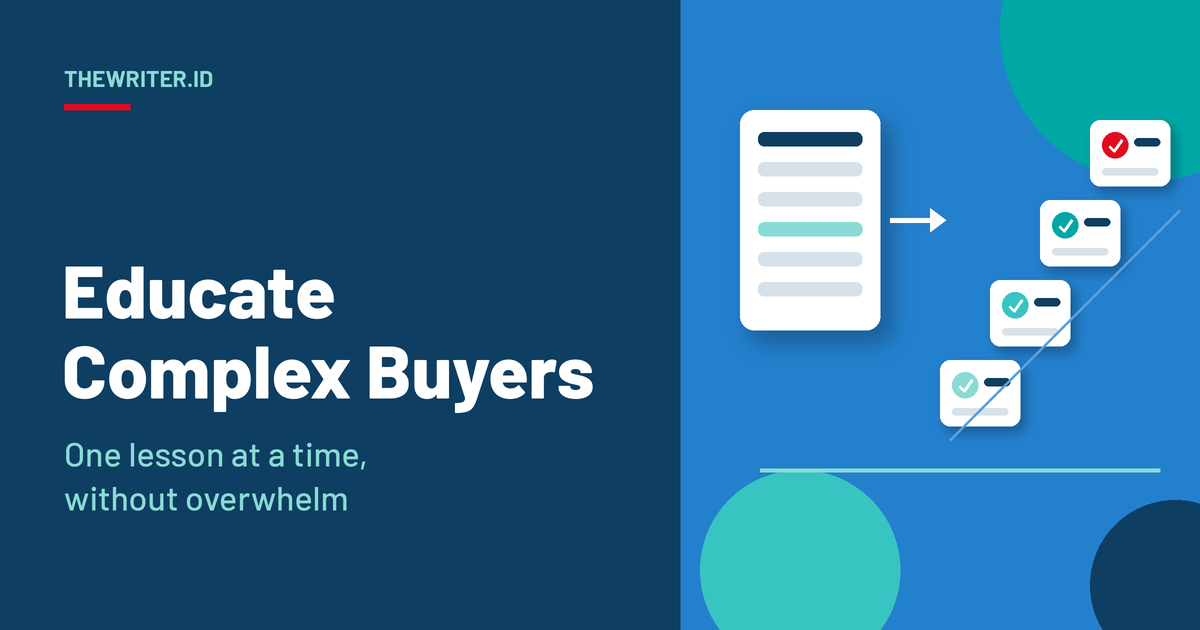
A lesson built from four parts, with a parking lot for everything else: one question, one number, one example and one task. It is our framework, built from the segmenting evidence above and from how technical buyers read. It is not a published standard and no study has tested it on fiber buyers.
| Part | What it is | The test |
|---|---|---|
| One question | The question the buyer already has about this topic, in their words. | Can the buyer say it in one sentence without your jargon? |
| One number | A single figure that answers the question, with its source and date. | Can the buyer open the source? If not, cut the number. |
| One example | A worked case using a figure the buyer can change. | Does the example show the number doing something? |
| One task | Something the buyer does, then keeps or forwards. | Does it take under ten minutes and leave a result on the page? |
| The parking lot | Everything else the engineer knows, on a linked reference page. | Is it linked from the lesson, and is nothing deleted? |
The parking lot is what keeps experts willing to cut. Engineers resist short lessons because they fear the omitted detail will be missed. A linked reference page answers that worry, and it is also where depth belongs for the readers who want it. The same rule serves a buyer’s colleagues: a procurement officer who receives a forwarded lesson reads a page, not a manual.
What does a finished lesson look like?
Here is one on SLAs: a single question, a sourced number, a neighboring number for comparison and a task. An SLA percentage is a good first lesson because buyers see it in every proposal and few can say what it allows.
| Availability | Per month | Per year |
|---|---|---|
| 99.9% | about 43.2 minutes | about 8.76 hours |
| 99.99% | about 4.32 minutes | about 52.6 minutes |
| 99.999% | about 26 seconds | about 5.26 minutes |
The table is from a Baeldung guide to cloud SLA calculations (published 11 July 2025, updated 6 August 2025). It is about cloud services, but the arithmetic is the same for any availability percentage over a 30-day month or a year. The guide also gives the caveat that makes the task worth doing: the measurement period is commonly a calendar month, quarter or year, scheduled maintenance is typically excluded if it was announced in advance, and degraded performance is usually counted like an outage unless the SLA weights it differently. A buyer who knows only the percentage does not know what is counted.
That is the whole lesson. Service credits, repair times and the claim process wait on the parking lot. They matter, but a buyer who has not yet understood what 99.9% allows is not ready for them.
How do you slice PON architecture, route diversity, ROI, SLA and capacity planning?
Give each topic its own question and its own number, and refuse to add a second of either. The first table shows the question, number and example for each topic. The second shows the task and what goes in the parking lot.
| Topic | One question | One number | One worked example |
|---|---|---|---|
| PON architecture | What is shared on a PON, and what is not? | 10 Gbit/s in each direction, nominal, for XGS-PON (ITU-T G.9807.1) | One fiber feeds a passive splitter that serves a neighborhood, so the 10 Gbit/s is shared by every home behind it. A PON can serve up to 32 homes on one fiber (CCG Consulting). |
| Route diversity | Could one dig-in take both circuits down? | Four things two routes must not share: conduit, entrance, crossing and right of way (VAST Networks) | Two carriers whose routes meet in one duct bank for the last stretch. One dig-in takes both circuits down, though the buyer has two bills. |
| ROI | How many customers must connect before the build pays back? | Average FTTH take rate of 40%, or 46.5% on unique passings (Gary Bolton, FBA, citing RVA) | 500 passings at 40% is 200 customers. At 30% it is 150, a quarter fewer for the same build cost. This is our arithmetic. |
| SLA | What does the percentage actually allow? | 99.9% allows about 8.76 hours of downtime a year (Baeldung) | 99.99% allows about 52.6 minutes, ten times less. |
| Capacity planning | How full can a PON get before customers notice? | A GPON port shares 2.4 Gbps downstream (CCG Consulting) | 20 customers on gigabit plans is 20 Gbps of potential demand: about 8:1 on GPON and about 2:1 on XGS-PON. This is our arithmetic on nominal rates. |
| Topic | One task | Parked for the reference page |
|---|---|---|
| PON architecture | Draw one PON on a page: the port, the splitter and the number of homes. | Optical loss budget, wavelength plan and coexistence with GPON |
| Route diversity | Ask each provider whether it leases fiber from the other. VAST says the answer is “often yes and rarely volunteered.” | Permits and easements, route audits, triversity |
| ROI | Replace 40% with your own take rate and rerun the count. | The payback model and financing. For costs, the 2025 medians were $18 per foot underground and $8 aerial (FBA and Cartesian) |
| SLA | Ask what the SLA excludes and over what window it is measured. | Service credit tiers, repair times, degraded versus down |
| Capacity planning | Count the customers and plan speeds on your busiest PON port. | Burstiness, schedulers and the peak-hour formula |
Two of our own articles show the parking-lot idea at full depth. The GPON to XGS-PON migration article carries a weighted scoring model and readiness gates, yet it can be taught in one lesson as a single question: which customers first? The underground FTTH design article uses a segment-by-segment duct reserve worksheet to answer one question: how much room is left for the next cable? Each is the reference page behind a short lesson.
The tables show why the framework needs an engineer. A single wrong figure ends the lesson, so every number must be checked, dated and linked. The route-diversity source is a provider’s guide, the capacity figure is from a consultant’s blog post that is nearly six years old, and the SLA table is a cloud guide. All are fine for teaching the arithmetic. None replaces your own measured figures for your own network.
What does capacity planning look like as one number?
As an oversubscription ratio: the potential demand on a PON port divided by the capacity that port shares. CCG Consulting explains that oversubscription “comes into play in any network when the aggregate subscribed customer demand is greater than the available bandwidth.” Its example puts 20 customers on gigabit plans on a GPON port that shares 2.4 Gbps downstream, which is “more than 8 times more capacity” than is physically available (CCG Consulting, 4 December 2020).
| PON type | Shared capacity, downstream | Potential demand | Ratio |
|---|---|---|---|
| GPON | 2.4 Gbps | 20 Gbps | about 8:1 (20 ÷ 2.4 ≈ 8.3) |
| XGS-PON | 10 Gbit/s | 20 Gbps | about 2:1 (20 ÷ 10) |
The lesson must also say what the ratio is not. CCG notes that residential users rarely draw their full plan speed at once, so providers set ratios from typical usage, and that heavy oversubscription can cause slowdowns. A ratio of 8:1 is therefore not a fault, and 2:1 is not a guarantee. The reference page can go further. Nokia, a vendor, writes that the classic planning formula, C ≥ (N × T) + (K × PIR), is “limited and imprecise” because it ignores traffic burstiness (Nokia blog, 7 November 2023). That is a good item for the parking lot and a poor opening lesson.
The task for the buyer is small and concrete: count the customers and their plan speeds on the busiest PON port, divide, and note the result. It takes minutes, it produces a number they own, and it is the best reason for them to reply with a question.
What would a five-day course on these topics look like?
One topic per day, each a one-question lesson, ending with an invitation to review the buyer’s own numbers. This is a “Crash Course,” the type that suits a buyer who is new to the subject. The outline is an illustration, not a course we have run.
| Day | Lesson | The question | The task |
|---|---|---|---|
| 1 | PON architecture | What is shared on a PON, and what is not? | Draw one PON on a page |
| 2 | Capacity planning | How full can a PON get before customers notice? | Count customers and speeds on the busiest port |
| 3 | Route diversity | Could one dig-in take both circuits down? | Ask whether the carriers lease from each other |
| 4 | SLA | What does the percentage allow? | Ask what the SLA excludes and the measurement window |
| 5 | ROI, and an invitation | How many customers must connect before the build pays back? | Rerun the count with your own take rate, then book a review with an engineer |
The order is deliberate. Days 1 and 2 give the buyer a picture and a ratio. Days 3 and 4 give them two questions to put to any supplier. Day 5 joins everything to money, which is what the finance lead and procurement officer in the group will read first. Forrester’s group of 13 internal stakeholders and nine external influencers is a reason to write Day 5 so that it makes sense forwarded on its own (Forrester).
How do you name the course so buyers sign up?
Name it like a physical asset, say who it is for, make the bad outcomes concrete and answer the quiet objection. “Cheat Sheet” suits a short course that explains terms. The outcomes should be things a buyer can picture, such as signing an SLA they cannot explain. This sample offer is our illustration, not a live offer.
| Type | Sample offer |
|---|---|
| Crash Course | The Fiber Buyer’s Plain-English Cheat Sheet: Buying Fiber Without An Engineering Degree? Read These 5 Short Lessons To Avoid Signing An SLA You Cannot Explain, A Route That Fails Twice In One Dig-In, And A Business Case Nobody Can Check (Even If You Have Never Read A Network Diagram) |
The three bad outcomes map to Days 4, 3 and 5. The objection in brackets matters because a buyer who feels unqualified will not sign up for a technical course.
What should you measure to know the lessons work?
Measure whether buyers act, not only whether they open. We make no promise about results, and no source we found tests a course like this in fiber. These four measures are our suggestions:
- Task replies: how many readers send back the number from the task, such as a port ratio or a take rate.
- Parking-lot clicks: which linked reference pages are opened, which shows where depth is wanted.
- Forwards: new addresses, such as a finance lead or a procurement officer, that join after a forward.
- The question that arrives next: what buyers ask after a lesson, which becomes the next lesson or a new parking-lot page.
If readers finish the lessons and do not act on the tasks, the task is too big. If they open every parking-lot page, the lesson cut too much. Adjust the slice, not the topic.
Where does a specialist writer help?
In the cut: choosing the one question, the one number and the one example, and moving the rest to the parking lot without losing accuracy. Engineers can write everything and find it hard to leave anything out. In an engagement, we would organize it this way:
- We interview your engineer and list the questions buyers ask. You see the five topics, the question for each and the proposed number before anything is drafted.
- We write the lessons and the reference pages. Each number is sourced and dated, and your engineer reviews rows of source wording, not whole drafts.
- You send the sequence under your names. We agree that task replies and booked reviews come first, ahead of opens and clicks.
The reference pages also serve search and AI tools: each one opens with a direct answer, gives the evidence under it, and links the source. We cannot promise what any tool will cite, but clear, sourced pages are the ones a human or a tool can quote.
Three honest warnings. The one-question lesson is our framework: it rests on a general finding about segmented learning and on Gartner and Forrester buyer research, and we found no study that tests it on fiber buyers. Several sources here are vendors or blogs, one Gartner page is undated, and the oversubscription example is from 2020, so each number needs your own engineer’s sign-off before it goes out. We cannot promise a conversion rate. Check customer confidentiality and NDAs before you publish a network detail, and follow the email and data laws that apply to you, such as CAN-SPAM in the United States, GDPR in Europe and Indonesia’s Personal Data Protection Law. This is general information, not legal advice.
Frequently asked questions
How do you educate complex buyers without overwhelming them?
Give each technical topic its own short lesson with four parts: one question the buyer already has, one sourced number, one worked example and one task that takes under ten minutes. Move everything else to a linked reference page. Gartner reports that 77% of B2B buyers call their latest purchase very complex or difficult, and a meta-analysis of 56 investigations found that segmenting instruction reduced cognitive load. The framework is our own application of those findings and has not been tested on fiber buyers.
What is a one-question lesson?
A one-question lesson is a short piece of education built around a single question the buyer already has. It carries one sourced number that answers the question, one worked example the buyer can change, and one task that leaves a result they can keep or forward. Everything else the expert knows goes on a reference page that the lesson links to, so nothing is deleted.
How do you explain what an SLA percentage means?
Translate the percentage into time. In one SLA guide, 99.9% availability allows about 43.2 minutes of downtime a month and about 8.76 hours a year, while 99.99% allows about 4.32 minutes a month and about 52.6 minutes a year. Then ask what the SLA excludes and over what window it is measured, because scheduled maintenance is typically excluded and degraded service may be counted differently from an outage.
How do you explain PON oversubscription to a buyer?
Divide the potential demand on a PON port by the capacity it shares. In CCG Consulting’s example, 20 customers on gigabit plans represent 20 Gbps of potential demand on a GPON port that shares 2.4 Gbps downstream, about 8 to 1. On an XGS-PON port with 10 Gbit/s nominal in each direction, the same customers are about 2 to 1. These are nominal ratios, and real traffic is bursty, so a ratio is not a fault or a guarantee.
How many technical topics should one email course cover?
We suggest five lessons, one per day, each on one topic with one question. No study we found identifies the best number, so treat five as a working rule from our own practice. If a topic needs more than one question, make it a separate course or put the extra material on a linked reference page.
What is in TheWriter.id’s educational email course?
Our services page describes a five-day automated email sequence that walks decision-makers through budget and consensus frameworks before a sales conversation. It lists executive-level curriculum design, a lead capture and nurture strategy, a call-to-action framework for each email, and performance metrics with open-rate benchmarks.
Sources and how we checked
We read each source on October 14, 2026. Dates are shown so you can judge how current each one is. Page numbers refer to the GlobalSpec report as paginated in its PDF.
- Gartner, “Customer Confidence,” web page. It carries no publication date, no sample size and no named study.
- Gartner, “Gartner Sales Survey Finds 67% of B2B Buyers Prefer a Rep-Free Experience,” 9 March 2026.
- Günter Daniel Rey, Maik Beege, Steve Nebel, Maria Wirzberger, Tobias Schmitt and Sascha Schneider, “A meta-analysis of the segmenting effect,” Educational Psychology Review 31, pp. 389–419, 2019. We read the publication record, not the full paper.
- Forrester, The State of Business Buying, 2026, press release, 21 January 2026. We read the release, not the report.
- GlobalSpec, TREW Marketing and Elektor, 2026 State of Marketing to Engineers (PDF, March 2026).
- ITU-T, Recommendation G.9807.1, 10-Gigabit-capable symmetric passive optical network (XGS-PON), summary page for Corrigendum 1, March 2020. We read the summary, not the full text.
- Doug Dawson, CCG Consulting, “Understanding Oversubscription,” POTs and PANs blog, 4 December 2020. A consultant’s blog post.
- Tom Bostoen, Nokia, “How data is driving the future of PON capacity planning,” 7 November 2023. A vendor blog.
- VAST Networks, “Why Fiber Route Diversity Matters,” guide dated 24 August 2026. A provider source.
- Gary Bolton, “What Were Fiber’s 2025 Gains? Will We See 2026 Acceleration?” Broadband Communities, 5 January 2026, citing RVA research. We use the take-rate figures as direction, because the article does not spell out every base.
- Fiber Broadband Association and Cartesian, “Fiber Broadband Association Reports Rapid Fiber Expansion Amid Rising Labor, Materials, Permitting Costs,” press release, 20 January 2026. We read the release, not the full report.
- Baeldung, guide to cloud SLA calculations, published 11 July 2025 and updated 6 August 2025. A technical blog about cloud services.
- TheWriter.id services page, for the description of the educational email course, and the two articles linked in the text: GPON to XGS-PON migration and underground FTTH network design.
The one-question lesson framework, the lesson tests, the topic tables, the course outline and the sample offer are our illustrations, as are the 500-passing take-rate example and the GPON and XGS-PON ratios, which are our arithmetic on nominal rates. The Rey et al. result comes from classroom multimedia learning and is applied here by analogy. Figures are as of October 14, 2026.