FTTH lead generation • Technical buyers
Why Most FTTH Lead Generation Fails (And What Actually Converts Technical Buyers)
Most FTTH lead generation does not fail for lack of leads. It fails in the gap between a lead and a conversation. A fiber vendor can leave a trade show with a full list and still book few calls, because the people on that list are engineers, finance leads and committees who have already done most of their research without you.
Quick answer: Most FTTH lead generation fails for three connected reasons. The message answers the seller’s question instead of the buyer’s, the claims cannot be checked so nobody trusts them, and the campaigns run as separate one-offs so no buyer is walked from first touch to a sales conversation. What converts technical buyers is the opposite: a message built on their own question, proof that a named engineer stands behind, and a short sequence of education that ends in an invitation to talk. A five-day email course is one way to build it, and this page shows the structure.
Generic advice says to write better subject lines or buy a bigger list. This page takes a different view. It treats failure as three leaks on the path from first touch to sales conversation, and gives you a test for each leak that you can run on your own materials today. It is written for vendors, contractors, consultants and open-access network operators that sell to ISPs, utilities, cooperatives and municipalities. The research behind it describes technical buyers in general rather than FTTH buyers specifically, and the page says so wherever it matters.
What does 2026 research say about how technical buyers buy?
They research alone and online, they usually pick from a short list drawn up early, and most of the time they contact you, not the other way round. Treat the sales call as the end of your marketing, not the start. The table lists what we used, with a note on how far each source stretches.
| Source | What it says | Read this carefully |
|---|---|---|
| GlobalSpec and TREW Marketing, 2026 State of Marketing to Engineers (reported 31 March 2026) | Over 1,000 engineers and technical professionals worldwide. About 62% of the buying process happens online before they engage sales (pp. 6–7). 70% are likely or very likely to choose the better-known brand when two solutions are technically similar (p. 11). Engineering experts at vendor companies are the most trusted authors, at 66% (p. 33). 42% actively avoid clicking sponsored search links (p. 29). | Engineers across many industries. Communications and networking appears to be about 7% of respondents, and respondents skew older. Directional for fiber buyers, not FTTH-specific. |
| 6sense, 2025 B2B Buyer Experience Report | Just under 4,000 buyers. They chose from their day-one shortlist 95% of the time, started 79% of first engagements, made first contact about 61% of the way through the journey, and weighed 5.1 vendors on average. | Global B2B, mostly technology and services; telecom is about 2% of the sample. We read the report page and one secondary summary, and field dates are not stated. |
| Edelman and LinkedIn, 2025 B2B Thought Leadership Impact Report | 79% of surveyed buyers say they are more likely to champion a vendor during the RFP process when it consistently publishes quality thought leadership. | Stated intent, not observed behavior, and the word “quality” carries the finding. |
| Light Reading, “The Buildout,” 9 October 2026 | REV Fiber broke ground on 2,840 locations in Central, Louisiana, counted toward the state’s target of 15,000 BEAD locations by the end of the first quarter of 2027. Its consortium won roughly $378 million in BEAD funding. | One builder in one state. It shows that BEAD construction is only now starting. |
| Fierce Network, 5 January 2026 | Dell’Oro’s Jeff Heynen: “we won’t see as much flow-through to the equipment vendors this year.” He expected the effect to shift to 2027, with most of 2026 spent on design. | A January forecast for equipment vendors. We paraphrase it and do not extend it to services. |
| Light Reading, reporting Dell’Oro, 8 September 2026 | North American PON spending rose 26% in the second quarter of 2026, while global broadband access spending fell 3% to $4.5 billion. | Equipment spend, not marketing or services. It shows money moving in North America. |
| Fiber Broadband Association, 15 April 2026 | Nearly 100 million U.S. fiber passings, and competitive providers make up 40% of fiber providers, up from 12% in 2017. | The provider mix tells us the buyer base is widening. The article’s take-rate figures are a consumer measure and we do not use them here. |
Our reading of these sources: the buyer has done more than half the work before you hear from them, the short list forms early, and the spending is arriving over many months. Those three facts explain the three leaks below.
Why does FTTH lead generation fail?
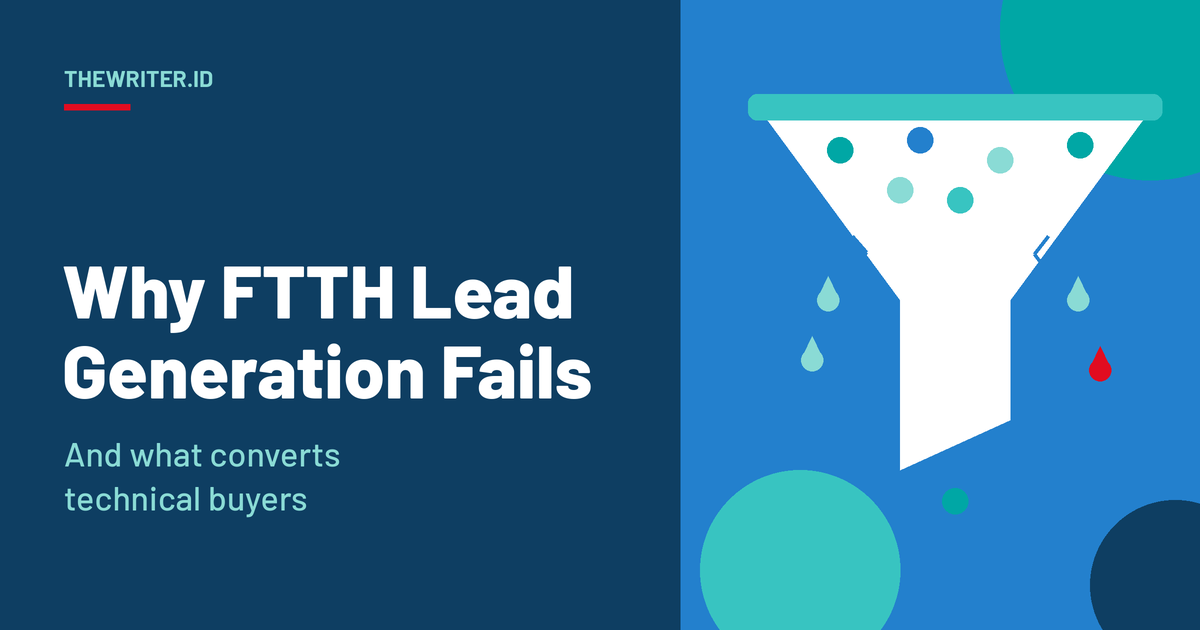
Three leaks sit between a lead and a conversation, and most programs fix none of them: the message answers the wrong question, the claims cannot be checked, and nothing connects one touch to the next. The animation follows ten leads through two campaigns. The dot counts are illustrative and are not measured data.
| Leak | What it sounds like | The test you can run today |
|---|---|---|
| Misaligned messaging | “Industry-leading end-to-end FTTH solutions for every network.” | Delete your company name. Does the headline still say which question it answers? |
| Low trust | “Trusted by leading operators,” with no author, figure or source. | For each claim, can the reader see who said it, what the figure is and where it came from? |
| Fragmented campaigns | A trade-show scan, a webinar and a LinkedIn post, each with a different offer. | Can you say which message a lead receives next, and when? |
Leak one: why does misaligned messaging lose technical buyers?
Because the message is written for the seller’s goal, while the buyer arrives with a question about cost, risk or schedule. In the GlobalSpec research, pricing and inventory questions were the most common trigger for a first contact with sales, at 26%. The procurement department was the trigger for 2% (p. 9). Buyers also exchange their email address for substance: ebooks and guides (47%) and white papers (37%) were the content most likely to prompt a form fill (p. 34).
A typical FTTH program offers a “consultation” or a “demo” to people who have not yet decided there is a problem. It helps to write down who is reading and what each reader is asking.
| Reader | What they are really asking | A seller-focused line | A buyer-focused line |
|---|---|---|---|
| Network planner or CTO | Will this fit the design I already have? | “Industry-leading end-to-end FTTH solutions.” | “Eight questions to ask before you choose an OLT design.” |
| Construction or operations manager | What will stop my crew on day one? | “Reliable deployment partners you can trust.” | “A pre-construction checklist your splice crew can tick off.” |
| Owner or finance lead | What will it cost, and what could make it cost more? | “Cost-effective fiber, delivered.” | “Where fiber build budgets slip, and what to ask a vendor to rule out.” |
| Municipal or grant manager | Can we show we are ready for funding? | “Your partner for broadband success.” | “A readiness roadmap for a funding application.” |
The buyer-focused lines are not cleverer. They name a reader and a question, and they promise a piece of work the reader can use. That is why the test in the earlier table works: strip out your name, and a seller-focused line could belong to any company, while a buyer-focused line still describes a specific piece of help.
Leak two: why does low trust stop FTTH leads converting?
Because technical buyers check claims, and most FTTH marketing offers claims with no author, no figure and no source. The GlobalSpec research found that engineering experts at vendor companies were the most trusted content authors, at 66%, ahead of technical editors (45%) and industry analysts (41%) (p. 33). So your most credible voice is already on your payroll, and most campaigns leave their name off the page.
Three more signals point the same way. 42% of engineers actively avoid sponsored search links (p. 29), so paid visibility earns less trust than it costs. Trust in generative AI averaged 4.7 out of 10 (p. 21), so generic AI-written content is a poor bet for this audience. And 70% would choose the better-known brand when two solutions look technically similar (p. 11), which means trust is built by showing up credibly many times, not once. A single campaign cannot do that.
| Without proof | With proof a buyer can check |
|---|---|
| “We deliver fast, reliable fiber builds.” | An article by your construction lead that walks through the checklist their crews use before a 300-home zone starts, line by line, with their name on it. |
| “Trusted by leading operators.” | One customer project described in full, with scope, constraints and result, shared with the customer’s permission. |
| “Cutting-edge network design.” | A design guide that quotes the standard or white paper it relies on, with the section and page. |
The same research on buyers in general points the same way. In the Edelman and LinkedIn report, 79% of surveyed buyers said consistently published quality thought leadership makes them more likely to champion a vendor during an RFP. The qualifier that matters is “quality”. A named engineer, a checkable figure and a source are what quality means to this audience. Never invent proof: no unnamed customer counts, no awards you cannot document.
Leak three: why do fragmented campaigns go cold?
Because each touch is planned as a separate event with its own offer, owner and goal, so the buyer never receives a clear next step. The 6sense data shows what is at stake. Buyers chose from their day-one shortlist 95% of the time, and they started 79% of the first engagements themselves. So the work that counts happens before the buyer calls, and most of it happens in the weeks when nobody is talking to them.
Timing makes it worse in FTTH. Light Reading reported on 9 October 2026 that BEAD construction is only now beginning, with the Louisiana target set for the end of the first quarter of 2027. In January, Dell’Oro expected BEAD’s flow-through to equipment vendors to shift to 2027, after a year mostly spent on design. A lead you meet at a trade show this autumn may not buy for many months, and a campaign with a 30-day horizon forfeits that lead.
| Week | What happens | What the buyer experiences |
|---|---|---|
| 1 | Badge scan at a trade show | A friendly chat, then silence |
| 2 | The company’s monthly newsletter, sent to everyone | A message with no link to the chat |
| 3 | A cold email from sales offering a demo | A request to commit before they have decided there is a problem |
| 4 to 9 | Nothing | Six weeks of silence while the shortlist forms |
| 10 | A webinar invitation on an unrelated topic | A reminder that the company does not know what they asked |
Each touch is reasonable alone. Together they leave the buyer to connect the dots. A useful habit is to map a lead’s first ten weeks the way you would map a customer’s installation. The FTTH Installation Journey Mapper draws an installation as a color-coded timeline that shows where communication is strong, weak or missing. It was built for installation customers, and we are borrowing the method: the weeks that come out weak or missing in your buyer’s timeline are your third leak.
What actually converts technical buyers?
Five things, in order: the buyer’s own question, proof a named engineer stands behind, substance in exchange for an email address, a short sequence of education, and a sales step the buyer chooses. Each one closes a leak, and each has support in the research.
| Principle | What it looks like in FTTH | Evidence |
|---|---|---|
| 1. Start with the buyer’s question | Headlines that name a reader and a cost, risk or schedule question | Pricing and inventory questions are the top trigger for first sales contact (26%) |
| 2. Put a named engineer behind it | A byline from the person who knows the work, with figures and sources | Vendor engineering experts are the most trusted authors (66%) |
| 3. Trade substance for the email address | A checklist, guide or white paper, not “contact us” | Ebooks and guides (47%) and white papers (37%) prompt form fills; technical articles and white papers were the most valued newsletter content (43%) |
| 4. Sequence the education | A short course where each message answers the next question | Buyers start most first contacts (79%) and make them late in the journey (about 61%), so the sequence must already be there |
| 5. Let the buyer choose the sales step | A visible price range and a call with the engineer, offered after the reading | About 62% of the process is done before sales is engaged, and 10% prefer not to talk to salespeople at all |
Notice what is missing: more volume. None of the five asks you to send more messages. They ask you to send fewer, in an order that makes sense. The tactic that best combines all five is a short educational email course, so that is the one we outline next.
What does a five-day email course for technical buyers look like?
Five short emails, one a day, each answering the next question a buyer’s committee would ask, ending with an invitation to talk. Telecom email marketing usually fails by being a newsletter blast. A course fixes that, because every email has one job and the order is the point.
Our services page describes an educational email course as a five-day automated email sequence that walks decision-makers through budget and consensus frameworks before a sales conversation. The deliverables it lists are the five-day sequence, an executive-level curriculum design, a lead capture and nurture strategy, a call-to-action framework for each email, and performance metrics with open-rate benchmarks. As reported there, a BEAD Funding Readiness Roadmap course converted 38% of subscribers into qualified sales calls within 14 days. That is one engagement, not a benchmark, and the page does not give the audience size.
The outline below is our example of the structure for a vendor that sells to operators. It is not the content of any client course, and the topics change with the buyer.
| Day | The email’s job | Leak it closes | The one action it asks for |
|---|---|---|---|
| 1 | Name the cost of the problem in the buyer’s terms | Misaligned messaging | Reply with the project you are planning |
| 2 | Give one figure, its source and a named engineer | Low trust | Check the source yourself |
| 3 | Walk through a real project the buyer can compare with their own | Low trust | Compare it with your scope |
| 4 | Give the buyer a one-page summary to forward to their committee | Fragmented campaigns | Forward the summary |
| 5 | Invite a call with the engineer, with the price range stated | Fragmented campaigns | Book 20 minutes |
Five habits keep a course honest:
- One idea and one action per email. A second action splits attention and weakens the first.
- Sign it with the engineer or executive. The trust data says that name matters more than the logo.
- Show the source. Every figure carries its origin, so the reader can check it.
- Let people leave in one click. Follow the email laws that apply to you, such as CAN-SPAM in the United States and GDPR in Europe. This is general information, not legal advice.
- Measure conversations, not opens. The number to watch is the share of subscribers who book a qualified call within about two weeks, which is the measure the case study above reports.
How does an email course compare with other FTTH lead generation tactics?
An email course is best for long, committee-based decisions; the other tactics work better as the start of a course than as a replacement for one. The table compares the usual options for fiber provider lead generation aimed at technical buyers.
| Tactic | What the buyer gets | Where it leaks | Best use |
|---|---|---|---|
| Trade-show badge scan | A conversation and a follow-up | The follow-up rarely says what was discussed | The first name on a course list |
| Cold outreach from sales | A pitch | Most first contacts are started by the buyer (79%), so cold outreach arrives uninvited | A warm follow-up after the buyer has engaged |
| Gated white paper alone | Substance, once | One touch, then silence | The first email of a course |
| Sponsored search and ads | Visibility | 42% of engineers avoid sponsored links | Support for a piece of real content |
| Educational email course | A sequence of answers | It needs engineer time and upkeep | Long decisions made by a committee |
How do you fix your own lead generation program in a week?
Audit five assets against the three tests, map one lead’s first ten weeks, and rebuild your best asset as the first email of a sequence. You can do the audit with no new tools or budget.
- Monday: collect. Pull your last five assets: a landing page, an email, a LinkedIn post, a brochure and a webinar invitation.
- Tuesday: test. Run the three tests from the earlier table on each one. Mark every failure.
- Wednesday: map. Draw a lead’s first ten weeks and mark the weeks with no contact. The Customer Waiting Time Anxiety Calculator scores how much frustration builds when customers wait without updates. It was built for installation waits, but a buyer waiting between your emails is the same shape, and it will suggest the kind of message that fills a silence.
- Thursday: choose. Pick one buyer question your best asset answers, and rewrite that asset as Day 1 of a five-day sequence.
- Friday: attach an engineer. Ask one engineer to read, correct and sign the first two emails. Then plan the other three.
Why this stalls, and where a specialist writer helps
The structure is not the hard part. It stalls because it needs two scarce things at once: a writer who understands how a fiber build runs, and an engineer with an hour to check the result. In an engagement, we would organize the work this way:
- We map the buyer’s questions. You see the readers, their questions and the five emails we would write, before anything is drafted.
- We write the sequence with your engineer. Each email has one job, one figure with its source and one action, which matches the call-to-action framework on our services page.
- You send it under your names. The engineer’s sign-off is recorded, and we agree which numbers to track, such as the share of subscribers who book a qualified call.
Our services page lists the educational email course alongside industry blog posts, executive ghostwriting, technical whitepapers and case studies. A course often draws on those: a white paper becomes the proof in Day 2, and a case study becomes the project in Day 3.
Three honest warnings. We cannot promise a conversion rate, and the 38% result is one engagement, not a benchmark. Lead generation is not a separate service of ours: the course is the vehicle for the approach on this page. And we write about fiber but we are not your engineers, so every figure still needs your own expert’s sign-off before it goes out.
Frequently asked questions
Why does FTTH lead generation fail?
It usually fails at three points between a lead and a conversation. The message answers the seller’s question instead of the buyer’s, the claims have no named author, figure or source so technical buyers do not trust them, and separate one-off campaigns leave the buyer with no clear next step. In our view, fixing those three leaks matters more than adding more leads.
What converts technical buyers in telecom?
A message built on the buyer’s own question, proof from a named engineer with a figure and a source, substance in exchange for an email address, and a short sequence of education that ends in an invitation to talk. In the 2026 GlobalSpec research, vendor engineering experts were the most trusted authors, at 66%, and about 62% of the buying process happened online before buyers engaged sales.
Is email marketing still worth it for telecom and fiber companies?
Yes, when it teaches instead of broadcasting. Technical articles and white papers were the most valued newsletter content in the GlobalSpec research (43%), and ebooks and guides (47%) were the content most likely to prompt a form fill. A short sequence in which each email answers the next question suits long, committee-based sales better than a blast. We do not quote open-rate benchmarks here, because we could not verify a current telecom-specific figure.
Should I gate my content to generate FTTH leads?
Gate the long guides and white papers, since ebooks and guides (47%) and white papers (37%) are what buyers say will prompt a form fill. Keep the short answers on your own site ungated, so search engines and AI tools can read and quote them, and use the gated piece as the first email of a course.
How do I know whether engineers will trust my content?
Check each piece for three things: a named author who works on the subject, a figure, and a source the reader can open. If any is missing, the claim is a slogan. Engineers rated vendor engineering experts as the most trusted authors (66%), so put their names on the work.
What is in TheWriter.id’s educational email course?
Our services page describes a five-day automated email sequence that walks decision-makers through budget and consensus frameworks before a sales conversation. It lists executive-level curriculum design, a lead capture and nurture strategy, a call-to-action framework for each email, and performance metrics with open-rate benchmarks. As reported there, one course converted 38% of subscribers into qualified sales calls within 14 days.
Sources and how we checked
We read each source on October 12 and 13, 2026. Dates are shown so you can judge how current each one is. Page numbers refer to the GlobalSpec report as paginated in its PDF.
- GlobalSpec, TREW Marketing and Elektor, 2026 State of Marketing to Engineers (PDF, March 2026), and Lobna Belarbi, eeNews Europe, 31 March 2026. We checked each figure we used against the PDF in two separate passes.
- 6sense, 2025 B2B Buyer Experience Report, and a secondary summary at CustomerThink. Field dates are not stated on the report page.
- Edelman and LinkedIn, 2025 B2B Thought Leadership Impact Report.
- Nicole Ferraro, “The Buildout: REV Fiber begins Louisiana BEAD build,” Light Reading, 9 October 2026.
- Masha Abarinova, “Will access vendors see fiber profit soar in 2026?”, Fierce Network, 5 January 2026.
- Light Reading, “PON spending jumped as overall broadband access infrastructure spending dipped in Q2: Dell’Oro,” 8 September 2026.
- Doug Mohney, Fiber Broadband Association, “U.S. Fiber Broadband Total Passings Reach 100M Mark,” 15 April 2026 (RVA research).
- TheWriter.id services page and tools page, for the description of our services and tools, as reported there.
The figures are survey results from the sources above and describe technical and B2B buyers in general, not FTTH buyers specifically. The example lines, the week table, the five-day outline, the dot counts in Figure 1 and the confidence meter in Figure 2 are our illustrations. The 38% result and the services listed are as reported on our services page. Figures are as of October 13, 2026.