FTTH lead generation • Email courses
Why Educational Email Courses Outperform Single Lead Magnets in Telecom B2B
A white paper download feels like a win. Someone gave you their email address, so the lead is yours. Then the PDF sits in an inbox, the buyer gets on with their week, and your sales team calls a person who never opened it. The white paper was not the problem. Handing it over once, with nothing after it, was.
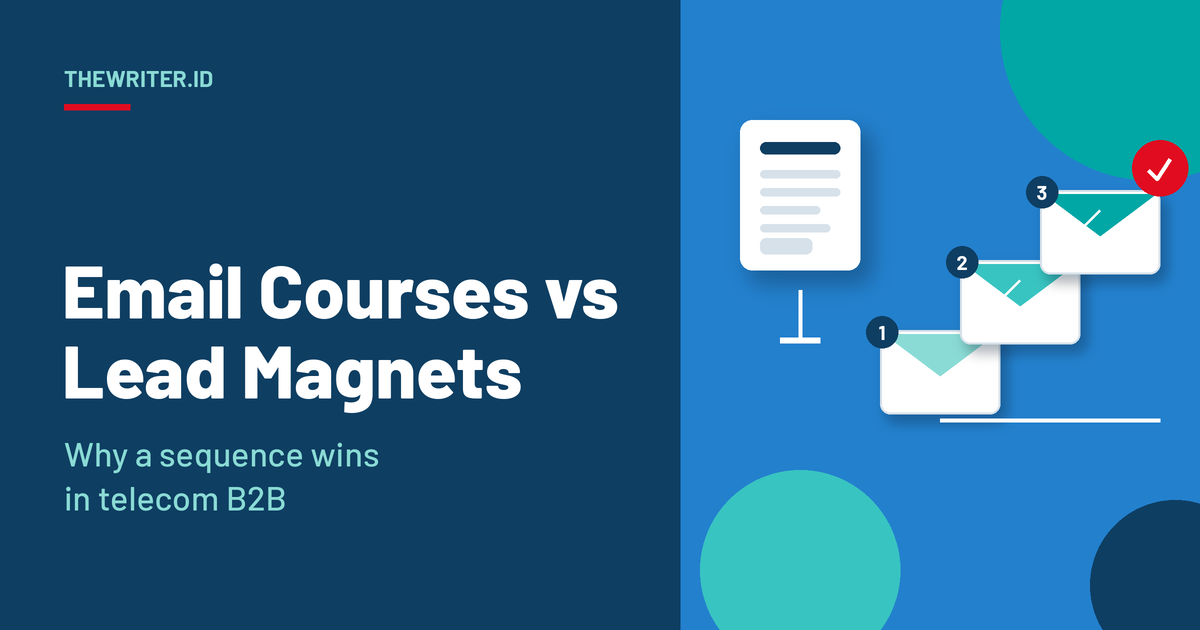
Quick answer: Educational email courses outperform single lead magnets in telecom B2B at one job: turning a request into a conversation. A PDF is read late and ends in a dead end. In 2024 data from NetLine, a requested piece of content waited about 39 hours, on average, before it was opened. A course arrives in short pieces over days, so each piece gets read, each one answers the next question a buyer’s committee has, and the last one invites a call. Keep the white paper. Use it as the raw material for the course, not as the whole strategy.
In this page, a single lead magnet is one gated asset, such as a white paper, ebook or checklist, delivered once. An educational email course is a short automated sequence of emails, five days in our version, in which each email answers the next question and the last one invites a conversation. We use “outperform” to mean more qualified conversations, not more downloads. One caution up front: we found no published head-to-head study of the two formats in FTTH. The case below rests on three strands of evidence, and the page says which is which.
What does the evidence say about lead magnets and email sequences?
It says requested content is opened late, that sequences get more action than one-off sends, and that technical buyers still want white papers. It does not contain an FTTH head-to-head test. So the argument here is built from two strands: how PDFs are consumed, and how sequences behave compared with one-off sends. The table shows each source and how far it stretches.
| Source | What it says | Read this carefully |
|---|---|---|
| NetLine, 2025 State of B2B Content Consumption & Demand Report (2024 data, 7.9 million registrations), as reported by Informa TechTarget (16 July 2025) and CustomerThink (31 May 2025) | The “consumption gap”, the time between a content request and the content being opened, averaged 39 hours in 2024, a widening of 7.3 hours on the year before. eBooks were more than half of the formats requested. Formats more often linked to a purchase decision within 12 months were playbooks, infographics, case studies, trend reports and buyer’s guides, while eBooks, the most requested, were not strongly associated with near-term intent. | Broad B2B content syndication, not telecom. A registration is a request, not proof of reading. NetLine’s page confirms the registration count and the widening gap. The 39-hour average and the format findings come from the two summaries, because the report itself needs registration. |
| GlobalSpec and TREW Marketing, 2026 State of Marketing to Engineers | Over 1,000 engineers and technical professionals. Ebooks and guides (47%) and white papers (37%) were among the content most likely to prompt a form fill (p. 34). Technical articles and white papers were the most valued newsletter content (43%) (p. 36). About 62% of the buying process happens online before sales is engaged (pp. 6–7). | Engineers across many industries; communications and networking appears to be about 7% of respondents. It shows that white papers are wanted, which is why this page keeps them. |
| Klaviyo, 2026 email marketing benchmarks (23 January 2026; over 183,000 customers) | Automated flows, which are sequences triggered by what a person does, averaged a 5.58% click rate against 1.69% for one-off campaigns. Open rates were close, at 32.2% against 31%. | Ecommerce and retail, not telecom. It shows how sequences behave, not how fiber buyers respond. Opens were similar; the difference was in action. |
| 6sense, 2025 B2B Buyer Experience Report | Just under 4,000 buyers. They chose from their day-one shortlist 95% of the time, started 79% of first engagements, and made first contact about 61% of the way through the journey. | Global B2B, mostly technology and services; telecom is about 2% of the sample. |
| Fiber Broadband Association, Chapter 3 page (cover dated September 2026; page published 30 September 2026), and the association’s 11 March 2026 release on Chapter 1 | A white paper of about 25 numbered pages on low-level design. It is Chapter 3 of a planned five-chapter series, with the first chapter released in March 2026 and the fourth, on permitting, still to come as of 9 October. | Not performance data. It shows how the industry’s own association publishes a technical paper: in installments, not in one drop. |
| Light Reading, “The Buildout,” 9 October 2026 | REV Fiber broke ground on 2,840 locations in Central, Louisiana, counted toward the state’s target of 15,000 BEAD locations by the end of the first quarter of 2027. | One builder in one state. It shows how long the sector’s decisions take to turn into construction. |
Our reading: a white paper is a good piece of content and a weak delivery system. Buyers want technical papers, but the data shows them arriving late, without a next step, in a market where decisions take many months.
Why do single lead magnets get ignored?
Because a PDF asks the buyer to do all the work at once, at a time the buyer chooses, and then leaves them with nowhere to go. Three habits of a one-off lead magnet explain most of the drift, and the animation below shows them as a shape over two weeks. The curves are illustrative and are not measured data. The 39-hour marker is the one real figure in the picture.
- It arrives on the reader’s schedule, not yours. The NetLine average of 39 hours is two days of cooling. Spear Marketing Group, which summarized the data, notes that most prospects do not read content immediately, especially on mobile.
- It asks for everything at once. The FBA’s Chapter 3 is about 25 pages for a reader who may want one section. A committee of several people, each with a different question, rarely reads a long PDF together.
- It ends in a dead end. A download usually triggers one fulfillment email. After that, the first thing the buyer often receives is a sales call, which Spear advises against making before the content has been read, because it lowers the chance of a positive response.
None of this means the white paper is poor. The GlobalSpec research shows engineers valuing technical articles and white papers, and the FBA’s own series shows that the industry still publishes them. The failure is what happens after the request. It is a delivery problem, and a delivery problem can be fixed without throwing away the paper.
How does a single lead magnet compare with an educational email course?
The lead magnet is cheaper to start and easier to find; the course is better at getting read, reaching a committee and earning a conversation. This is a comparison of how the two formats work, not a measured result.
| Dimension | Single lead magnet | Educational email course |
|---|---|---|
| What the buyer does | Requests once, reads later or never | Subscribes once, then reads a piece a day |
| When it is read | Whenever the reader gets to it, about 39 hours later on average | On arrival, in short pieces, so a late opener loses only one email |
| What it asks of the reader | A long read in one sitting | A few minutes a day |
| Fit for a committee | Poor: one person holds the file | Better: Day 4 is built to be forwarded |
| Next step | Usually none, then a cold call | One action per email, ending in an invitation |
| What you learn about the buyer | One event: a download | A trail: which emails were clicked, and which question mattered |
| Cost to produce | One asset | An asset plus five emails and the sequence design |
| Best for | A buyer who needs one answer now, and search traffic | Long decisions made by several people |
The reason sequences help is not mysterious. In Klaviyo’s 2026 data, automated flows and one-off campaigns were opened at about the same rate, and flows were clicked more than three times as often. People opened both. They acted on the one that arrived because of something they had done. That is ecommerce data, so we take the direction and not the numbers.
When does a single lead magnet still win?
When the buyer needs one answer fast, when you want to be found in search, and when you have no engineer time to maintain a sequence. A course is more work, and it is not always the right tool.
- The question is small. A buyer who needs one checklist before a site visit does not want five emails. Our own Technician Checklist Generator is a single-use magnet: it builds a pre-installation checklist in one sitting, covering equipment, access, signal and customer readiness. It works because it is usable at once. In our view, a 25-page PDF rarely is.
- You need search visibility. Open pages that answer one question each are what search engines and AI tools can read. Gate the long asset, keep the short answers public.
- You cannot yet staff the review. A course makes five claims where a post makes one, and every figure needs an engineer’s check. If that time does not exist, ship the PDF and add the sequence later.
- The paper itself is the proof. A well-cited white paper can win an evaluation on its own. The sequence is how the people who download it get a conversation.
How does an email course build momentum?
By giving each email one job, spacing the emails so each is read, and timing the sales conversation to what the reader does. Momentum is the sense that each step makes the next one easier. A PDF cannot create it, because there is no next step.
- One job per email. Day 1 names the cost, Day 2 shows the proof, Day 3 walks a project, Day 4 equips the committee and Day 5 invites the call. A reader who stops at any point still got something complete.
- One action per email. A single click, reply or forward is a signal. A second action splits attention and blurs the signal.
- Sales follows behavior. Spear advises tracking link clicks and triggering a sales follow-up only after content has been opened, with a reminder if nothing is clicked in about two days. That fits a course: the click on Day 5, not the sign-up on Day 0, is the moment to call.
Timing also fits the sector. Light Reading reported on 9 October 2026 that BEAD construction in Louisiana is only now starting, with the state’s target set for the end of the first quarter of 2027. In a market where money takes months to turn into construction, a lead that downloads a paper in October may not decide until well into next year. A sequence keeps you in the conversation across the gap, and a PDF does not.
| What the subscriber does | What it suggests | What to do |
|---|---|---|
| Opens Day 1, then goes quiet for two days | Busy, or the first question was not theirs | Send a short reminder with a different entry point, and let the course continue |
| Clicks the source in Day 2 | Checking the evidence, which is what an engineer does | No sales contact yet; the next email handles it |
| Replies to any email | A real question | Let the engineer or executive named on the email answer personally |
| Clicks the Day 4 summary or forwards it | A champion is building the case inside the company | Offer a call to the whole committee on Day 5 |
| Clicks the Day 5 invitation | Ready to talk | Contact them the same day, with the context of what they read |
How do you turn a white paper into a five-email course?
Keep the paper whole, choose five sections that answer five buyer questions, and send one a day, each linking back to the full paper. The animation uses the FBA’s Chapter 3 as an example of the mapping. The association has not published an email course from it. The email subjects and the order are our illustration, and the section names and pages come from the paper.
- Pick five questions, not five chapters. Chapters follow the author’s structure. Questions follow the buyer’s. Choose the five your buyer would ask before agreeing to a call.
- Order them along the decision. A useful order runs from the cost of the problem, to proof, to a worked example, to a summary the committee can read, to the invitation.
- Write each email answer-first. The first sentence is the answer. Then one figure with its source and page, then one line on what it means for the reader.
- End each email with one action. Reply, check the source, compare, forward, or book a call.
- Send the PDF with Email 1. The buyer asked for the paper, so give it to them. The course then reads the paper for them, in pieces, and links back to it every time.
| Day | Email subject | Section of the paper | The one action |
|---|---|---|---|
| 1 | What sets your build schedule | Introduction, p. 3 | Reply with the project you are planning |
| 2 | How many conduits should you install? | Section 3.1, p. 9 | Check the page yourself |
| 3 | When make-ready tips it underground | Section 4.1, p. 11 | Compare it with your own route |
| 4 | Catch errors before the permit office | Sections 7.2 to 7.4, pp. 23–24 | Forward the one-page summary |
| 5 | One page to forward, and a call | Conclusion, p. 25 | Book 20 minutes |
Each email carries one figure that an engineer has matched to the paper’s own wording, because a course makes five claims where a post makes one. That review step is the one that most often gets skipped, and it is the one that keeps an email course credible with engineers.
What should you measure instead of downloads?
Measure conversations: the share of subscribers who click through and book a qualified call within about two weeks. Downloads and sign-ups show interest. Calls show intent, and that is the number a sales team can act on.
| Measure | Single lead magnet | Email course |
|---|---|---|
| Requests | Yes, one number | Yes, as sign-ups |
| Engagement | Whether the fulfillment email was opened | Clicks on each of five emails |
| Which question matters | Not visible | The email clicked most |
| Sales readiness | Guessed from the download | A click on the Day 5 invitation |
| The number to report | Leads | Qualified calls within about 14 days |
Leads and calls are different numbers, so do not read one as larger than the other. A lead is a request. A call is a conversation.
One practical fix costs nothing. Treat the hours between a request and the first open as a wait, because that is how it feels from the buyer’s side. The Customer Waiting Time Anxiety Calculator scores how much frustration builds when customers wait without updates during an installation delay. It was built for installation customers, and a buyer waiting after a download has the same shape: a silence with nothing in it. Fill it with the fulfillment email, a reminder after about two days, and the next question.
Why this stalls, and where a specialist writer helps
Most FTTH companies already have the white paper. The sequence stalls because it needs a writer who can read a technical paper and an engineer who has an hour to check five emails. In an engagement, we would organize it this way:
- We read the paper and propose the five questions. You see the questions, the sections behind each one and the action each email asks for, before anything is drafted.
- We write the sequence and the claim check. Each email gets one figure with its source, and your engineer reviews rows of source wording, not whole drafts.
- You send it under your names. We agree which numbers to track, with qualified calls within about two weeks first.
Our services page lists the educational email course next to technical whitepapers, industry blog posts, executive ghostwriting and case studies. In practice they feed each other: the white paper is the course’s proof, and a case study becomes its Day 3.
Three honest warnings. We found no published head-to-head test of courses against lead magnets in FTTH, so this page argues from indirect evidence. We cannot promise a conversion rate for your course. And we write about fiber but we are not your engineers, so every figure needs your own expert’s sign-off. Follow the email laws that apply to you, such as CAN-SPAM in the United States and GDPR in Europe. This is general information, not legal advice.
Frequently asked questions
Are educational email courses better than lead magnets for telecom B2B?
For starting conversations, usually yes in our view, but we found no published study that compares them in FTTH. A single lead magnet gets requested. A course gets read in pieces and ends with a clear next step. The evidence is indirect: requested content waited about 39 hours on average before it was opened in NetLine’s 2024 data, and automated email sequences earned higher click rates than one-off campaigns in Klaviyo’s 2026 ecommerce benchmarks. Use the white paper as the source of the course, not instead of it.
Do white papers still work in telecom B2B?
Yes, as content. In the 2026 GlobalSpec research, white papers (37%) were among the content most likely to prompt an engineer to fill in a form, and technical articles and white papers were the most valued newsletter content (43%). They work less well as the only step, because the reader opens them late and nothing follows.
How long should an educational email course be?
Our services page describes a five-day sequence, and that is the length used in the example on this page. We have no study showing that five emails beat three or seven. A good length is the smallest number of emails that answers the questions a buyer’s committee needs settled before it will take a call.
How soon should you follow up after a white paper download?
Advice varies. Spear Marketing Group suggests waiting until the reader has clicked, with a reminder after about two days. Informa TechTarget’s blog suggests following up within 24 to 48 hours. Because requested content was opened about 39 hours later on average in NetLine’s 2024 data, we send the fulfillment email at once and let a click, or two days of silence, trigger the next message.
Which metric shows whether an email course works?
Qualified conversations: the share of subscribers who click through and book a call within about two weeks. That is the measure we would agree with you before the first send. Downloads, sign-ups and open rates show interest, not intent.
What is in TheWriter.id’s educational email course?
Our services page describes a five-day automated email sequence that walks decision-makers through budget and consensus frameworks before a sales conversation. It lists executive-level curriculum design, a lead capture and nurture strategy, a call-to-action framework for each email, and performance metrics with open-rate benchmarks.
Sources and how we checked
We read each source between October 12 and 13, 2026. Dates are shown so you can judge how current each one is. Page numbers refer to the GlobalSpec report as paginated in its PDF.
- NetLine, 2025 State of B2B Content Consumption & Demand Report (download page; registration required), through two summaries: Anastasia Dyakovskaya, “Closing the consumption gap,” Informa TechTarget blog, 16 July 2025; and David Dodd, “Research Round-Up: NetLine’s Latest Data on B2B Content Consumption,” CustomerThink, 31 May 2025.
- Howard Sewell, “The Consumption Gap,” Spear Marketing Group, 21 April 2025 (follow-up advice).
- GlobalSpec, TREW Marketing and Elektor, 2026 State of Marketing to Engineers (PDF, March 2026). We checked each figure we used against the PDF in two separate passes.
- Klaviyo, 2026 email marketing benchmarks, published 23 January 2026.
- 6sense, 2025 B2B Buyer Experience Report. Field dates are not stated on the report page.
- Fiber Broadband Association, “Building Better Broadband: Accelerating Designs & Securing Permit Approvals, Chapter Three: Low-Level Design (LLD) – From Intent to Execution,” cover dated September 2026 (read in full as a PDF), and “Fiber Broadband Association Releases First Chapter of Fiber Network Engineering Best Practices,” 11 March 2026.
- Nicole Ferraro, “The Buildout: REV Fiber begins Louisiana BEAD build,” Light Reading, 9 October 2026.
- TheWriter.id services page, for the description of our services, and the two tool pages linked in the article.
The curves in Figure 1, the email subjects and order in Figure 2 and the mapping table, the signals table and the comparison tables are our illustrations or recommendations. The only data points in Figure 1 are the 39-hour average and the day count. The Klaviyo figures are ecommerce benchmarks. Figures are as of October 13, 2026.