
Enterprise and wholesale fiber • Educational email courses
Enterprise Fiber and Dark Fiber: Educating Buyers Who Care About Route Diversity, Latency, and Control
Enterprise fiber buyers tend to ask three things before they ask “how fast is it?” Can two circuits fail together? How many milliseconds does the longer route add? Who will run the fiber for the next twenty years? A provider that answers those questions in writing, before the first call, is better placed to reach the shortlist, since buyers in the 6sense study picked from their day-one shortlist 95% of the time. This page shows how to turn them into a five-day email course.
Quick answer: To educate buyers who care about route diversity, latency and control, teach the three in that order, one email a day for five days. Route diversity comes first, because “two bills do not imply two paths” (VAST Networks). Latency comes second: light covers about 5 microseconds per kilometer of fiber (CommScope), so a diverse route that is 30 km longer adds about 0.15 ms one way. Control comes third: who lights, monitors and upgrades the fiber over a term that dark fiber deals often set at 20 to 30 years (Lightwave Online). Give each email one sourced figure and one task the buyer can do the same day.
The page is for wholesale carriers, enterprise-focused network operators, dark fiber providers and the vendors and consultants around them. It differs from our pages on consumer FTTH: the readers are engineers, procurement officers and finance leads who compare you in writing, and a vague claim loses them. We say where a source is a seller or a trade newsletter, and where the research describes buyers in general rather than fiber buyers.
How do enterprise and wholesale buyers research a fiber purchase?
They read before they call, they ask about price first, and they trust engineers over brands. None of the sources below tests an email course for dark fiber buyers, so the table also shows how far each one stretches.
| Source | What it says | Read this carefully |
|---|---|---|
| GlobalSpec, TREW Marketing and Elektor, 2026 State of Marketing to Engineers (PDF, March 2026) | About 62% of the buying process is done online before buyers engage sales (pp. 6–7). Pricing and inventory questions were the most common reason for first contact with a vendor, at 26% (p. 9). Vendor engineering experts are the most trusted content authors, at 66% (p. 33). | Over 1,000 engineers. Telecom is about 7% of the sample. It describes engineers in general, not fiber buyers. |
| 6sense, 2025 B2B Buyer Experience Report | Just under 4,000 buyers. They chose from their day-one shortlist 95% of the time, started 79% of first engagements and made first contact about 61% of the way through the journey. | Global B2B, mostly technology and services. Telecom is about 2% of the sample. |
| Edelman and LinkedIn, 2025 B2B Thought Leadership Impact Report (PDF) | 79% of the U.S. “hidden” decision-makers surveyed, who work in roles such as finance, operations and procurement, said they are more likely to champion RFP proposals from companies that consistently produce high-quality thought leadership (p. 25). | 1,934 executives, fielded 17 March to 3 April 2025. It measures stated intent, not behavior. |
| TeleGeography, “WAN Trends, Explained” (8 September 2026), from its seventh WAN Manager Survey | Dedicated internet access (DIA) rose from 27% of respondent sites to 54%, while MPLS fell from 82% to 22%. Managed SD-WAN accounts for 56% of deployments. | Only 52 survey responses and 13 interviews, from enterprise WAN managers. It is a podcast page, not the full report, and it does not mention dark fiber. |
Our reading: an enterprise fiber decision is made by a group, and most of that group never speaks to your sales team. The finance lead and the procurement officer form a view from what they can read. A course aimed at their questions, and signed by an engineer, is how you get into that reading before the shortlist closes.
Who are the buyers, and what does each one ask?
Five roles, each with one question that a course email can settle. This table is our reading of how an enterprise purchase divides up, not a survey result. Check it against your own sales calls.
| Role | The question they ask | Where the course answers it |
|---|---|---|
| Network or infrastructure architect | Do these two circuits share a duct, an entrance or a crossing? | Days 1 and 2 |
| Latency-sensitive application owner | How many milliseconds does the diverse route add, and is that number measured? | Day 3 |
| Procurement or sourcing lead | What will the provider put in the contract about routes, audits and exit? | Days 2 and 4 |
| Finance lead | What does each option cost over the term, and when does dark fiber pay? | Day 5 |
| Wholesale or ISP planner | Can we buy fiber and run it ourselves, or must we buy a service? | Day 4 |
How is an enterprise or wholesale course different from a consumer FTTH course?
The reader compares you in writing, the decision lasts for years, and the proof must stand up to an engineer. A consumer course can lean on speed, price and install day. An enterprise course cannot, because those are the points every provider already claims.
| Consumer FTTH course | Enterprise or wholesale course | |
|---|---|---|
| The reader | An operator executive or a municipal leader | An architect, a procurement officer and a finance lead, often in one buying group |
| The decision | Build, fund or partner | Which route, which contract and who operates it |
| The proof | Cost per foot, take-up, permit times | Route files, kilometers, audit rights, term and unit cost |
| What the reader does | Fills in a payback worksheet | Lists their circuits and checks each for shared segments |
| The invitation | A planning call | A route review with one of your engineers |
This is our judgment from the structure of the purchase, and your sales team will know it better than we do. It leads to one rule for the page copy and the course: lead with the buyer’s test, not your capacity. The rest of the article builds the test for three concerns.
How do you teach route diversity?
Define it as a second path that shares nothing with the first, then show the four places where two routes quietly meet. VAST Networks, a provider, defines a diverse route as “a second path sharing no conduit, entrance, crossing, or right of way with the first.” Its guide adds: “Two bills do not imply two paths.” The Global Data Center Hub newsletter puts the same point as “Carrier diversity and physical route diversity are different assets, and only one of them survives a backhoe strike.”
| Where they meet | What the buyer asks | What the source says |
|---|---|---|
| A shared conduit or duct bank | Does any segment of the two routes run in the same conduit? | VAST lists conduit segments first among the shared risks. The Global Data Center Hub reports a colocation operator who found both circuits in one duct bank for the final 600 m. The operator is anonymous, so treat it as an anecdote. |
| The building entrance | Do the two circuits enter the building through separate entrances? | VAST names the building entrance. The Global Data Center Hub calls the final approach and the entrance common failure points. |
| A crossing | Do both routes cross the same river, railway or highway on one structure? | VAST lists crossings of rivers, railways and highways. |
| A carrier hotel or metro ring | Do both circuits pass the same aggregation point? | The Global Data Center Hub lists the carrier hotel aggregation point and collapsed metro rings. |
| The same underlying fiber | Does either carrier lease fiber from the other? | VAST says to ask providers whether they lease from each other; the answer is, in its words, “often yes and rarely volunteered.” |
The building entrance is the one item a buyer can check on site. If you sell to enterprise sites, our Technician Checklist Generator shows the pattern: it builds a customized pre-installation checklist covering equipment, site access, signal and customer readiness. A course email can give the buyer an entrance checklist in the same spirit, and your own engineers can complete it.
Why the risk is real
Two recent sources put numbers on dig-ins. They are the strongest reason the course should not treat diversity as a feature.
| Source | What it says | Read this carefully |
|---|---|---|
| Patrick McLaughlin, Cabling Installation & Maintenance (6 August 2026), on the Common Ground Alliance 2025 DIRT report | 221,717 unique damage reports in 2025. The CGA index stood at 102, up from 96.7 in 2024. Telecom, MSO and CATV utilities were 51% of damage incidents, and 30% of those were self-inflicted by telecom or CATV crews. The top root causes were no 811 notification (22.3%), an excavator failing to keep clearance after the marks were verified (14.8%) and a locator error that left a facility unmarked (14.2%). | U.S. data from a trade article on the report. We did not read the full DIRT report. Damage is not the same as an outage. |
| Fiber Broadband Association, “Securing the Investment” (15 April 2026), by Ariane Schaffer and Brendon O’Boyle | A Texas cooperative with about 79,000 members had fiber damage at “35-40 per week in 2021.” Larger fiber cable cuts “cost between $15,000 – $20,000 each,” and annual costs “could exceed $300,000.” The authors call telecom and fiber providers “among the most under-reported sectors in the DIRT database.” | One cooperative’s figures from 2021, not an average. It is about repair cost, not enterprise outages. |
Treat both as context for the Day 2 email, not as an outage rate. They show that digging near fiber is common and that damage is under-reported. They do not tell a buyer how often a given route fails.
What a verification pack contains
The Global Data Center Hub recommends a short list of things to obtain from a provider, which makes a good Day 2 task. We have restated them as a pack the buyer can request.
- Conduit-level route files for both circuits, not a network diagram.
- A contractual representation of zero shared segments, in writing.
- Audit rights, so the buyer can have the route checked.
- Periodic re-verification, because a route can change after the contract is signed.
VAST also suggests a route diversity audit. The same newsletter warns that real separation takes months, because it needs permits and easements, so a provider that promises it in a week deserves a question. A second route is also a construction project. At the 2025 median of $18 per foot for underground construction (Fiber Broadband Association and Cartesian), one mile is roughly $95,000 before any special crossing. That is our arithmetic on a U.S. median, not a quote for any route, but it explains why diversity is priced.
Demand is moving the same way. BIG Fiber, a metro dark fiber provider, secured $250 million in financing in May 2026, and its chief commercial officer said customers increasingly want “extreme route diversity, often moving toward triversity or quadversity networks” (IEEE ComSoc Technology Blog). That is a provider describing its own customers, and the blog gives no announcement date, so we use it for direction only.
How do you teach latency without overselling it?
Teach one number, 5 microseconds per kilometer, and let the buyer do the arithmetic. A CommScope white paper from February 2017 states that “the latency is 5 µsec per kilometer” in optical fiber, and gives a refractive index of about 1.5 as the reason. The physics has not changed since, but the paper is a vendor document and it is nearly ten years old, so we cite it for the principle only.
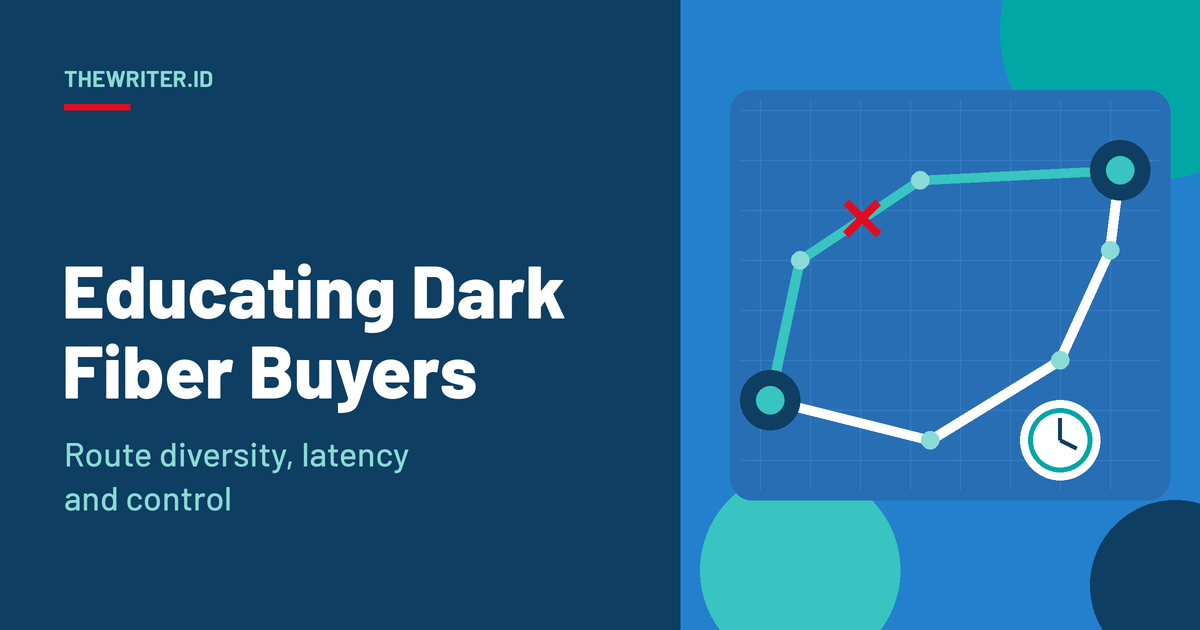
That makes route length the first lever. A diverse route is often longer, and the extra kilometers show up as time. The animation sends two pulses along an illustrative 100 km direct route and an illustrative 130 km diverse route.
| Route | Length (illustrative) | One way | Round trip |
|---|---|---|---|
| Direct | 100 km | 500 µs (0.50 ms) | 1.00 ms |
| Diverse | 130 km | 650 µs (0.65 ms) | 1.30 ms |
| Difference | 30 km | 150 µs (0.15 ms) | 0.30 ms |
Two points belong in the Day 3 email. First, equipment adds time. CommScope says the latency from signal conversion is “specific to the application, protocol, and active equipment involved,” so it is a fixed addition that does not depend on distance. Second, the right request is for the route length in kilometers and a measured round-trip time on the circuit, not a single latency claim. If the measured time does not fit the kilometers, the route is not what the order form says.
The honest message for most enterprise sites is that a 30 km detour costs a fraction of a millisecond, so for many applications diversity is cheap in latency terms. For a trading link or a synchronous replication link, the same 0.30 ms round trip may matter. The course should help the buyer decide which case they are in, not decide for them.
How do you teach control, and when does dark fiber pay?
Control means three things: who operates the fiber, how long the buyer is committed, and how cheaply capacity can grow. The buyer already has a view on the first. The second and third are where a course adds the most.
Who operates it
Lumen, a provider, describes dark fiber as “an optical cable that is installed underground but is not being used,” and says the lessee supplies the equipment to light it. Neos Networks, also a provider, describes lit fibre as “managed optical connectivity where the provider delivers a service over fibre they operate.” Under dark fiber, the customer is responsible for “deploying, monitoring, maintaining and securing your network.” Neos adds that dark fibre has a higher upfront cost, with cost per gigabit falling as capacity grows, while lit fibre has a lower upfront cost and recurring charges. It also notes that in the UK, business rates apply once dark fibre is lit. Tax treatment varies by place, and the course should say so.
How long the commitment lasts
Dark fiber is normally sold as an indefeasible right of use (IRU). In December 2024, the chief financial officer of Uniti, Paul Bullington, described dark fiber deals as IRUs, “a prepaid lease,” typically 20 to 30 years, and said the hyperscalers’ AI work was “largely driving dark fiber demand” (Lightwave Online). The article is about 22 months old and reports a provider’s view of hyperscaler demand, not enterprise demand in general. The term is what matters for the course: a buyer who signs a 20-year lease should be able to say who maintains the route and what happens if the provider is sold.
The timeline is part of control too. Between signature and light, a buyer waits through permits, easements and build, and the Global Data Center Hub says separation takes months. Our FTTH Installation Journey Mapper charts an installation as a color-coded timeline to expose communication gaps, with a communication score and recommended fixes. A provider can borrow the idea and give the enterprise buyer a dated timeline of the same kind in the Day 4 email.
How cheaply capacity can grow
A Cisco blog post by Jason Teller (22 May 2025) cites a three-year total-cost-of-ownership model from ACG Research. In a 50 km metro network, the tipping point for dark fiber comes above 100G. At 400G, the model finds dark fiber 48% cheaper than Carrier Ethernet and 55% cheaper than wavelength services. At 200 km, the saving against Carrier Ethernet at 400G is 61%. At 500 km, dark fiber is 46% cheaper than Carrier Ethernet above 400G and 14% cheaper than wavelengths above 800G. The post says that “dark fiber scales linearly with distance whereas wavelength costs rise in step increments,” and that wavelengths may be better on long-haul routes where fiber is scarce (Cisco).
| Source | What it says | Read this carefully |
|---|---|---|
| Lumen, “What is dark fiber?” (3 June 2025) | Defines dark fiber and says the lessee provides equipment at both ends. | A provider blog, so the framing favors the seller. |
| Neos Networks, “Dark Fibre vs Lit Fibre” (20 April 2026) | Dark fibre has a higher upfront cost and a falling cost per gigabit. Lit fibre has a lower upfront cost and recurring charges. The dark fibre customer operates and secures the network. | A UK provider blog. The business-rates point is UK-specific. |
| Sean Buckley, Lightwave Online (10 December 2024) | Dark fiber deals are IRUs, a prepaid lease, typically 20 to 30 years. | A CFO’s description, now about 22 months old. |
| Jason Teller, Cisco blog (22 May 2025), citing ACG Research | Dark fiber tips above 100G in a 50 km metro model, with 48% and 55% savings at 400G against Carrier Ethernet and wavelengths. | A vendor-sponsored model of three-year costs, built around data center interconnect. The inputs are Cisco’s, so a buyer should rerun it with real quotes. |
The lesson for Day 5 is to give the buyer a method, not a verdict. The tipping point depends on capacity, distance and who runs the network, so the course should hand over a worksheet and invite the buyer to bring their own quotes to a review with an engineer.
What would the five-day course look like?
Five emails, each with one sourced fact and one task, ending in an invitation to review the buyer’s own routes. This is a “Step-By-Step” course, because the buyer follows a sequence of checks. The outline is an illustration for this page, not a course we have run.
| Day | The task for the buyer | Proof in the email | |
|---|---|---|---|
| 1 | Two bills do not imply two paths | List every circuit, its carrier and what the order form says about routes | VAST’s definition of a diverse route (VAST) |
| 2 | Where two routes quietly meet | Request the verification pack and mark any shared segment, entrance or crossing | The 600 m shared duct anecdote (Global Data Center Hub) and the damage data (CGA via Cabling Installation & Maintenance) |
| 3 | What route length does to latency | Convert route kilometers to milliseconds and compare with a measured figure | 5 µs per km (CommScope) |
| 4 | Who runs the fiber for twenty years? | Mark which tasks the team would own under dark and under lit fiber, and read the IRU term | Dark and lit definitions (Lumen, Neos) and a 20 to 30 year term (Lightwave) |
| 5 | When does dark fiber pay? | Fill in the three-year cost comparison with real quotes and book a route review | The tipping-point model (Cisco and ACG Research) |
Each email should run on the buyer’s own data. Day 1 and Day 2 are the best lead-in to a conversation, because a buyer who finds a shared segment in their own network will want to talk. Measure the booked review, not the open, and keep the short public pages open so search engines and AI tools can quote the answers.
How do you name the course so buyers sign up?
Name it like a physical asset, say who it is for, make the bad outcomes concrete and answer the quiet objection. “Roadmap,” “Checklist” and “Blueprint” give a reader something to picture. The outcomes should be things they can see, such as two circuits failing in one dig-in. Here is a sample offer for the five-day course above. It is our illustration, not a live offer.
| Type | Sample offer |
|---|---|
| Step-By-Step | The Enterprise Fiber Buyer’s Roadmap: Buying Diverse Fiber For Your Sites? Follow These 5 Steps To Avoid Two Circuits That Fail Together In One Dig-In, A Latency Number Nobody Measured, And A 20-Year Contract Your Team Cannot Operate (Even If You Have Only Ever Bought Lit Services) |
The outline sits inside the offer. The three bad outcomes become the subject lines for Days 2, 3 and 4.
Where does a specialist writer help?
In the step between “our engineer knows this” and “a procurement officer can use this.” Enterprise and wholesale teams have the knowledge and little spare time. The course stalls because it needs someone who can read a route file, find the one decision in it, and write five emails an engineer will approve. In an engagement, we would organize it this way:
- We interview your engineer and propose the five days. You see the buyer roles and the outline before anything is drafted.
- We write the sequence and a claim check. Each email gets one figure with its source, and your engineer reviews rows of source wording, not whole drafts.
- You send it under your names. We agree that the booked route review comes first, ahead of opens and clicks.
Our services page lists the educational email course as a five-day automated sequence that takes decision-makers through budget and consensus frameworks before a sales conversation, and that suits a buying group. The same material can also feed a technical white paper, which then becomes the proof for the middle days.
Three honest warnings. We found no published test of email courses for enterprise or dark fiber buyers, so this page argues from adjacent research and from method. Several sources are sellers, namely VAST Networks, Lumen, Neos Networks, Cisco and BIG Fiber, and the shared-duct story is from an anonymous operator in a trade newsletter. We cannot promise a conversion rate, and we write about fiber but are not your engineers, so every technical figure needs your own expert’s sign-off. Check customer confidentiality, NDAs and any contract terms before you publish a route or a price, and follow the email and data laws that apply to you, such as CAN-SPAM in the United States, GDPR in Europe and Indonesia’s Personal Data Protection Law. This is general information, not legal advice.
Frequently asked questions
What is route diversity in fiber?
Route diversity means a second fiber path that shares no conduit, entrance, crossing or right of way with the first. VAST Networks defines it that way and notes that two bills do not imply two paths, because two carriers can run in the same duct, enter a building through the same entrance or lease fiber from each other.
How do you check that two fiber routes are really diverse?
Ask for conduit-level route files for both circuits, a written representation of zero shared segments, audit rights and periodic re-verification. Then check the four common meeting points: shared conduit or duct bank, the building entrance, crossings of rivers, railways or highways, and carrier hotel or metro ring aggregation points. Also ask whether the carriers lease fiber from each other. The Global Data Center Hub and VAST Networks both recommend this kind of check, and both note that real separation can take months.
How much latency does a longer diverse route add?
About 5 microseconds per kilometer of fiber, per a CommScope white paper. A diverse route that is 30 km longer adds about 150 microseconds, or 0.15 ms, one way and about 0.30 ms round trip. Active equipment adds a separate fixed delay that does not depend on distance. Ask for route kilometers and a measured round-trip time, not only a latency claim.
When is dark fiber cheaper than leased circuits or wavelengths?
In a Cisco blog post citing a three-year ACG Research model, the tipping point in a 50 km metro network comes above 100G, and at 400G dark fiber is 48% cheaper than Carrier Ethernet and 55% cheaper than wavelength services. The post also says wavelengths may be better on long-haul routes where fiber is scarce. It is a vendor-sponsored model, so a buyer should rerun it with real quotes.
What is an IRU in a dark fiber deal?
An indefeasible right of use is the contract form for most dark fiber deals. Uniti’s CFO described dark fiber deals in December 2024 as IRUs, which he called a prepaid lease, typically for 20 to 30 years. The buyer lights and operates the fiber, so the course should explain who maintains the route over the term and what happens if the provider is sold.
What is in TheWriter.id’s educational email course?
Our services page describes a five-day automated email sequence that walks decision-makers through budget and consensus frameworks before a sales conversation. It lists executive-level curriculum design, a lead capture and nurture strategy, a call-to-action framework for each email, and performance metrics with open-rate benchmarks.
Sources and how we checked
We read each source between October 12 and 13, 2026. Dates are shown so you can judge how current each one is. Page numbers refer to the GlobalSpec and Edelman reports as paginated in their PDFs.
- GlobalSpec, TREW Marketing and Elektor, 2026 State of Marketing to Engineers (PDF, March 2026).
- 6sense, 2025 B2B Buyer Experience Report. Field dates are not stated on the report page.
- Edelman and LinkedIn, 2025 B2B Thought Leadership Impact Report (PDF, July 2025).
- Greg Bryan, “WAN Trends, Explained,” TeleGeography, 8 September 2026. We read the summary page, not the full survey report.
- VAST Networks, “Why Fiber Route Diversity Matters,” guide dated 24 August 2026. A provider source.
- Global Data Center Hub, “Two Carriers, One Trench” (subtitle omitted), 13 August 2026. A trade newsletter. The duct-bank example is anonymous.
- Patrick McLaughlin, “Underground utility damage worsened in 2025, and telecom networks got hit the most,” Cabling Installation & Maintenance, 6 August 2026, on the Common Ground Alliance 2025 DIRT report. We read the article, not the report.
- Ariane Schaffer and Brendon O’Boyle, “Securing the Investment: Why Damage Prevention is the Fiber Industry’s Greatest Responsibility,” Fiber Broadband Association, 15 April 2026.
- Fiber Broadband Association and Cartesian, “Fiber Broadband Association Reports Rapid Fiber Expansion Amid Rising Labor, Materials, Permitting Costs,” press release, 20 January 2026. We read the release, not the full report.
- CommScope, Latency in Optical Fiber Systems (white paper WP-111432-EN, February 2017). A vendor document, cited for the principle.
- Lumen, “What is dark fiber?” 3 June 2025.
- Neos Networks, “Dark Fibre vs Lit Fibre: which is right for your business?” 20 April 2026.
- Sean Buckley, article on Uniti’s CFO and dark fiber demand, Lightwave Online, 10 December 2024.
- Jason Teller, “The Tipping Point: Managing the Cost of Data Center Interconnect in the AI Era,” Cisco Blogs, 22 May 2025, citing ACG Research. A vendor-sponsored model.
- IEEE ComSoc Technology Blog, post on BIG Fiber’s $250M financing for dark fiber routes, 19 May 2026. It does not give the announcement date.
- TheWriter.id services page, for the description of the educational email course, and the two tool pages linked in the article.
Most figures describe technical or B2B buyers in general, not dark fiber buyers specifically. The TeleGeography sample is small, and the Cisco model, the VAST and Neos guides and the BIG Fiber quote come from sellers. The route lengths in Figures 1 and 2, the cost lines in Figure 3, the buyer-role table, the course outline and the sample offer are our illustrations. The cost per mile is our arithmetic on a U.S. median. Figures are as of October 13, 2026.