How FTTH Executives Should Structure Partnerships With ISPs on Open Access Networks

The call comes three years into a partnership: the ISP is leaving. You’ve built a world-class network, you’ve invested millions in fiber infrastructure, and you’ve connected thousands of premises. Yet your partner has decided to walk. By the time you’re negotiating the exit, it’s already too late.
This scenario plays out across the open-access fiber industry more often than operators want to admit. The root cause isn’t network quality or coverage—it’s partnership structure. FTTH operators often treat ISP partnerships as transactional relationships, focusing on acquisition over retention. But in open-access networks, your partners ARE your business. Lose them, and your wholesale revenue evaporates.
How should FTTH executives structure partnerships with ISPs on open-access networks to avoid this fate? The answer lies in embedding retention into every layer: contracts, revenue models, and operational support systems. This post outlines a framework for building partnerships that survive market cycles and grow together.
The Partnership Retention Crisis in Open-Access Networks
Open-access FTTH networks are built on a simple premise: the infrastructure operator leases capacity to multiple ISPs, who compete for end customers on the same fiber. This model works—in theory. In practice, partnerships fracture within 24 to 36 months for three predictable reasons.
First, ISPs struggle with margin. Wholesale rates that seemed reasonable at contract signing become unsustainable as customer acquisition costs rise and churn accelerates. ISPs find themselves with no clear path to profitability and no leverage to renegotiate. They either leave or operate at a loss.
Second, operational handoffs fail. An FTTH operator’s commercial team closes a deal with an ISP, then disappears. The ISP’s technical team has no single point of contact. Provisioning takes weeks. Support tickets go unanswered. Within a year, the partnership relationship erodes into a transactional mess.
Third, incentives misalign. The FTTH operator wants to maximize take-rate (total wholesale revenue per premise). The ISP wants to maximize customer lifetime value. When these goals conflict—or when the ISP sees no path to hitting their numbers—they exit.
The irony: retention, not acquisition, is the real lever for profitability. A partner who stays for seven years generates 3-4x the revenue of one who stays for two. Yet most FTTH operators optimize for deal closure, not partner success.
The fix requires restructuring partnerships at three levels: the contract, the revenue model, and the operational infrastructure. Each layer must reinforce the others.
Agreement Architecture: Building Retention Into the Contract
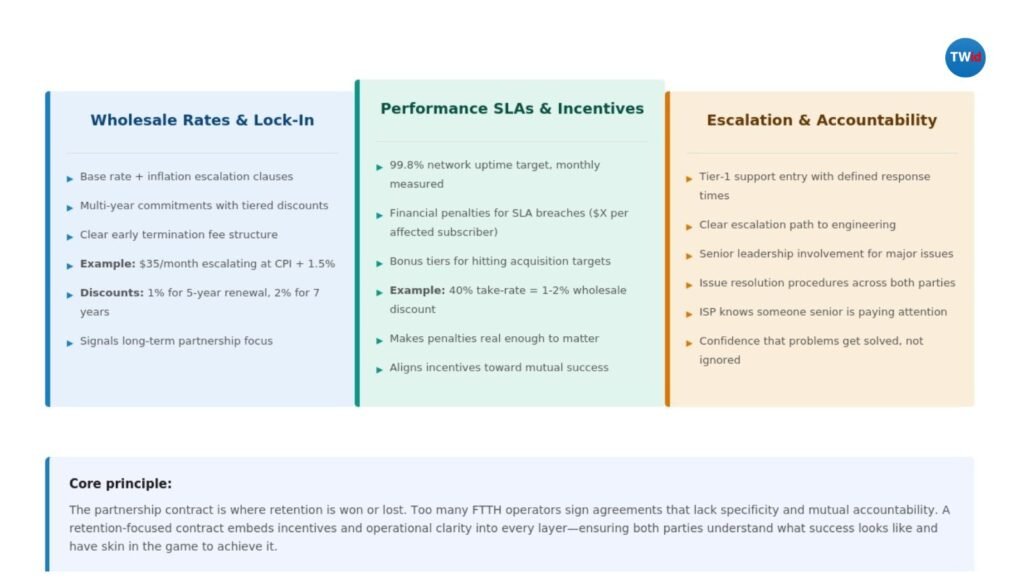
The partnership contract is where retention is won or lost. Most FTTH operators sign ISP agreements that lack the specificity and mutual accountability required for long-term success. They’re typically thin on commercial terms and silent on operational expectations.
A retention-focused agreement has three components.
Clarity on Wholesale Rates and Long-Term Lock-In
Start with the wholesale rate structure. Too many FTTH operators lock ISPs into fixed rates for 3-5 years without escalation clauses tied to cost inflation. This creates a time bomb: as network operations costs rise, the ISP’s margin gets squeezed, and they start shopping for alternatives.
Instead, structure wholesale rates around transparent cost indices. For example: “Base rate of $35 per subscriber per month, escalating annually at [CPI + 1.5%].” This signals that you’re not treating the partnership as zero-sum. The ISP can model their long-term margins with confidence.
Pair rate clarity with multi-year commitments that reward longevity. Offer tiered discounts: 1% discount for a 5-year renewal, 2% for 7 years. This creates a financial incentive for the ISP to stay, and it locks in predictable revenue for you.
Exit costs matter too. Don’t make exit free—but make it transparent. A clear early termination fee (e.g., 6 months of remaining wholesale revenue) signals that you expect long-term relationships. It also gives the ISP’s board a reason to fix problems internally before walking.
Performance SLAs and Penalty/Reward Structures
Network uptime is table stakes. But equally important is the ISP’s confidence that when things break, someone will respond.
Define SLAs with teeth. For example: “99.8% network availability, measured monthly. For each 0.1% below target, FTTH operator credits ISP $X per affected subscriber per month.” Make the penalties real—large enough that operations teams prioritize fixes, not so large that they bankrupt you.
Equally critical: escalation procedures. If an ISP experiences a service issue, there should be a clear path to resolution—starting with tier-1 support, escalating to engineering if needed, with defined response times at each level. The ISP should know that someone senior is paying attention.
Include bonus tiers for partners who hit customer acquisition targets together. If an ISP reaches 40% take-rate on a network, reward them with a 1-2% wholesale discount. This aligns incentives and signals that you want them to succeed.
Revenue Models That Create Mutual Growth
The revenue model determines whether partnership retention is even possible. If your model doesn’t allow the ISP to build a sustainable business, no amount of goodwill fixes the relationship.
Most FTTH operators use one of two models: per-subscriber or capacity-based. Each has retention implications.
Per-subscriber models are simple to administer but create perverse incentives. As an FTTH operator, you want to maximize the number of active subscribers. The ISP wants to maximize customer lifetime value (which means higher churn tolerance if margins are fat). These goals diverge over time. Once an ISP realizes they’re paying you for every customer they acquire, regardless of lifetime value, they’ll hunt for alternatives or push back on rates.
Capacity-based models flip the incentive. You’re paid based on total provisioned capacity (e.g., $5 per Mbps per month), not actual customer count. The ISP can now optimize for profitability without worrying that every new customer costs them money. But this model requires clear definitions of capacity commitment and true-up mechanisms (annual adjustments based on actual usage).
Consider a hybrid: a blended rate that includes both per-subscriber revenue (base wholesale fee) and shared upside. For example: “$25 per subscriber monthly + 15% of retail ISP revenue above $45 per subscriber monthly.” This ties your upside to the ISP’s success. When they grow revenue per customer (through higher speeds, value-adds, or reduced churn), you both win.
To go deeper on structuring wholesale rates for profitability, read our guide on FTTH operators increasing take-rate. The key insight: take-rate isn’t just a pricing lever—it’s a partnership health metric. If your take-rate is dropping, your partners are struggling.
Building Operational Muscle to Keep Partners Sticky
Contracts and revenue models set the frame. Operational excellence keeps partners committed.
Partner Support Infrastructure
Most FTTH operators have a commercial team that closes deals, then hands off to a generic “operations” group. The ISP is now just another customer, competing for support bandwidth with hundreds of other issues.
Retention-focused operators build a dedicated partner success function. This is a small team (2-3 people per 5-10 ISP partners) whose only job is ensuring ISPs succeed. They should have deep technical knowledge, but also business acumen—they need to understand the ISP’s margin pressures, customer acquisition costs, and competitive threats.
The partnership success team owns three things:
Onboarding. The first 90 days determine the partnership’s trajectory. Have a documented onboarding playbook that covers technical integration (how the ISP’s systems connect to your network), commercial setup (billing, reporting, escalation contacts), and a joint business plan (targets for the year, how you’ll measure success together). Assign a single point of contact who stays with the partner for at least the first year.
Technical escalation. When a customer reports a service issue, the ISP needs to know that your NOC will respond. Define clear escalation paths: tier-1 support handles basic troubleshooting, tier-2 handles network diagnostics, tier-3 involves your engineering team. Response time should be faster for issues affecting multiple customers (indicating a network fault vs. a single customer issue).
Proactive outreach. Don’t wait for problems to surface. Partner success teams should monitor partner performance—customer growth, churn, support ticket volume—and flag trends before they become crises. If an ISP’s customer churn suddenly doubles, you should notice and ask what’s wrong before they do.
Joint Business Planning and Communication Cadence
Open-access partnerships are complex. They need more than annual contract reviews.
Establish a quarterly business review (QBR) cadence. Agenda items:
- ISP performance: customer additions, churn, average revenue per user, wholesale revenue
- Network performance: uptime, mean time to repair, ticket resolution times
- Joint initiatives: upcoming network expansions, new service offerings, marketing campaigns
- Troubleshooting: what’s working, what isn’t, and what needs to change
Use these reviews to surface issues early. If an ISP’s customer acquisition has stalled, you can diagnose together: Is it a network issue? A sales execution problem? A pricing misalignment? Solving it together strengthens the partnership; ignoring it accelerates churn.
Transparency about your network roadmap is equally critical. If you’re planning an expansion that will double available capacity in 12 months, the ISP needs to know. This helps them plan their own growth and reinforces that you’re betting on long-term success together.
Conduct a win-loss analysis on customer acquisitions. When an ISP loses a customer to a competitor, understand why. Is it price? Service quality? Product gaps? Use this intelligence to improve your offering and help the ISP compete better.
Measuring Retention: Metrics That Signal Trouble
By the time an ISP announces they’re leaving, the damage is done. Early warning systems help you intervene before the exit conversation happens.
Track these retention signals monthly:
Partner NPS. Ask your ISP partners, “How likely are you to recommend this partnership to other ISPs?” An NPS above 50 is healthy; below 30 signals serious problems. Follow up with losers (those rating below 6) to understand what’s broken.
Engagement metrics. Are your partner contacts attending QBRs? Responding to outreach? Engaging with your product roadmap? Declining engagement often precedes a breakup.
Revenue per partner trend. Is wholesale revenue per ISP growing, flat, or declining? A declining trend means fewer customers, which signals either churn at the ISP or the partner redirecting their sales focus elsewhere.
Customer win/loss by partner. Which ISPs are growing customers on your network? Which are losing them? If one ISP is dramatically outperforming another, the underperformer may be losing confidence (either in your network or in their own ability to compete).
Support ticket patterns. A sudden spike in escalations often precedes churn. Conversely, partners who never escalate may be quietly giving up on your network.
Your First 90 Days With a New ISP Partner
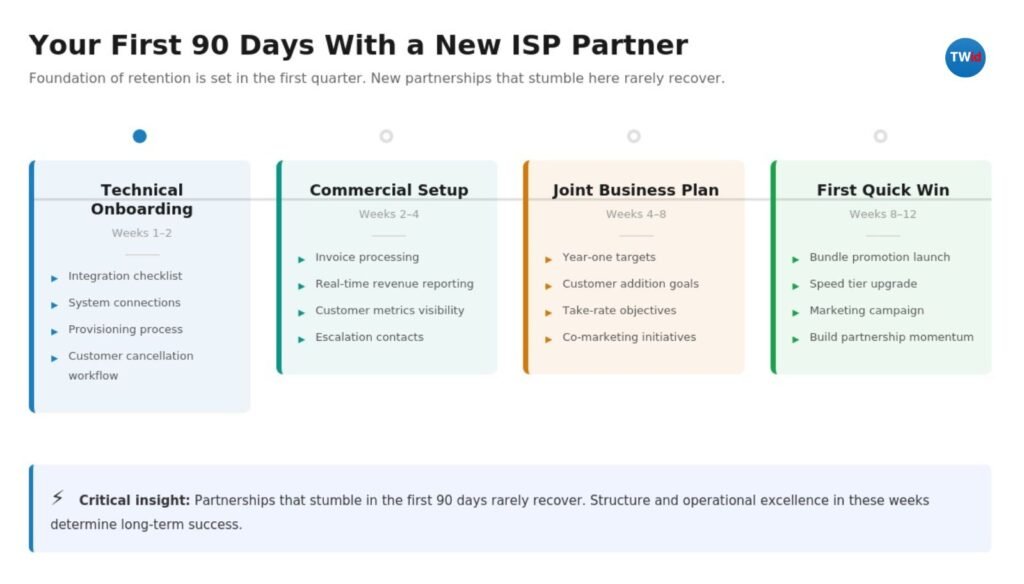
The foundation of retention is set in the first quarter. New partnerships that stumble here rarely recover.
Weeks 1-2: Technical onboarding. Your partner success lead and the ISP’s technical team should work through a detailed integration checklist. How do their systems connect to yours? What’s the provisioning process? What happens when a customer cancels? Leave no ambiguity.
Weeks 2-4: Commercial setup. Ensure the ISP’s billing team can process invoices. Set up reporting so they can see real-time revenue and customer metrics. Establish escalation contacts at your NOC and theirs.
Weeks 4-8: First joint business plan. Sit down with the ISP’s leadership and agree on year-one targets: customer additions, take-rate on the network, any co-marketing initiatives. Write it down. This becomes your shared scorecard.
Weeks 8-12: First quick win. Launch something together early. Maybe it’s a bundle promotion, a speed tier upgrade, or a marketing campaign. The goal is to prove the partnership works and build momentum before market headwinds hit.
For a deeper dive into how to structure open-access networks to support partnership success, review our guide on the open-access FTTH model. The core idea: your network architecture should enable, not constrain, ISP differentiation.
Conclusion: Structure Beats Execution
FTTH operators often assume that good partnerships are the result of good salespeople or good relationships. In reality, they’re the result of good structure.
If your contracts lack clarity on margins and escalation, no amount of friendliness fixes the partnership. If your revenue model doesn’t allow ISPs to build sustainable businesses, they will leave. If your operational infrastructure doesn’t support partner success, you’ve handed the advantage to competitors who do.
The partnerships that last 7+ years are built on aligned incentives, transparent communication, and operational excellence. They’re boring. They’re unsexy. And they’re profoundly profitable.
Your next step: Audit your current ISP partnership agreements against the three pillars outlined here—contract clarity, revenue model alignment, and operational support. Where are the gaps? Which partnership is at the highest risk? Start there.