How to Hire a Ghostwriter in the Telecommunication Industry (Without Wasting Your Budget)

If you’re running an FTTH rollout, managing a fiber operator, or advising infrastructure investors — you already know the stakes. The market is moving fast, competition is scaling, and every board deck, LinkedIn article, and white paper you publish either builds your authority or quietly erodes it.
The problem? Most executives don’t have time to write. And when they try to hire a ghostwriter, they end up with someone who confuses PON architecture with a podcast network.
This guide is for FTTH leaders who want to get thought leadership right — without spending months on trial and error. We’ll walk through what to look for, where to find specialized writers, and exactly how to structure the engagement so your ghostwriter sounds like you at your sharpest.
Why Generic Ghostwriters Fail in Telecommunications
Let’s start with the expensive truth most content agencies won’t tell you.
The global FTTH/B market is projected to exceed $115 billion by 2030, growing at a CAGR of over 12% (IMARC Group, 2024). Decision-makers in this space — from C-suite operators to PE infrastructure funds — are reading content that reflects deep technical and commercial understanding.
When you publish something that gets the terminology wrong, or worse, stays surface-level on topics your audience has been living for a decade, you don’t just miss an opportunity. You signal that you’re not the expert in the room.
A generalist ghostwriter can write. A telecom ghostwriter can write and understand what ARPU pressure actually means for a rural fiber deployment. That distinction is everything.
Related: Why a Generalist Copywriter Is Costing Your Telecom Brand Millions
What a Telecom Ghostwriter Actually Does?
Before you post a job listing or reach out to a freelancer, get clear on what you’re actually buying.
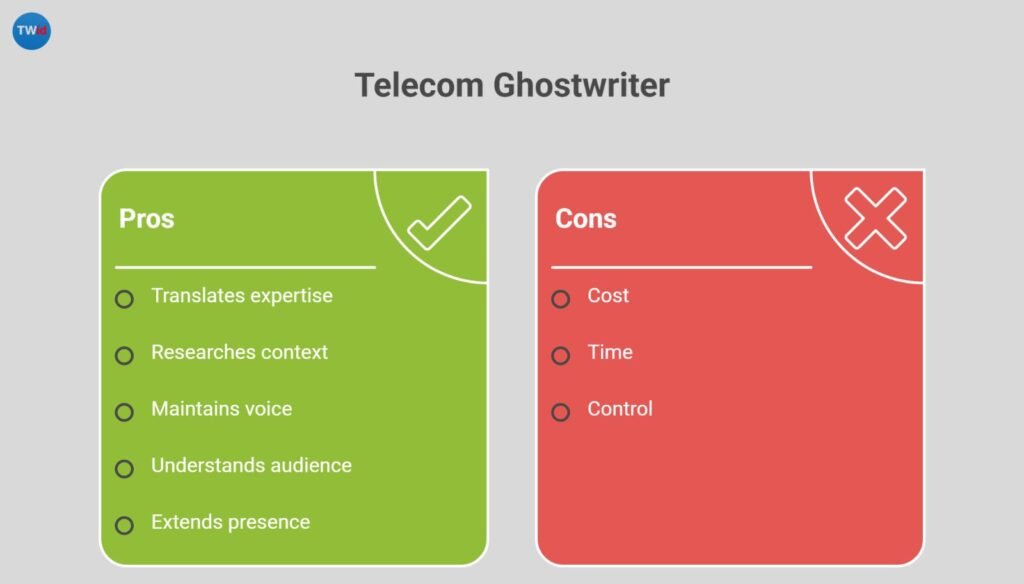
A ghostwriter in the telecom space isn’t just a “content writer.” They are a strategic communication partner who:
- Translates your expertise into articles, LinkedIn posts, white papers, and executive speeches
- Researches industry context so your content references real market dynamics (not just Wikipedia-level overviews)
- Maintains your voice consistently across formats and platforms
- Understands your audience — whether that’s a procurement VP evaluating vendors or an investor assessing a fiber asset
The best telecom ghostwriters have either worked in the industry, covered it as analysts/journalists, or spent years exclusively writing for telco and infrastructure clients. You’re not hiring someone to “make content.” You’re hiring someone to extend your intellectual presence.
5 Criteria to Evaluate a Ghostwriter Before You Sign Anything
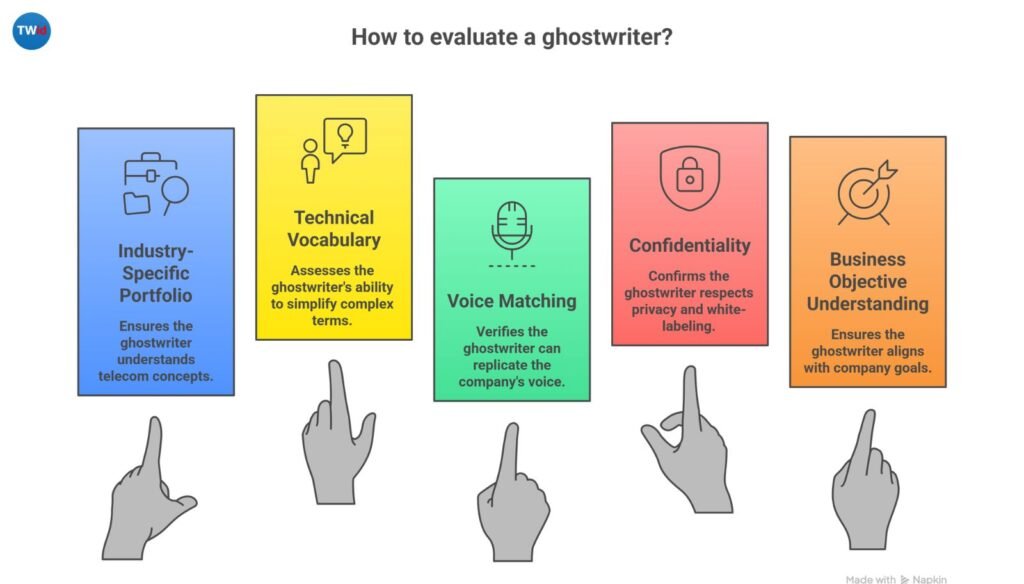
This is the vetting framework that separates a $500 mistake from a long-term asset.
1. Industry-Specific Portfolio
Ask for writing samples that are specifically from the telecom, fiber, or infrastructure space. Not “technology” broadly. Not “B2B SaaS.” Fiber. If they can’t show you at least two pieces that discuss concepts like last-mile connectivity, CapEx deployment models, or regulatory frameworks — keep looking.
2. Technical Vocabulary Without the Jargon Wall
The best ghostwriters know when to use technical terms and when to simplify. Ask them to explain GPON vs. XGS-PON to a non-technical CFO. If they write a coherent, accurate paragraph in plain language — they’re a strong candidate.
3. Voice Matching Ability
Send them a 200-word sample of your own writing — a past email, an internal memo, a LinkedIn comment. Ask them to write a 150-word LinkedIn intro in your voice. This single exercise will tell you more than any portfolio.
4. Confidentiality and White-Label Experience
Executive ghostwriting requires complete discretion. Confirm they have experience with confidential engagements and are comfortable with NDAs. If they hesitate or seem unclear on “white-label” writing — that’s a flag.
5. Understanding of Your Business Objective
A strong ghostwriter will ask you questions before pitching. They’ll want to know your positioning goals, your target audience segments, and what outcomes matter (thought leadership? inbound leads? speaking invitations?). If they just quote you a price without asking context — they’re treating you like a content factory, not a strategic client.
Where to Find Specialized Telecom Ghostwriters
You won’t find the best telecom ghostwriters on generic content marketplaces. Here’s where to look:
LinkedIn is still the most reliable channel. Search for “FTTH writer,” “telecom content strategist,” or “fiber optic copywriter.” Review their own content — do they publish original insights on the industry? If their own profile is a ghost town, that tells you something.
Industry-specific platforms and referrals are underrated. Ask peers in your telecom network who handles their content. Many top ghostwriters work exclusively through referrals because they’re already at capacity.
Boutique telecom content agencies combine specialist knowledge with process. The trade-off is higher cost — but if you need consistent volume (weekly LinkedIn posts, quarterly white papers, speaking scripts), the investment pays back fast.
Related: Why a Fiber Optic Copywriter Is the Competitive Edge FTTH Executives Are Overlooking
How to Structure the Engagement the Right Way
Even the best ghostwriter will underperform if you give them a bad brief. Here’s how to set up the relationship for success from day one.
Start With a Discovery Session
Block 60–90 minutes for a deep-dive conversation. Share your positioning, your core beliefs about the FTTH market, your controversial opinions (yes, those matter — they’re what make thought leadership interesting), and the audience you’re writing for.
According to the Content Marketing Institute’s 2024 B2B report, 72% of the most successful B2B content marketers say documenting their content strategy is a key differentiator (CMI, 2024). That strategy starts with a proper brief — not just a vague topic list.
Create a Voice Document
A voice document captures how you write, speak, and think. Include:
- 5–10 phrases or expressions you use naturally
- Tone preferences (do you prefer “operators” or “telcos”?)
- Topics you consider off-limits or overly commoditized
- Examples of content you admire (doesn’t have to be yours)
This becomes the ghostwriter’s operating manual. Update it as your positioning evolves.
Agree on a Review and Approval Workflow
Define upfront: How many revision rounds are included? What’s the turnaround time? Who else reviews content before it goes live? Ghostwriting relationships break down most often over unclear processes, not talent mismatches.
Start With a Pilot Project
Before committing to a 3-month retainer, assign a single pilot piece — a LinkedIn article, a short white paper, or a 500-word thought leadership post. Evaluate it on accuracy, voice match, and whether it says something genuinely useful to your audience.
The Cost Question: What Should You Budget?
Ghostwriting rates in the telecom space vary widely depending on format, depth, and experience level.
| Format | Typical Range |
|---|---|
| LinkedIn post (single) | $150–$400 |
| Long-form article (1,500+ words) | $500–$1,500 |
| White paper (6–10 pages) | $2,000–$6,000 |
| Monthly retainer (content strategy + writing) | $2,500–$8,000/month |
Rates at the higher end reflect writers with genuine industry knowledge, strategic input, and consistent output quality. For a senior FTTH executive whose time is worth $500–$1,000/hour, even a $5,000/month ghostwriter is a high-leverage investment.
The right question isn’t “how do I pay less?” — it’s “what’s the cost of publishing weak content for 12 more months?”
5 FAQs: How to Hire a Ghostwriter in the Telecom Industry
Will the content still sound like me if someone else writes it?
Yes — if you onboard them properly. The voice document, discovery session, and pilot project all exist to ensure your ghostwriter captures your perspective accurately. The best ghostwriters become invisibly integrated into your communication style within 2–3 pieces.
Do I need to provide technical content, or will the ghostwriter research everything?
A specialist ghostwriter will do deep research, but your insight is irreplaceable. Plan to spend 30–60 minutes per major piece sharing your point of view, key arguments, and examples from your experience. You provide the executive perspective; they provide the structure, language, and SEO optimization.
Is it ethical for executives to use ghostwriters?
Absolutely. Ghostwriting has been standard practice in executive communications, publishing, and journalism for decades. Your name on the content signals that the ideas are yours — the writing is simply the delivery mechanism. What matters is that the content authentically represents your thinking.
How long does it take to see results from thought leadership content?
Expect a 60–90 day runway before you see meaningful engagement growth, inbound connection requests, or speaking inquiries. LinkedIn’s algorithm rewards consistency, and authority builds through accumulated impression. Set a 12-week minimum commitment before evaluating ROI.
What’s the biggest mistake executives make when hiring a ghostwriter?
Treating it like a one-off transaction. The highest-value ghostwriting relationships are ongoing partnerships. A writer who has 6 months of context on your voice, your market positions, and your strategic goals will produce dramatically better content than someone working from a single brief.
The Bottom Line
The FTTH industry is growing too fast, and the executive attention landscape is too competitive, to keep deprioritizing your content presence.
Knowing how to hire a ghostwriter isn’t just a writing decision — it’s a strategic one. The right writer becomes a force multiplier for your expertise, turning your ideas into assets that attract opportunities while you focus on running the business.
Do the vetting properly. Start with a pilot. Invest in the onboarding. And give it time.
The executives who own the FTTH conversation in 2025 and beyond aren’t necessarily the ones with the most experience. They’re the ones who found the best way to make their experience visible.
Ready to explore specialized ghostwriting for your FTTH leadership brand? Connect with a telecom ghostwriter who understands the industry →
Joen — TheWriter.id
Specialized ghostwriter for the FTTH and Telecommunications industry. I help ISPs, network architects, and telecom vendors translate technical complexity into executive-level business value.
joen@thewriter.id →