The Telecom Whitepaper Ghostwriter for Hire: What ISP Vendors Get Wrong About B2B Content

Your whitepaper took three months to produce. Your engineering team contributed weekends. Your marketing director approved every paragraph. And the procurement committee at your target operator? They skimmed the executive summary, didn’t forward it to the CFO, and moved on.
This is the pattern that costs ISP vendors deals they should have won. The problem isn’t effort — it’s architecture. And it starts with a fundamental misunderstanding of who B2B content is actually written for.
If you’re evaluating a ghostwriter for hire to fix your content pipeline, this breakdown is for you.
Why Telecom Whitepapers Fail to Move Decision-Makers
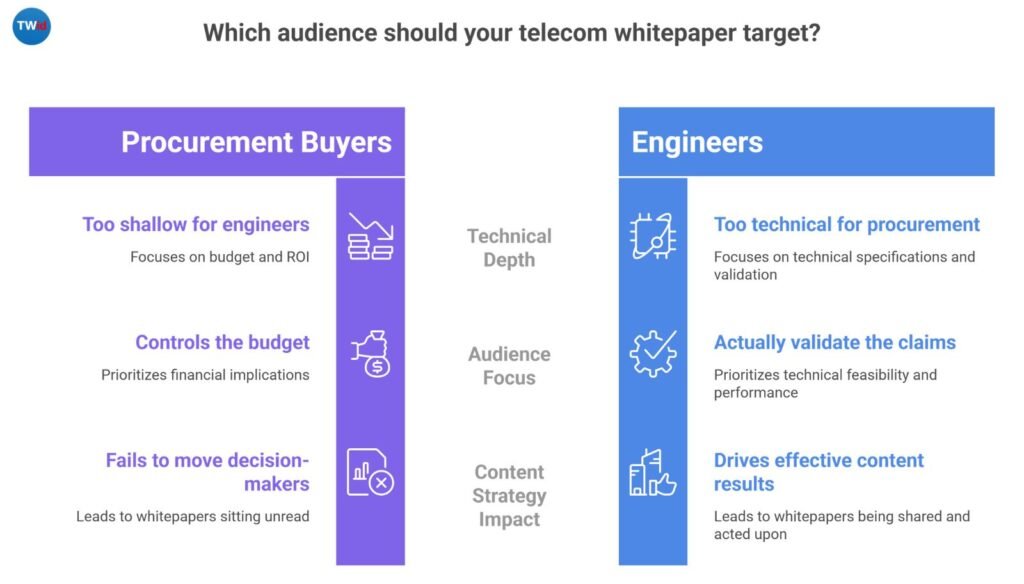
Most telecom whitepapers sit in a painful middle ground: too technical for procurement buyers who control the budget, and too shallow for engineers who actually validate the claims.
That’s not a writing problem. That’s a strategy problem.
According to the Content Marketing Institute’s B2B benchmarks research, 51% of B2B marketers say thought leadership whitepapers and e-books deliver their best content results — but only 29% rate their overall content strategy as “extremely or very effective.” The gap between producing whitepapers and producing effective whitepapers is where most vendors lose.
In FTTH specifically, the stakes are higher. You’re competing for attention from operators running $200M–$500M capex programs, with procurement committees that include engineers, CFOs, and C-suite executives simultaneously. A document that satisfies one audience and alienates the other is a document that doesn’t get shared internally — which means it never reaches the person who signs the contract.
Mistake 1 — Writing for Internal Audiences Instead of Procurement Decision-Makers
The most common whitepaper mistake in telecom isn’t factual error — it’s audience confusion.
ISP vendors typically have their engineering or product teams drive whitepaper content. The result reads like an internal architecture review: precise, thorough, and entirely unreadable to a procurement VP whose primary concern is vendor risk and ROI.
The engineer who validates your XGS-PON claims is not the same person who approves your vendor status. A whitepaper that only speaks to the technical reviewer never reaches the decision-maker — because the technical reviewer has no reason to forward it up the chain.
The fix is structural, not cosmetic. Every section of a well-written vendor whitepaper should answer two questions simultaneously: What does this mean technically? and Why does this matter commercially? That dual-layer architecture is what separates documents that get filed from documents that get presented in board rooms.
Mistake 2 — No Narrative Arc (Data Dump vs. Problem-Solution-Proof Structure)
Here’s a test. Open your last whitepaper to page three. If you see a table, a spec comparison, and two paragraphs of product description — you have a data dump, not a business document.
Procurement teams read for narrative, not inventory. They want to understand the problem you’re solving, see the evidence that your approach works, and feel confident that the proof maps to their specific situation. That’s problem-solution-proof structure, and it’s almost entirely absent from vendor-produced telecom content.
The instinct to lead with product specs is understandable — your engineering team built something impressive, and they want that work recognized. But a whitepaper structured around your product architecture, rather than your buyer’s deployment challenge, signals immediately that the document was written for internal validation, not external persuasion.
A skilled ghostwriter for hire with FTTH domain knowledge restructures this instinctively. The product doesn’t lead — the operator problem leads. The specs follow as proof, not premise.
Mistake 3 — Missing the CFO Layer (No ROI Framing, No CAPEX/OPEX Language)
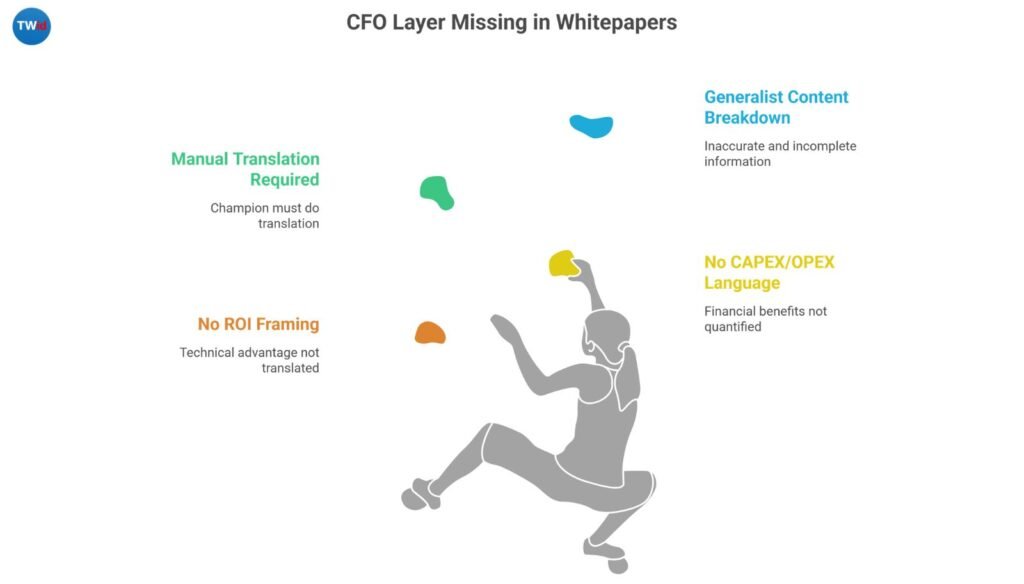
The CFO is rarely in the room when your whitepaper is first reviewed. But they’re almost always in the room when the contract gets approved.
If your whitepaper doesn’t translate technical advantage into financial language — IRR, ARPU uplift, OPEX reduction per subscriber, payback period — it forces your internal champion to do that translation manually. Most won’t. They’ll champion a competitor’s document that already speaks CFO.
This is where generalist content completely breaks down. Writing “our solution reduces installation time by 40%” is accurate but incomplete. A telecom-literate ghostwriter translates that to: “a 40% reduction in average installation time across a 50,000-home passings build reduces direct labor costs by approximately $X and pulls forward subscription revenue by 3–5 months, improving project IRR by an estimated Y basis points.”
That’s what CFOs forward to the deal team.
Mistake 4 — Using a Generalist Ghostwriter Who Can’t Verify the Technical Claims
This is the mistake that compounds all the others.
Bringing in a generalist content writer — or a broad-scope marketing agency — to write telecom whitepapers creates a specific kind of failure: content that sounds credible but can’t withstand scrutiny from an operator’s technical team.
Generalists default to surface framing. They write that “FTTH delivers superior bandwidth and lower latency” without engaging the real procurement question: which passive optical network architecture fits this operator’s density profile, competitive environment, and upgrade roadmap? They can’t, because they haven’t spent years in the space.
The consequence isn’t just weak content — it’s reputational risk. An operator’s network planning engineer who finds a technical claim that doesn’t hold up under verification will flag your entire document as unreliable. That’s not a content problem. That’s a vendor trust problem.
As we outlined in our analysis of why a generalist copywriter costs telecom brands more than they realize, the gap between domain vocabulary and domain knowledge is where most generalist writers fail — and where specialized ghostwriters create genuine differentiation.
What a Specialized Telecom Ghostwriter for Hire Brings That a Marketing Agency Can’t
A specialized ghostwriter for hire in the FTTH space isn’t just a better researcher. They operate differently from the first brief.
They ask different questions. A generalist asks about tone and word count. A telecom specialist asks whether your target operator is pursuing a greenfield build or an overbuilder position, what their take-rate assumptions are, and whether their procurement committee has previously evaluated open-access models. Those questions shape every structural decision in the document.
They carry the vocabulary without the learning curve. Terms like XGS-PON, OSS/BSS integration, wholesale open-access, IRR on passive infrastructure, and ARPU leakage don’t need explaining — and more importantly, they don’t get used incorrectly. The operator’s technical team notices when they’re used wrong.
They write at the right layer for each audience simultaneously. Technical credibility for engineers. Commercial logic for procurement. Financial translation for CFOs. That multi-layer structure is what makes a whitepaper travel internally — which is the only way it reaches the actual decision-maker.
According to SeoProfy’s B2B marketing research, 52% of B2B marketers are increasing investment in thought leadership content in the coming year. In FTTH — where deal cycles are long, trust is the primary buying signal, and a single operator contract can represent eight figures of revenue — that investment only pays off if the content is built for the right audience.
You can learn more about how open-access economics and the financial arguments that actually move fiber investors in our breakdown of FTTH network utilization and revenue yield — the kind of framing that belongs in your next whitepaper.
Checklist: How to Evaluate a Whitepaper Ghostwriter Before You Hire
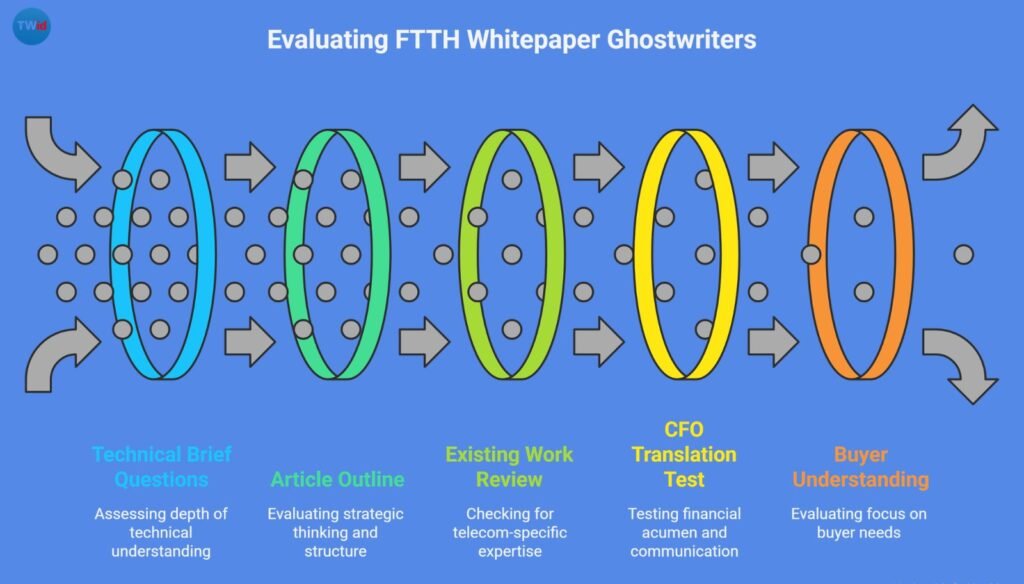
Before you engage a ghostwriter for hire on your next FTTH vendor whitepaper, run them through this filter:
1. Give them a technical brief — read the questions they ask back. A generalist asks about tone, length, and deadline. A specialist asks about your target operator’s network topology, your deployment model, and whether the primary reader is operator-side or investor-side.
2. Ask them to outline an article cold. Request an outline on “the business case for open-access FTTH in a competitive overbuild market.” A generalist produces a generic structure. A specialist immediately maps stakeholder incentives, revenue share mechanics, and regulatory framing.
3. Check for technical specificity in their existing work. Not telecom-adjacent work — telecom-specific work. Look for precise industry figures, engagement with real market debates, and content structured for senior audiences, not general technology readers.
4. Test their CFO translation instinct. Give them one technical spec — say, a 35% reduction in truck rolls. Ask them to translate it into financial language. If they can’t move from the operational metric to IRR, OPEX, and payback period without prompting, they’re not the right fit.
5. Evaluate the questions they ask about your buyer. The best ghostwriters spend more time understanding your buyer than your product. If they haven’t asked about the operator’s procurement structure, decision timeline, or competitive pressures within the first conversation, treat that as a signal.
Frequently Asked Questions
What’s the difference between a telecom ghostwriter for hire and a general B2B content writer? A general B2B writer understands content structure, tone, and SEO mechanics. A telecom ghostwriter for hire brings applied industry knowledge — they understand PON architectures, CAPEX/OPEX dynamics, operator procurement logic, and the regulatory environment that shapes fiber investment decisions.
In practice, this means technical accuracy, CFO-ready framing, and content that travels inside an operator organization rather than stalling at the first technical reviewer.
How long does it typically take to produce a vendor whitepaper with a specialized ghostwriter? A well-structured FTTH vendor whitepaper typically takes three to five weeks from brief to final draft — one week for discovery and outline alignment, two to three weeks for drafting and internal review cycles, and one week for revisions. Compressed timelines are possible but tend to reduce the depth of the CFO-layer framing, which is usually where the most value sits.
Should ISP vendors produce whitepapers or case studies as a priority?
Both serve different stages of the procurement cycle. Whitepapers build positioning and technical credibility at the top of the funnel.
Case studies close the gap between credibility and trust at the bottom of the funnel, where operators need proof that a comparable network actually delivered the promised results. The strongest content programs in FTTH use whitepapers to open the conversation and case studies to win the final evaluation.
Can a ghostwriter maintain technical accuracy without deep engineering access?
Yes — but it requires a structured process. A qualified telecom ghostwriter for hire will typically conduct two to three subject matter expert interviews, review internal technical documentation, validate key claims against publicly available operator data or analyst benchmarks, and flag assertions that require verification before publication.
The ghostwriter’s role isn’t to invent technical claims — it’s to translate validated claims into language that moves multiple audiences.
What’s the ROI case for hiring a specialized ghostwriter versus using an in-house marketing team?
In-house marketing teams in ISP vendor organizations are typically strong on campaign execution, brand consistency, and product positioning. They are rarely equipped to write at the technical depth required for operator-facing whitepapers, and the time cost of bridging that gap — through extended review cycles with engineering and product teams — is often higher than the cost of a specialist ghostwriter.
More importantly, a whitepaper that stalls in internal review for eight weeks and reaches procurement two months after your competitor’s is a whitepaper that loses regardless of its quality.
The Bottom Line
Most ISP vendor whitepapers fail for three compounding reasons: wrong audience targeting, absent narrative architecture, and a ghostwriter who couldn’t verify the technical claims being made. The fix isn’t producing more content — it’s producing content built for the specific procurement reality of FTTH operator deals.
If your next whitepaper needs to survive technical scrutiny, move through a procurement committee, land on a CFO’s desk, and influence a contract decision — the ghostwriter you hire needs to understand the industry well enough to have written the brief themselves.
Ready to build FTTH content that actually reaches decision-makers? Contact TheWriter.id to discuss your next whitepaper or thought leadership project.
Joen — TheWriter.id
Specialized ghostwriter for the FTTH and Telecommunications industry. I help ISPs, network architects, and telecom vendors translate technical complexity into executive-level business value.
joen@thewriter.id →