What Drives FTTH Retention More: Price, Reliability, or Wi-Fi Experience?
You just passed 50,000 homes. Your take rate is climbing. The board is happy.
Then Q3 hits, and your churn report tells a different story. Subscribers are leaving — not to a cheaper competitor, but to one that “just works better at home.” Your FTTH retention strategy, if you even have one, is bleeding revenue faster than your acquisition engine can replace it.
Here is the uncomfortable truth most fiber operators avoid: acquiring a broadband subscriber costs roughly five times more than keeping one. Yet the overwhelming majority of FTTH operators still allocate 80% or more of their commercial budget to acquisition and less than 20% to retention. That math does not hold up when monthly churn compounds over a 36-month payback period.
So what actually keeps a fiber subscriber loyal? Is it the monthly price tag? Network uptime? Or the Wi-Fi experience inside their home — the thing your network operations center cannot even see?
Let us break it down with data.
Price: The Loudest Factor, but Not the Strongest

Price dominates every customer satisfaction survey headline. According to research across European telecom markets, price is the single most cited reason consumers switch fixed broadband providers. In the U.S., a 2024 study by Recurly found that 71% of respondents named price increases as the top reason for canceling subscriptions. It is hard to argue with numbers like that.
But here is where FTTH executives need to read the fine print.
Price sensitivity is highest during two moments: the initial purchase decision and the post-promotional price jump. Outside of those windows, price drops significantly as a churn driver — especially for fiber subscribers.
The EY analysis of the U.S. FTTH market points out that transparent, guaranteed pricing through fixed contract terms builds trust and brand loyalty far more effectively than promotional discounts. Cost-conscious consumers respond better to pricing clarity than to the lowest number on the page.
In other words, the operators losing subscribers to “price” are often not losing on price at all. They are losing on pricing transparency — hidden fees, surprise rate hikes after the first year, and equipment rental charges that feel like a bait-and-switch.
What Smart Operators Are Doing About Price
The leading FTTH providers are not racing to the bottom on price. Instead, they are removing pricing friction. Multi-year price locks, transparent all-in billing, and tiered plans that match household usage patterns are proving more effective at retention than reactive discount offers. When a subscriber calls to cancel and gets a 20% discount, that is not a retention strategy — that is a confession that the original price was wrong.
Reliability: The Silent Loyalty Builder
If price is the loudest churn driver, reliability is the quietest retention driver. Subscribers rarely call to say “great uptime this month.” But they absolutely notice when the connection drops during a video call with their CEO or when their kid’s online exam freezes mid-session.
The data supports this. The Broadband Customer Satisfaction Report for 2025 found that ISPs maintaining network uptime above 99.95% received satisfaction scores 24% higher than those with lower reliability. Among fiber subscribers specifically, 87% of households with three or more simultaneous users reported zero slowdowns — compared to just 63% of cable subscribers. That reliability gap is one of fiber’s strongest competitive moats.
The JD Power 2025 U.S. Residential Internet Service Provider Satisfaction Study reinforced this point. Satisfaction is built on seven dimensions, and “consistently delivering high-quality service” sits at the top. Speed matters, but speed without consistency is just a marketing number.
For FTTH operators building a long-term retention strategy, reliability is the foundation. If your network goes down twice a month, no pricing trick or Wi-Fi upgrade will save your subscriber base. This is especially relevant as operators adopt AI-driven automation for fault management — proactive detection and resolution of network issues before subscribers even notice them.
The Reliability Benchmark You Should Be Tracking
Forget average uptime. Track “subscriber-impacting events per month” — the number of times an individual household experiences a service interruption, regardless of duration. The industry average sits around 1.9 events per month. Leading fiber operators target fewer than 0.5. That gap is where loyalty is won or lost.
Wi-Fi Experience: The Retention Battleground Operators Are Ignoring
Here is where the conversation gets interesting — and where most FTTH operators have a massive blind spot.
A Parks Associates and TechSee research study surveying 8,000 U.S. households found that in-home Wi-Fi performance — not broadband speed — is what actually drives customer satisfaction, loyalty, and churn risk. Despite over 25% of households reporting gigabit-speed service, satisfaction was driven as much by perceived performance as by raw download speeds. Even more telling: 40% of smart device owners reported frequent Wi-Fi connectivity loss affecting their overall network experience.
Think about what that means for your FTTH retention strategy. You can deliver a flawless 1 Gbps connection to the ONT on the side of the house, and your subscriber still experiences buffering in the bedroom, dropped connections in the home office, and smart home devices that randomly go offline. From their perspective, your service is unreliable. They do not care that the problem is their router or the physical layout of their home. They care that it does not work.
This perception gap is the single biggest unaddressed vulnerability in most FTTH retention strategies.
Why Wi-Fi Is Now an Operator Problem
The traditional industry position has been that the home Wi-Fi environment is the subscriber’s responsibility. That position is becoming commercially untenable. As the Dell’Oro Group noted in their 2026 broadband predictions, the competitive battleground is shifting from headline speeds to experiential quality.
Operators that invest in reducing latency, minimizing jitter, and ensuring rock-solid reliability throughout the home — not just to the premises — will build competitive advantages that are much harder to replicate.
Leading operators are already making this shift. Managed Wi-Fi services, mesh network solutions bundled with fiber plans, proactive Wi-Fi diagnostics, and AI-powered network optimization within the home are becoming standard tools in the FTTH retention playbook.
Operators that can “see” inside the home network and resolve issues before the subscriber picks up the phone are dramatically reducing truck rolls, support costs, and — most importantly — churn.
This shift also connects directly to how operators structure their revenue models on open-access networks. When multiple ISPs compete on the same fiber infrastructure, the differentiator is no longer the pipe — it is the experience delivered through it.
The Retention Hierarchy: How All Three Factors Work Together
So which factor matters most? The answer is not one over the other — it is about sequencing.
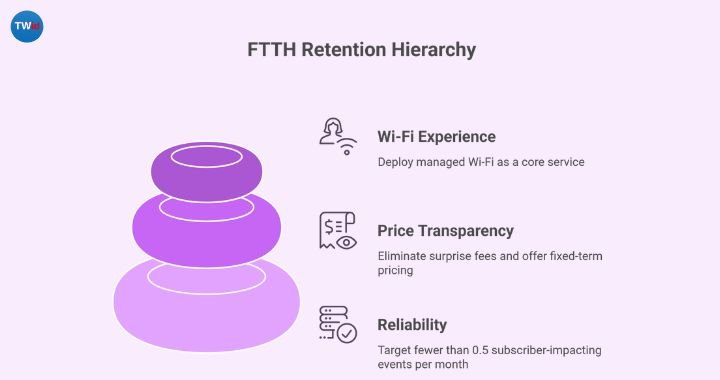
Think of FTTH retention as a hierarchy. Reliability is the foundation. Without it, nothing else matters. Price transparency is the second layer — subscribers need to feel the value is fair and predictable. Wi-Fi experience is the top layer — and increasingly, it is the one that separates operators who retain 95% of subscribers from those stuck at 85%.
Here is a practical framework for FTTH executives building a retention strategy:
Layer 1 — Reliability: Target fewer than 0.5 subscriber-impacting events per month. Invest in proactive monitoring, predictive maintenance, and automated fault resolution. This is table stakes.
Layer 2 — Price Transparency: Eliminate surprise fees. Offer fixed-term pricing guarantees. Align plan tiers to actual household usage rather than aspirational speed benchmarks. Stop training subscribers to call and threaten cancellation for a discount.
Layer 3 — Wi-Fi Experience: Deploy managed Wi-Fi as a core service, not an upsell. Use AI-driven diagnostics to identify and resolve in-home connectivity issues proactively. Measure subscriber experience at the device level, not at the ONT.
What This Means for Your 2026 Retention Budget
If your current FTTH retention strategy is built around reactive discount offers and a customer service hotline, you are fighting with 2018 tools in a 2026 market. The operators that will win on retention are the ones investing in three capabilities: network intelligence that prevents outages before they happen, pricing models that build trust rather than trap subscribers, and in-home Wi-Fi management that makes the subscriber’s entire connected experience seamless.
The ROI case is straightforward. Reducing monthly churn by even 0.5 percentage points on a 100,000-subscriber base translates to 6,000 fewer lost subscribers per year. At a lifetime value of $2,000-$3,000 per subscriber, that is $12-18 million in preserved revenue — far exceeding the cost of a managed Wi-Fi program or a predictive maintenance platform.
Stop treating retention as a cost center. Start treating it as the single highest-ROI investment in your FTTH operation.
Audit your current retention stack this week. Map where your subscribers are actually churning — is it price, reliability, or the in-home experience? Then allocate your next budget cycle accordingly. The data says most of you are underinvesting in Wi-Fi experience. Fix that, and the numbers will follow.
Frequently Asked Questions
What is the average churn rate for FTTH providers?
FTTH providers typically see monthly churn rates between 1.0% and 2.5%, depending on market maturity, competitive intensity, and contract structures. Operators with strong retention programs — including managed Wi-Fi and proactive reliability monitoring — can push monthly churn below 1.0%.
In contrast, operators relying solely on promotional pricing often experience churn at the higher end of this range, particularly after initial contract terms expire.
How does Wi-Fi experience affect FTTH subscriber retention?
Wi-Fi experience has become one of the most significant — and most overlooked — drivers of FTTH churn. Research from Parks Associates found that 40% of smart device owners experience frequent Wi-Fi connectivity loss, and subscribers consistently blame their internet provider for in-home Wi-Fi issues, even when the fiber connection itself is performing perfectly. Operators deploying managed Wi-Fi solutions and proactive diagnostics are seeing measurable reductions in both support calls and subscriber churn.
What is more important for FTTH retention — price or reliability?
Both matter, but reliability is the stronger long-term retention driver. Price sensitivity is highest at the point of purchase and during post-promotional increases, but reliability complaints compound over time and erode trust. ISPs with network uptime above 99.95% consistently score 24% higher in customer satisfaction than those with more frequent outages.
The most effective retention strategies address reliability first, then build pricing transparency on top of that foundation.
How can FTTH operators reduce churn without lowering prices?
The most impactful non-price retention levers include deploying proactive network monitoring that resolves issues before subscribers notice them, offering managed Wi-Fi services that ensure consistent performance throughout the home, providing transparent and predictable billing with no hidden fees, and investing in self-service tools that give subscribers visibility into their own network performance.
Bundling value-added services like cybersecurity protection and parental controls can also increase perceived value without discounting the core service.
What metrics should FTTH operators track to measure retention effectiveness?
Beyond monthly churn rate, effective FTTH retention measurement includes subscriber-impacting events per month (target below 0.5), Net Promoter Score segmented by tenure cohort, support ticket volume per subscriber, time-to-resolution for reported issues, and the ratio of proactive fixes to reactive support calls.
Operators should also track “silent churn indicators” — subscribers who reduce usage or stop engaging with self-service portals — as these often precede cancellation by 30-60 days.
Joen — TheWriter.id
Specialized ghostwriter for the FTTH and Telecommunications industry. I help ISPs, network architects, and telecom vendors translate technical complexity into executive-level business value.
joen@thewriter.id →