How to Structure FTTH ISP Partnerships on Open-Access Networks

Most FTTH operators who move into open-access territory spend months negotiating fiber capacity agreements, only to realize 12 months in that the economics don’t work — not because the market is wrong, but because the partnership architecture was wrong from day one.
Structuring FTTH ISP partnerships on open-access networks is less about technology and more about governance, incentives, and commercial alignment.
Get those three right, and you create a platform that scales. Get them wrong, and you end up with under-utilized infrastructure, frustrated ISP partners, and a pipeline of unresolved disputes.
This guide breaks down exactly how to structure these partnerships — the commercial models, the contractual essentials, the SLA frameworks, and the performance levers that separate high-performing open-access networks from expensive infrastructure experiments.
Why Open-Access Models Are Forcing a New Partnership Playbook
Open-access FTTH isn’t new — but the competitive pressure to execute it well is intensifying fast. The global fiber-to-the-home market is projected to reach USD 25.1 billion by 2030, growing at a CAGR of over 10% (source: Grand View Research). That growth is being driven, in large part, by open-access mandates and wholesale models that require network operators to serve multiple ISPs on a single passive infrastructure layer.
The upside is real: open-access networks spread CapEx across multiple revenue streams, attract ISP partners with differentiated service packages, and future-proof infrastructure investment. But the model introduces complexity that pure retail operators simply don’t face.
When you’re serving three, five, or ten ISPs on the same fiber plant, every structural decision — from how you price capacity to how you define “acceptable latency” in an SLA — becomes a negotiation point. And if your partnership agreements aren’t built for that complexity, the operational drag will eat your margins.
The Three Commercial Models for FTTH ISP Partnerships
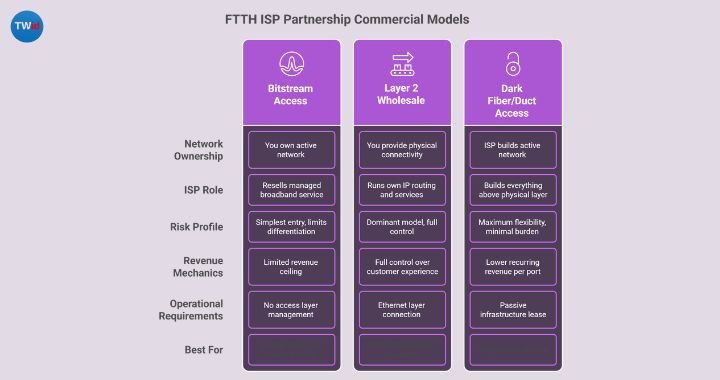
Before drafting any agreement, you need to decide which commercial model governs the partnership. Each carries different risk profiles, revenue mechanics, and operational requirements.
1. Bitstream Access
You own the active network and sell ISPs a managed broadband service at a defined speed tier. The ISP doesn’t manage the access layer — they just resell to end-users. This is the simplest entry point for ISP partners, but it limits their differentiation and your revenue ceiling.
Best for: Smaller ISP partners or new market entrants who want speed-to-market without infrastructure complexity.
2. Layer 2 Wholesale (VLAN-based)
ISPs connect at the Ethernet layer, run their own IP routing and services, and you provide the physical and data-link connectivity. This is the dominant model across European open-access markets — the Dutch, Swedish, and Australian NBN frameworks all lean on Layer 2 variants.
Best for: ISPs with technical capability who want full control over their customer experience.
3. Dark Fiber or Duct Access
You lease passive infrastructure — fiber strands or physical ducts — and the ISP builds everything above the physical layer. Maximum flexibility for the ISP, minimal operational burden for you, but lower recurring revenue per port.
Best for: Large telcos and alternative network operators (altnets) who want to run their own active equipment.
Understanding which model (or which combination) fits your ISP partner mix is the first decision that shapes everything downstream — from pricing schedules to NOC escalation workflows. If you’re still deciding between a full open-access model and a hybrid retail approach, this breakdown of retail vs wholesale vs open-access FTTH models is worth reading before you finalize your commercial framework.
Contractual Essentials: What Every FTTH ISP Partnership Agreement Needs
A signed ISP partner agreement that’s missing key provisions isn’t a contract — it’s a liability. These are the non-negotiable elements every open-access ISP agreement should include.
Network Access Terms Define the points of interconnection (PoI), handover specifications, and what happens when infrastructure changes. ISPs need certainty that the physical and logical access points they build their network around won’t shift without adequate notice.
Capacity and Port Commitment Specify minimum port reservations, maximum contention ratios, and the process for scaling. Ambiguity here creates disputes the moment an ISP’s traffic grows faster than expected.
Service Level Agreements (SLAs) This deserves its own section — and it gets one below. For now: every metric in an SLA needs an agreed measurement methodology, not just a target number.
Revenue and Billing Structure Monthly recurring charges, activation fees, provisioning timelines, and payment terms should be explicit. Include a mechanism for price reviews — quarterly indexing or annual renegotiation clauses prevent the resentment that builds when costs drift without a formal process.
Dispute Resolution Define a tiered escalation process: operational escalation first, commercial escalation second, formal mediation third. Most disputes get resolved at level one if the process is clear upfront.
Termination Provisions Include minimum commitment periods, early termination fees, and a clear process for decommissioning ports. ISPs that exit abruptly without a structured offboarding process create operational chaos.
Designing SLAs That Actually Hold Up Under Pressure
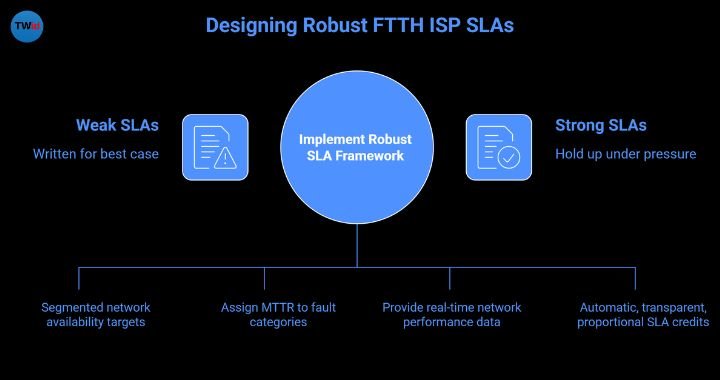
SLAs in FTTH ISP partnerships fail for one reason more than any other: they’re written for the best case, not the real operating environment.
A robust open-access SLA framework has four components:
1. Availability Targets (by segment) Don’t set a single network availability target. Separate backbone availability, access network availability, and PoI uptime — each has different failure modes and recovery timelines. A 99.9% target means nothing if it’s averaged across segments with wildly different risk profiles.
2. Mean Time to Repair (MTTR) by fault category Categorize faults by severity (P1 through P4) and assign MTTR commitments to each. A fiber cut affecting 500 homes is not the same as a single-ONT provisioning failure. Your ISP partners need to know which problems get the all-hands response and which go into the normal queue.
3. Measurement and Reporting ISPs should have real-time visibility into network performance data — not monthly PDF reports. Consider a partner portal with live dashboards showing port status, fault tickets, and SLA credit accruals. Transparency reduces disputes before they start.
4. Credit Mechanisms SLA credits need to be automatic, transparent, and proportional. If an ISP has to fight for credits every time you miss a target, the relationship degrades fast. Build the credit calculation into your billing system and apply it without requiring a formal claim.
Revenue Models That Align Incentives on Both Sides
The commercial tension in most FTTH ISP partnerships comes from misaligned incentives. The network operator wants high port utilization and predictable recurring revenue. The ISP wants low fixed costs and flexibility to scale or contract based on market conditions.
Here’s how to structure revenue models that work for both:
Port-Based Flat Fee + Usage Uplift Charge a fixed monthly fee per provisioned port, with a variable uplift for traffic above a defined threshold. ISPs can forecast their fixed costs; you capture upside as their customer base grows.
Take-or-Pay Commitments Require ISP partners to commit to a minimum port volume — typically 60-70% of their contracted capacity — regardless of actual utilization. This protects your revenue floor while giving ISPs room to manage seasonal demand fluctuations.
Tiered Pricing by Speed Tier Price access differently for 100Mbps, 500Mbps, and 1Gbps service tiers. This gives ISPs flexibility to differentiate their product portfolios while creating a natural revenue escalation path as end-users upgrade.
Revenue Sharing on Value-Added Services If you’re enabling ISP partners to offer managed Wi-Fi, smart home services, or B2B connectivity products over your infrastructure, consider a revenue-share arrangement on those incremental services. It creates shared upside and deepens the partnership beyond a pure capacity transaction.
The goal is a model where your ISP partners succeed when your network is performing — because their growth directly drives your revenue. For operators focused on maximizing revenue per subscriber, the strategies in how fiber broadband providers can grow ARPU without increasing churn apply directly to how you structure your ISP partner tiers.
According to FTTH Council Europe’s 2024 market analysis, open-access networks in markets with structured ISP partnership frameworks show 15-22% higher port utilization rates compared to networks with informal or underdefined commercial arrangements. The structure itself drives performance. (Source: FTTH Council Europe)
Governance: The Part Most Operators Underinvest In
You can have a perfect commercial model and a robust SLA framework — and still watch the partnership deteriorate if governance is weak.
Governance in FTTH ISP partnerships means establishing formal mechanisms for ongoing decision-making, conflict resolution, and strategic alignment. At minimum, structure this:
Operational Review Cadence Monthly operational reviews between NOC teams and ISP technical counterparts. Agenda: open faults, SLA performance, upcoming maintenance windows, provisioning backlog.
Commercial Review Cadence Quarterly reviews at the commercial/VP level. Agenda: revenue performance, pricing review triggers, ISP growth plans, capacity forecasting.
Strategic Partnership Reviews Annual reviews at the C-suite level. Agenda: network roadmap alignment, new service opportunities, contract renewal discussions, market expansion.
Escalation Contacts Every ISP partner should have a named relationship manager on your side — not a general support queue. When something goes wrong at 2am on a Saturday, the ISP’s NOC should know exactly who to call.
Governance isn’t bureaucracy — it’s the infrastructure that keeps commercial relationships functional as they scale.
5 Most Common Mistakes in FTTH ISP Partnership Structures
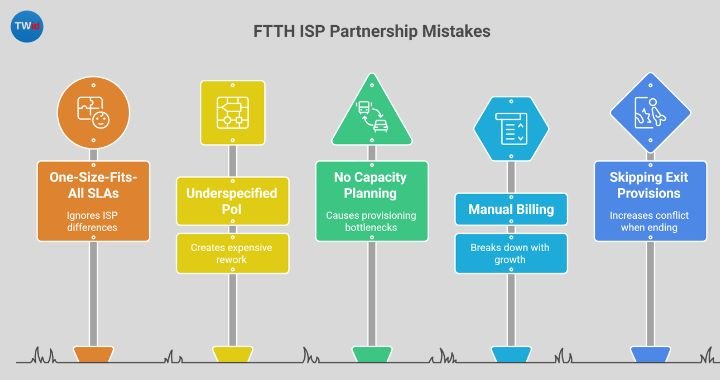
1. One-size-fits-all SLAs Different ISPs have different customer bases, technical capabilities, and risk tolerances. A startup ISP serving residential customers doesn’t need the same SLA as an enterprise-focused provider running mission-critical services.
2. Underspecified PoI requirements Leaving interconnection specifications vague creates expensive rework when the ISP’s equipment doesn’t match your handover assumptions.
3. No capacity planning mechanism ISP growth is rarely linear. If there’s no formal process for ISPs to signal capacity requirements 6-12 months ahead, you’ll end up with provisioning bottlenecks at exactly the wrong time.
4. Manual billing with no audit trail Open-access billing is complex. Automate it from day one and maintain a transparent audit trail that ISP partners can access. Manual processes break down as partner count grows.
5. Skipping the exit provisions Operators avoid drafting termination clauses because they don’t want to signal doubt in the relationship. Don’t skip this. Clear exit provisions actually reduce conflict when a partnership ends — and some of them will.
FAQ: FTTH ISP Partnerships on Open-Access Networks
What’s the minimum contractual term that makes sense for an ISP partnership on an open-access network?
Most operators find that 3-year initial terms with annual renewal options strike the right balance — long enough for the ISP to justify their own infrastructure investment, short enough to remain commercially flexible. Anything under 12 months rarely justifies the onboarding cost.
How do you handle ISP partners who consistently underutilize committed capacity?
Start with a commercial conversation, not a contractual one. Underutilization often signals a market development issue the ISP is struggling with — and if you can help them grow their subscriber base, everyone wins. If it’s a structural mismatch, invoke the take-or-pay clause and use the renegotiation window to right-size the commitment.
Can a network operator serve both retail customers and ISP wholesale partners on the same infrastructure without conflict of interest?
Yes, but it requires structural separation — at minimum, a separate commercial team managing the wholesale channel and a clear policy preventing the retail arm from accessing ISP partner commercial data. Some operators go further with legal separation. Transparency is the key variable.
What’s the most effective way to onboard a new ISP partner technically?
Run a structured technical readiness assessment before signing. This covers the ISP’s equipment specifications, NOC capabilities, IP addressing plan, and provisioning workflow. Catching technical mismatches pre-launch is far cheaper than fixing them post-launch under SLA pressure.
How should SLA credits be structured to avoid abuse or gaming by ISP partners?
Tie credits to measurable, system-generated metrics — not self-reported ISP claims. Define the measurement window (rolling 30 days vs. calendar month), the credit calculation formula, and the maximum credit cap per incident. A well-defined credit framework eliminates the ambiguity that makes gaming possible.
Structure First, Scale Second
The operators who build high-performing open-access ISP partnership programs aren’t necessarily the ones with the best technology — they’re the ones who invested in the right structure before the first ISP contract was signed.
Commercial model clarity, SLA rigor, governance discipline, and revenue alignment aren’t overhead. They’re the foundation that makes everything else scalable.
If you’re building or rebuilding your FTTH ISP partnership framework, start with the commercial model, nail the SLA design, and build your governance cadence before you focus on the pitch to new partners. The partnerships that perform are the ones that were structured to perform from day one.
Ready to build an FTTH content strategy that positions your brand as the authority in this space? Connect with TheWriter.id to explore how specialized FTTH ghostwriting can accelerate your thought leadership.
Joen — TheWriter.id
Specialized ghostwriter for the FTTH and Telecommunications industry. I help ISPs, network architects, and telecom vendors translate technical complexity into executive-level business value.
joen@thewriter.id →