FTTH Growth Strategy: How Fiber Operators Increase Take-Rate, ARPU, and Market Share

Here’s a number that should keep every fiber executive up at night: across Europe, only 53% of homes passed by fiber are actually connected. Nearly half of the capital deployed in FTTH infrastructure is sitting idle — generating zero revenue. And Europe isn’t unique. In competitive U.S. urban markets, take-rates often hover between 30% and 50%.
The gap between homes passed and homes connected is where FTTH growth strategy lives or dies. You can build the best fiber network on the planet, but if your take-rate stalls, your ARPU flatlines, and your competitors are chipping away at your addressable market, the economics fall apart fast.
This post breaks down the specific growth levers that high-performing fiber operators use to increase take-rate, expand ARPU, and capture lasting market share — backed by current industry data and real strategic frameworks.
The Take-Rate Problem Is a Revenue Problem
Let’s put the math in perspective. According to EY’s analysis of the U.S. FTTH market, build return minimums have risen from 8–10% in 2021 to 12–15% today, driven by interest rate shifts and competitive overbuild risk (EY — How US FTTH Providers Can Navigate an Evolving Market). That means the margin for error on take-rate has shrunk dramatically. Dense suburban and urban builds can still deliver high returns — but only when penetration and ARPU targets are met.
Every home passed but not connected is stranded capital. Fiber rollout is front-loaded in cost. Returns only materialize when customers migrate and pay. If your FTTH growth strategy doesn’t address the conversion gap, you’re essentially financing infrastructure for your competitors’ future customers.
The operators winning this race aren’t just building faster. They’re converting faster.
Five Growth Levers That Actually Move the Needle
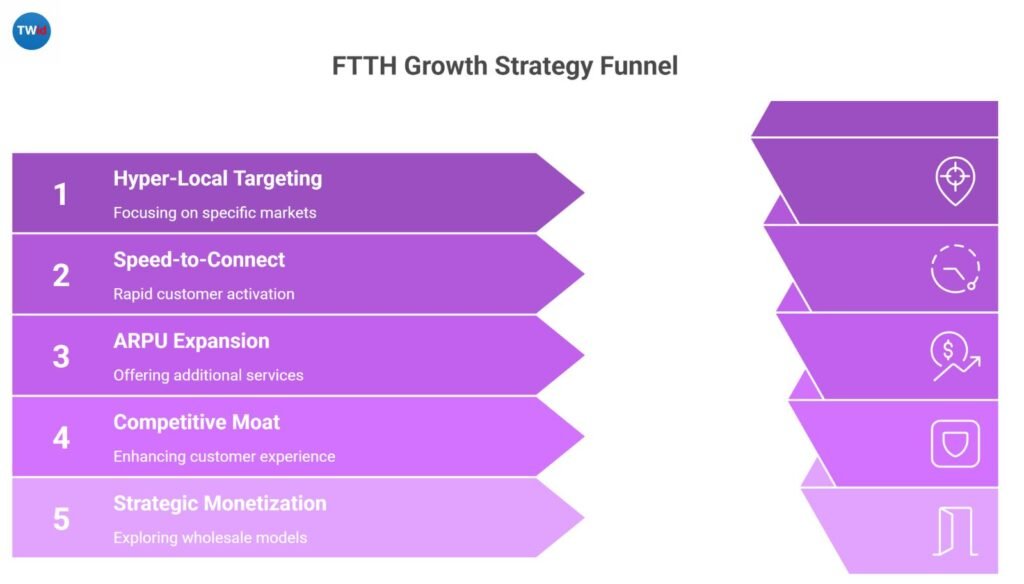
1. Hyper-Local Market Targeting
The first lever in any serious FTTH growth strategy is getting granular about where you build and where you sell. Not every market delivers the same return profile, and blanket rollout strategies waste capital.
High-performing operators are building detailed, address-level targeting models that factor in competitive overlap, demographic profiles, housing density, and historical conversion rates. EY recommends what they call an “intentional market targeting plan” — one that carefully forecasts performance against current and potential future competitors at granular geographic levels.
The practical takeaway: stop thinking in city-wide deployment phases. Start thinking in micro-markets. Rank every cluster by expected take-rate, competitive intensity, and time-to-payback. Deploy sales resources accordingly.
2. Speed-to-Connect After Build Completion
The window between network availability and customer activation is critical. The longer a home sits “passed but not connected,” the harder conversion becomes. Inertia sets in. Competitors make offers. The moment of highest intent — when the fiber truck is on the street and neighbors are talking — fades.
Top operators are compressing the order-to-activation timeline to days, not weeks. They’re deploying pre-registration campaigns months before construction starts, running “fiber-ready” community events during build, and offering same-week installation once the network lights up.
Track your conversion rate within the first 90 days of availability. That single KPI tells you more about your FTTH growth strategy effectiveness than any annual take-rate number.
3. ARPU Expansion Beyond Baseline Broadband
Here’s where the revenue story gets interesting. According to Cartesian’s 2025 Communications Year-End Review, U.S. ISPs are shifting away from traditional promotional pricing toward multi-year price guarantees — trading some short-term ARPU upside for trust, lower churn, and long-term subscriber value (Cartesian — 2025 Year-End Review and 2026 Outlook).
Operators like AT&T and Spectrum are introducing enterprise-style service level agreements into the residential market, promising uptime thresholds and proactive outage credits.
This trend signals a fundamental shift in FTTH growth strategy thinking: ARPU growth increasingly comes from value differentiation, not just speed-tier upselling.
The smartest operators are layering revenue through whole-home Wi-Fi management services, cybersecurity packages, smart home bundles, and enterprise-edge connectivity products built on the same fiber infrastructure.
The AI boom, in particular, is creating demand for high-capacity edge connectivity in the same markets where residential fiber already exists — a meaningful ARPU expansion opportunity if you build the product and sales motion to capture it.
Understanding what drives customers to stay — and pay more — is equally critical. Retention and ARPU are inseparable. Operators who invest in customer retention strategy find that satisfaction with Wi-Fi experience and service reliability often matters more than price alone when it comes to preventing churn and sustaining ARPU growth.
4. Competitive Moat Through Service Experience
In markets where multiple fiber providers overlap — and that number is growing fast — the product itself becomes commoditized. Everyone offers gigabit. Everyone claims reliability. The differentiator becomes the experience layer.
This includes installation experience (was it fast, professional, and on-time?), customer support quality (can I reach someone who actually understands fiber?), proactive network management (do you tell me about issues before I notice them?), and transparent pricing (no surprise rate hikes at month 13).
Operators building a genuine service moat are investing in NPS tracking, technician quality programs, app-based customer management, and proactive communication during outages. These aren’t “nice to have” features. In an overbuilt market, they’re the difference between 40% take-rate and 60% take-rate.
5. Strategic Network Monetization Models
Not every home needs to be a retail customer for the infrastructure to generate returns. Operators exploring open-access and wholesale models are finding ways to monetize fiber capacity even when the end customer chooses a competitor’s brand.
In an open-access model, if a competing ISP acquires a customer over your network, you still earn wholesale fees. The customer is monetized regardless of retail brand preference. This transforms competition from zero-sum to collaborative at the infrastructure layer. Operators who understand open-access FTTH economics can unlock revenue from the same fiber plant that a vertically integrated retail model would leave dark.
This is especially relevant in markets where take-rate ceilings exist due to brand preference diversity. Rather than fighting for every retail customer, the infrastructure owner captures value from all providers on the platform.
Market Share Defense in an Overbuild Era
Fiber is now passing 58% of U.S. households — a 13% increase year over year, according to the Fiber Broadband Association. In Europe, FTTH coverage reached 77.2% of households in 2025. The build phase is maturing. The fight for market share is intensifying.
At the same time, fixed wireless access has emerged as a viable competitor, adding roughly two million U.S. subscribers in the first half of 2025 alone — outpacing fiber subscriber growth in some segments. Cable operators are bundling broadband with wireless service at aggressive discounts.
Your FTTH growth strategy needs a market share defense component that addresses three realities. First, new fiber entrants will continue entering your markets. Second, FWA will erode the bottom of your addressable base. Third, cable operators will fight harder as their competitive position weakens.
The operators holding market share are those who moved first on service differentiation, locked in customers with transparent multi-year pricing, and built a brand that customers trust enough to recommend.
Building a Growth Metrics Framework
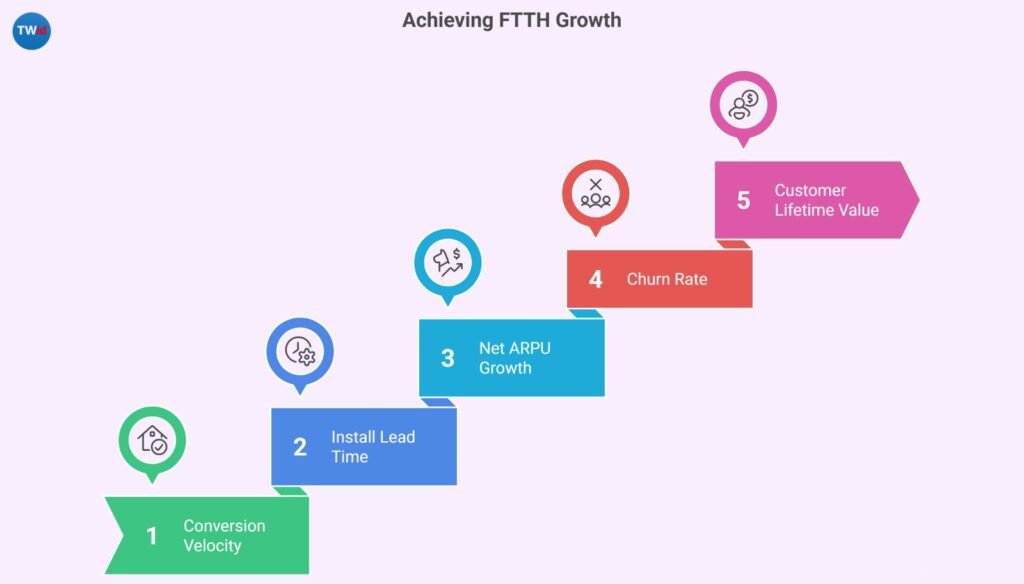
Stop measuring success by homes passed alone. The operators executing the best FTTH growth strategies track a different set of KPIs.
Conversion velocity measures the percentage of homes passed that order service within 90 days of availability. Install lead time tracks average days from customer order to activated service. Net ARPU growth tracks revenue per user after accounting for promotional discounts and bundling.
Churn rate by cohort segments customers by acquisition date and competitive environment. Customer lifetime value calculates the full revenue potential of each subscriber over their expected tenure.
These metrics, tracked monthly and segmented by micro-market, give you the operational visibility to course-correct before a take-rate problem becomes a balance sheet problem.
The Bottom Line
The FTTH market is shifting from a build race to a monetization race. The operators who win the next five years won’t be those who passed the most homes. They’ll be the ones who converted the most homes, grew ARPU through value-layered services, and defended market share with experiences that customers can’t get from a wireless hotspot or a cable modem.
Audit your take-rate by micro-market this quarter. Identify where the conversion gap is widest and deploy resources there first. The infrastructure investment is already in the ground. The question is whether your FTTH growth strategy is turning that investment into sustainable revenue.
Frequently Asked Questions
What is an FTTH growth strategy?
An FTTH growth strategy is the operational and commercial playbook a fiber operator uses to increase subscriber take-rate, grow average revenue per user (ARPU), and expand market share after network deployment. It encompasses market targeting, customer acquisition, pricing models, service differentiation, and network monetization — all focused on converting infrastructure investment into recurring revenue.
What is a good take-rate for FTTH operators?
Take-rates vary significantly by market and competitive environment. In competitive urban markets, take-rates typically range from 30% to 50%. In less competitive or subsidy-supported rural markets, mature operators can achieve 60% or higher. The critical metric isn’t just the final take-rate — it’s the conversion velocity within the first 90 days of network availability, which predicts long-term penetration.
How can fiber operators increase ARPU without raising prices?
The most effective ARPU growth strategies involve layering value-added services on top of baseline broadband. This includes managed Wi-Fi services, cybersecurity packages, smart home bundles, and enterprise-edge connectivity products. Operators are also shifting from promotional pricing to transparent multi-year price guarantees, which stabilize ARPU over time and reduce churn-driven revenue volatility.
How does fixed wireless access (FWA) impact FTTH market share?
FWA has emerged as a meaningful competitive force, particularly at the lower end of the broadband market. In the U.S., FWA added roughly two million subscribers in the first half of 2025, outpacing fiber growth in some segments.
Fiber operators counter FWA competition by emphasizing symmetrical speeds, dedicated connections, lower latency, and long-term reliability — advantages that become more pronounced as household bandwidth demand increases.
Should FTTH operators consider open-access models for growth?
Open-access models can be a powerful growth lever, particularly in markets where single-operator retail take-rates hit a ceiling. By allowing multiple ISPs to serve customers on the same fiber infrastructure, the network owner earns wholesale fees regardless of which retail brand the customer selects. This approach transforms competition from zero-sum to collaborative at the infrastructure layer and can significantly improve network utilization and revenue yield.
Joen — TheWriter.id
Specialized ghostwriter for the FTTH and Telecommunications industry. I help ISPs, network architects, and telecom vendors translate technical complexity into executive-level business value.
joen@thewriter.id →