What Does an FTTH Ghostwriter Actually Do? (And Why Telecom Brands Are Hiring One Now)

Most fiber executives have more domain knowledge than any content agency they’ll ever hire. They’ve lived through deployment nightmares, CapEx battles, and regulatory rewrites. They know the difference between GPON and XGS-PON — and why it matters.
Yet their LinkedIn sits empty. Their insights never reach the investors, operators, or procurement teams who are actively searching for credible voices in the FTTH space.
That gap — between deep expertise and public visibility — is exactly what an FTTH ghostwriter is built to close. This article explains what that role actually involves, what it doesn’t, and why a growing number of telecom brands are making it a strategic priority right now.
The Problem No One in FTTH Talks About
There is no shortage of FTTH expertise in the market. What’s missing is the translation of that expertise into content that builds authority, attracts deals, and positions a professional as a go-to voice in the industry.
The challenge has three layers:
Generic writers can’t speak the language. A content generalist handed a brief on passive optical network architecture, CapEx optimization, or regulatory compliance frameworks will produce surface-level content that educated FTTH audiences will see through immediately. Credibility requires technical fluency — not just a willingness to Google.
Executives don’t have time to write. A CEO overseeing a multi-region fiber rollout isn’t sitting down on Wednesday afternoon to draft a 1,500-word LinkedIn article on deployment frameworks. The insight exists; the bandwidth to communicate it doesn’t.
The credibility gap has real commercial consequences. When decision-makers — investors, procurement leads, board members — can’t find your thinking online, they default to whoever they can find. In a sector growing as fast as FTTH, the window to establish a visible position is narrowing.
What Is an FTTH Ghostwriter — A Clear Definition
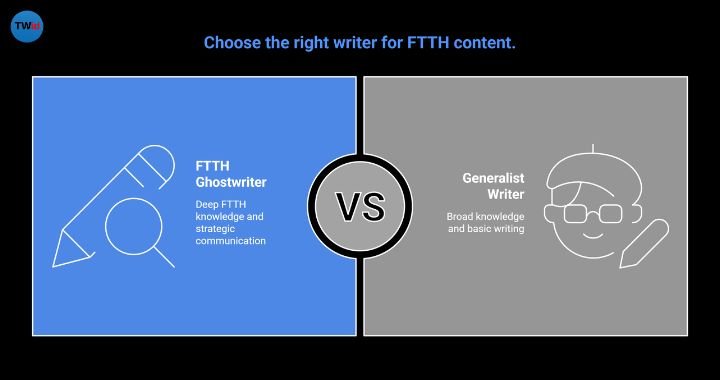
An FTTH ghostwriter is a specialist writer with deep knowledge of the fiber-to-the-home industry who creates authoritative content under another person’s name or brand — translating technical expertise into strategic narratives that build thought leadership, attract business opportunities, and influence industry conversations.
They are not a generalist copywriter who can “research any topic.” They are not a PR agency producing press releases. They are not a content mill generating keyword-stuffed blog posts.
The role sits at the intersection of three capabilities:
- Technical fluency — understanding PON architecture, deployment economics, CapEx/OpEx modeling, regulatory environments, and competitive dynamics
- Strategic communications — knowing which insights matter to which audience (C-suite vs. investor vs. operator vs. regulator) and how to frame them
- Content craft — producing writing that is clear, credible, and compelling enough to hold the attention of busy executives who read a lot
Remove any one of these three, and what you have is not an FTTH ghostwriter — it’s something cheaper that will produce cheaper results.
The 4 Core Things an FTTH Ghostwriter Actually Does
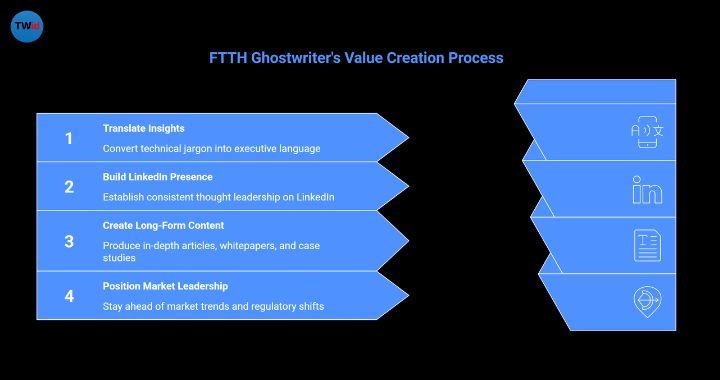
1. Translates Technical Depth Into Executive-Ready Narratives
The most valuable insights in the FTTH industry live inside the heads of people who are too close to them to communicate them clearly to outsiders.
An FTTH ghostwriter extracts that knowledge through structured conversations, interviews, or written briefings — and turns it into content that lands with an executive audience. That means stripping out the internal jargon, adding strategic context, and building arguments that connect technical decisions to business outcomes.
A piece about network design optimization becomes a post about how the right architecture decisions today protect margin over a 10-year asset horizon. A comment about vendor selection becomes an article about the hidden costs of procurement shortcuts that don’t show up until year three of deployment.
2. Builds a Consistent LinkedIn Thought Leadership Presence
LinkedIn is where FTTH decision-makers are spending attention right now. According to the 2024 Edelman–LinkedIn B2B Thought Leadership Impact Report, 73% of B2B decision-makers say an organization’s thought leadership is a more trustworthy basis for assessing its capabilities than its marketing materials. Another 75% say a piece of thought leadership has directly led them to research a product or service they were not previously considering.
That is not a content marketing statistic. That is a pipeline statistic.
An FTTH ghostwriter develops and executes a LinkedIn content strategy: consistent posting cadence, format variation (long-form posts, carousels, short takes, industry commentary), and an editorial angle that builds a recognizable point of view over time. Consistency is what converts visibility into authority.
3. Creates Long-Form Authority Content — Articles, Whitepapers, Case Studies
Not all thought leadership lives in social posts. Some of the highest-value content in the FTTH space takes longer form:
- In-depth LinkedIn articles that anchor a subject matter position
- Whitepapers used in investor relations or enterprise sales conversations
- Case studies that demonstrate deployment or strategy outcomes
- Industry commentary pieces submitted to trade publications
An FTTH ghostwriter manages the full production of these assets — from structuring the argument to final copy — while keeping the voice and perspective unmistakably the client’s.
For a deeper look at how open-access strategy creates the kind of positioning worth writing about, see How Open-Access FTTH Networks Improve Utilization and Revenue Yield.
4. Positions You Ahead of Market Cycles
The FTTH market is moving fast. The global market was valued at USD 12.5 billion in 2024 and is forecast to reach USD 41.3 billion by 2033 — a 14.2% CAGR (Market Size and Trends, 2024). Capital is flowing in. Competition for operator mindshare, investor attention, and partnership opportunities is intensifying.
An FTTH ghostwriter tracks what’s happening in the market — regulatory shifts, overbuild dynamics, technology evolution, M&A activity — and turns it into content that positions their client as a forward-thinking voice rather than a reactive one. The goal is to be the person others cite when these topics come up, not the person who comments after the conversation has already happened.
Why Telecom Brands Are Hiring FTTH Ghostwriters Now?
Several forces have converged to make this a particularly high-priority investment in 2025 and 2026.
The infrastructure boom has created a content demand surge. As more capital enters the fiber space — from infrastructure funds, sovereign wealth vehicles, and strategic operators — buyers at every level are looking for credible insight to guide decisions. The voices that fill that demand now will hold their positions for years.
LinkedIn’s algorithm is rewarding personal executive content. Platform-level reach for personal profiles significantly outperforms company page content on LinkedIn. Executives who publish consistently are reaching audiences their corporate communications teams never could.
The AI content flood has raised the premium on genuine expertise. As generic AI-generated content proliferates, audiences are becoming better at identifying — and discounting — surface-level takes. Authentic, technically grounded content from someone who has actually navigated FTTH deployment, financing, or regulation stands out precisely because it cannot be replicated by a prompt.
The competitive window is not permanent. A handful of FTTH professionals are already building visible platforms. For operators evaluating their competitive positioning against overbuilders, this dynamic is worth understanding — see FTTH Overbuild Strategy — And the Five Moves That Win.
What Separates a True FTTH Ghostwriter From a Generic Writer?
If you are evaluating whether a writer has what it takes to produce credible FTTH content, the following questions will tell you quickly:
Technical depth: Can they explain the difference between GPON and XGS-PON without looking it up? Do they understand why CapEx per home passed varies so dramatically across deployment environments? Can they speak credibly about the tradeoffs in choosing between a retail, wholesale, or open-access FTTH model?
Audience fluency: Can they write the same topic differently for an infrastructure investor, a local government procurement lead, and a telecom operator CFO — because those audiences have fundamentally different priorities?
Thought leadership track record: Have they produced content that builds someone’s position, not just their visibility? There is a meaningful difference between writing that generates likes and writing that generates inbound conversations from qualified buyers.
A generalist writer can be trained on FTTH basics. A true FTTH ghostwriter brings the technical and strategic context that makes content credible to an expert audience — and that distinction shows up immediately in the quality of the output.
Who Actually Needs an FTTH Ghostwriter?
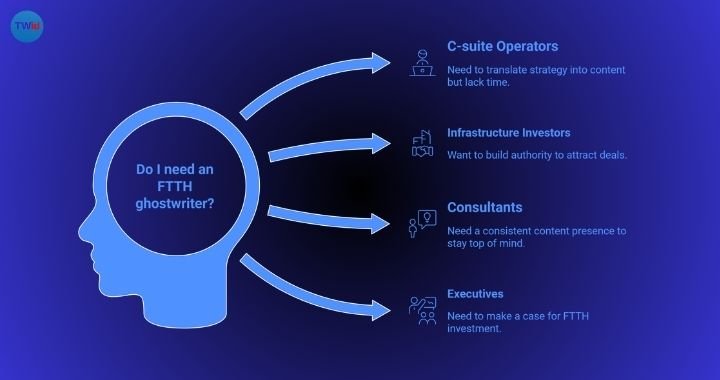
The answer is more specific than “anyone in telecom.” The clients who get the most value from this engagement share a common profile:
C-suite operators managing rollout or scale who have clear thinking on strategy, deployment, or market positioning but zero time to translate that thinking into content.
Infrastructure investors and fund managers who want to build personal authority in the fiber space to attract deal flow and LP confidence.
Consultants and advisors who monetize expertise but need a consistent content presence to stay top of mind between engagements.
Executives making the case internally or externally for FTTH investment — whether that’s a business case for the board, a market positioning piece for investors, or public commentary on topics like how to grow fiber ARPU without spiking churn.
The common thread: they have the knowledge. What they need is someone who can turn that knowledge into content that works.
Frequently Asked Questions
Is ghostwriting ethical in the B2B space?
Ghostwriting has been standard practice in publishing, politics, and business communications for decades. In B2B, the convention is well established — executives work with speechwriters, communications advisors, and content specialists routinely. What matters is that the ideas and perspectives are genuinely the client’s. A good FTTH ghostwriter surfaces and articulates the client’s actual thinking; they do not fabricate positions.
How does an FTTH ghostwriter learn my voice?
Through an onboarding process that typically involves structured interviews, review of existing written or spoken material (presentations, emails, past articles), and iterative drafting where feedback calibrates tone, depth, and preferred framing. After three to five pieces, the voice alignment is usually tight.
What content formats does an FTTH ghostwriter produce?
LinkedIn posts (short-form, long-form, and carousel scripts), LinkedIn articles, whitepapers, industry commentary, trade publication submissions, executive bios, and speaking proposal abstracts. The format mix depends on the client’s goals and audience.
Get 2 Free Pieces of FTTH Content — No Commitment
The fastest way to evaluate whether this approach works for your situation is to see it in action with your own ideas and voice.
Here’s the offer: Share your perspective on one FTTH topic — a trend you’re watching, a deployment challenge you’ve navigated, a strategic position you hold — and receive two fully developed content pieces, written in your voice, ready to publish.
No pitch. No retainer conversation unless you want one. Just content that demonstrates what’s possible.
Claim your 2 free pieces → Contact via thewriter.id
Published by TheWriter.id — Specialized ghostwriting for the FTTH and telecommunications industry.
Joen — TheWriter.id
Specialized ghostwriter for the FTTH and Telecommunications industry. I help ISPs, network architects, and telecom vendors translate technical complexity into executive-level business value.
joen@thewriter.id →