How Fiber Broadband Providers Can Grow ARPU Without Increasing Churn
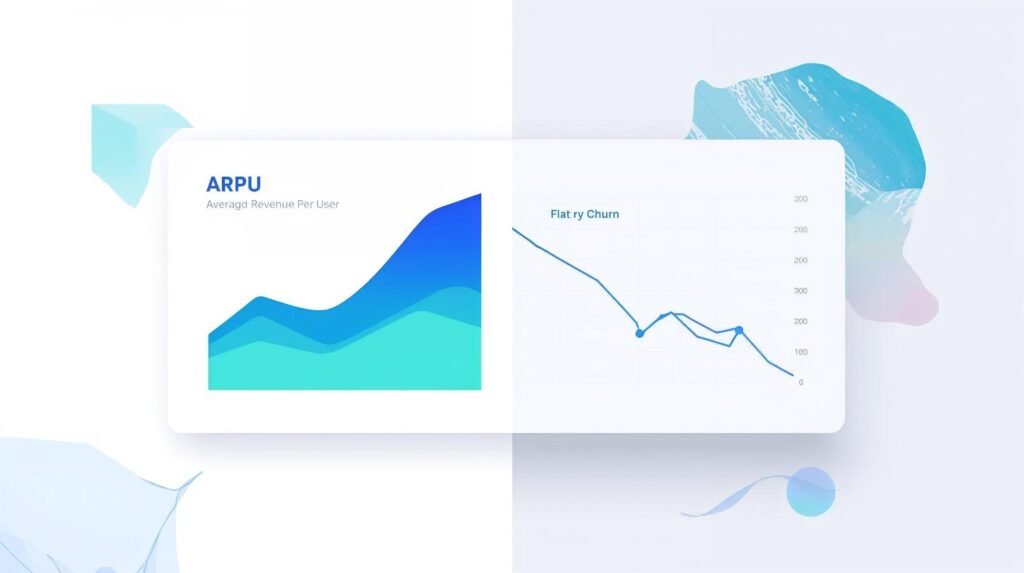
Here’s the uncomfortable truth: most fiber broadband providers have built world-class infrastructure and then handed customers world-class pricing leverage right along with it.
Subscribers know what gigabit costs down the street. They’ve read the comparison sites. They’ll threaten to churn — and sometimes follow through — the moment you nudge prices upward. So your finance team wants fiber ARPU growth, and your CX team wants churn contained. And somewhere in the middle, your strategy team is trying to figure out how to satisfy both.
The good news? Growing ARPU and controlling churn are not mutually exclusive. They only feel that way when you’re using blunt instruments — price hikes on commodity tiers — instead of precision tools. The operators scaling ARPU most effectively in 2025 are doing it by delivering more value, not just charging more for the same pipe.
Let’s break down exactly how they’re doing it.
Why Treating ARPU and Churn as Enemies Is the Wrong Mental Model
The instinct to raise prices on your base tier feels logical — you’ve deployed expensive infrastructure, and you need returns. But in a competitive fiber market, undifferentiated price increases are a fast-track to customer dissatisfaction.
According to Omdia’s 2024 Fixed Broadband Operator Report, operators that increase revenue primarily through price hikes on base plans see churn rates spike an average of 1.8 percentage points in the 90 days following the increase. That’s revenue given with one hand and taken back with the other.
The operators growing ARPU sustainably — think Openreach’s wholesale ARPU trajectory, or Comcast’s broadband ARPU sitting above $65/month despite intense cable competition — are doing so through value perception, not price coercion.
Customers pay more when they believe they’re getting more. That’s the mental model shift that changes everything.
The 5 Proven Levers for Fiber ARPU Growth
1. Tiered Speed Architecture That Maps to Real Household Behavior
Most FTTH providers offer three tiers and call it a day. But the operators driving the best ARPU outcomes are engineering tier structures around actual household use cases — not just Mbps numbers.
Think: a “Work From Home Power” tier with SLA-backed uptime and priority QoS. A “Gamer & Streamer” tier with low-latency guarantees and 4K multi-stream headroom. A “Connected Home” tier bundled with mesh Wi-Fi equipment included.
Analysys Mason’s broadband pricing research shows that operators using use-case framed tiers achieve 22–31% higher uptake on mid and premium tiers versus those using speed-only positioning. The customer isn’t buying 500 Mbps — they’re buying the ability to work, stream, and game without arguments in the house. That’s a story worth more money.
2. Value-Added Services (VAS) That Turn Your Network Into a Platform
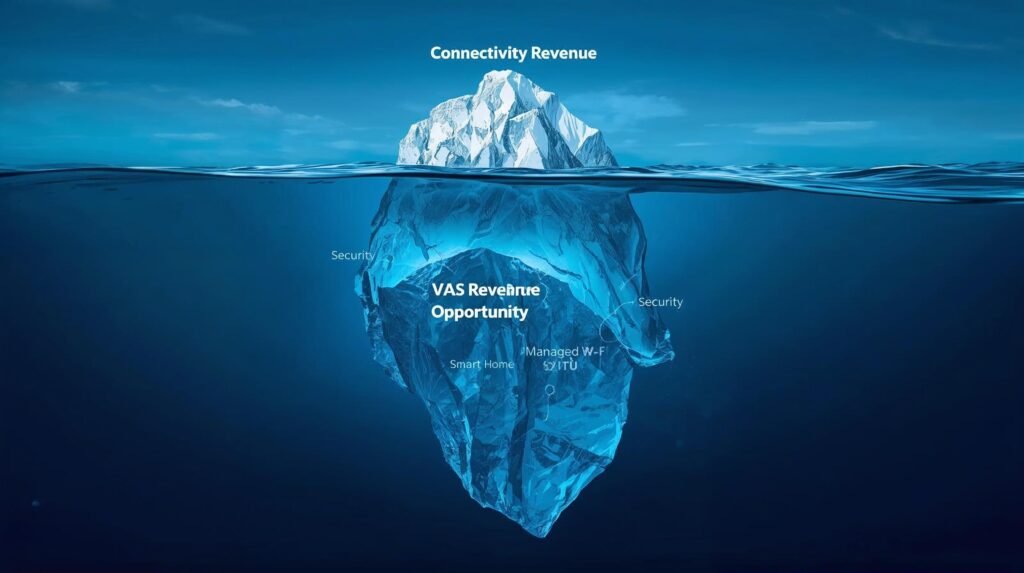
The single biggest ARPU growth opportunity most FTTH operators are underexploiting is the app and service layer above the pipe. Your fiber network is already inside the home — that’s an extraordinary distribution advantage if you use it.
High-performing VAS categories for FTTH providers include:
- Managed Wi-Fi & Home Network Security — chargeable at $5–12/month, with cloud-managed security platforms like Calix Revenue EDGE delivering measurable churn reduction alongside ARPU lift
- Smart Home Integration — energy management, smart lighting, and home automation tie-ins
- Cloud Backup & Storage — particularly compelling for SME-adjacent residential subscribers
- Premium OTT Bundles — co-branded Netflix, Disney+, or regional streaming packages that you can negotiate wholesale and retail with margin
IDATE DigiWorld’s 2024 FTTH Revenue Report found that operators with three or more active VAS offerings per subscriber base achieved average ARPU premiums of $8–14/month over operators running connectivity-only models. That’s real money at scale.
3. Bundle Architecture That Creates Switching Costs Without Feeling Like a Trap
Bundling works — but only when it’s engineered around customer utility, not operator convenience. Customers who are bundled because it’s genuinely easier and cheaper for them have dramatically lower churn propensity than customers who are bundled because they got confused during the sign-up flow.
The framework that works: anchor on the fiber connection, then build utility outward.
- Fiber + Managed Wi-Fi + Security = the “Safe & Fast Home” bundle
- Fiber + OTT Entertainment + Smart TV box = the “Entertainment Hub” bundle
- Fiber + VoIP + Business-Grade SLA = the “Work From Home Pro” bundle
Analysys Mason research on multi-play bundling consistently shows that customers on two-service bundles churn at 40–50% lower rates than single-play broadband subscribers. Three-service customers lower still.
Bundle your way to ARPU growth — but build bundles people want to stay in.
4. SME and SOHO Upsell Within Your Residential Footprint
This is one of the most underrated fiber ARPU growth plays in the market today. In virtually every FTTH deployment area, a meaningful percentage of your “residential” subscribers are actually running home-based businesses, freelancers, or micro-enterprises.
These subscribers have enterprise-grade needs with residential pricing. That’s a gap you can close profitably:
- Offer a “Business Essentials” residential-plus tier with static IPs, uptime SLAs, and priority support
- Position it as a professional-grade service — not just a faster pipe
- Price it at a 30–50% premium over top residential tier
Ofcom’s Connected Nations 2024 report noted that over 28% of UK residential broadband users conduct regular paid work or business activities from home. That’s nearly a third of your base with potential willingness-to-pay for business-grade features. Most operators leave this on the table entirely.
5. Loyalty and Tenure-Based Upgrade Pathways
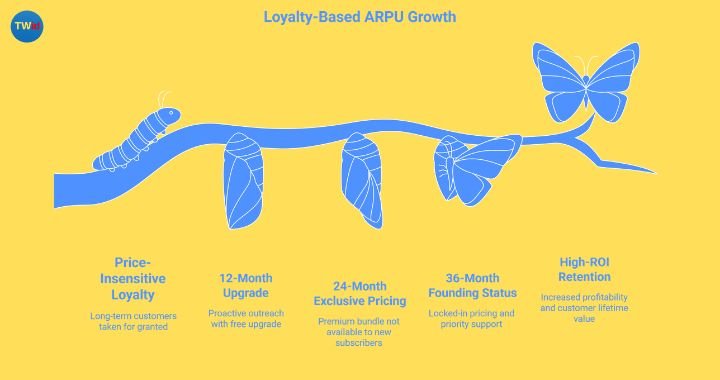
Counterintuitive but powerful: your longest-tenured customers are often your most price-insensitive — provided you acknowledge their loyalty proactively rather than taking it for granted.
Best-practice operators are running “Loyalty Upgrade” programs that work like this:
- At 12-month mark: proactive outreach with a free speed tier upgrade or VAS trial
- At 24-month mark: exclusive pricing on a premium bundle not available to new subscribers
- At 36-month mark: “Founding Customer” status with locked-in pricing and priority support
This is the opposite of the standard telco playbook (best deals go to new customers, loyalty gets punished). And it works: Bain & Company’s telecom loyalty research shows that a 5% improvement in customer retention in broadband translates to 25–95% improvement in profitability over a customer lifetime.
Tenure-based ARPU growth isn’t just feel-good — it’s the highest ROI retention play available.
What High-Churn Operators Get Wrong About Pricing
If you’re seeing churn accelerate every time you touch pricing, it’s almost always one of three root causes:
1. Price increases without value narrative. Subscribers got a rate hike letter with no explanation of what improved. Fix: always communicate what changed — new infrastructure investment, speed upgrades, security enhancements.
2. New customer pricing is visibly better than existing customer pricing. This is the fastest way to weaponize your own subscriber base against you. Price parity or tenure discounts are non-negotiable in competitive markets.
3. ARPU optimization is happening at the wrong point in the customer lifecycle. Upsell attempts at month 2 (before trust is established) underperform dramatically versus attempts at month 6–12. Time your revenue expansion motions to lifecycle stage.
Building Your Fiber ARPU Growth Roadmap: Where to Start
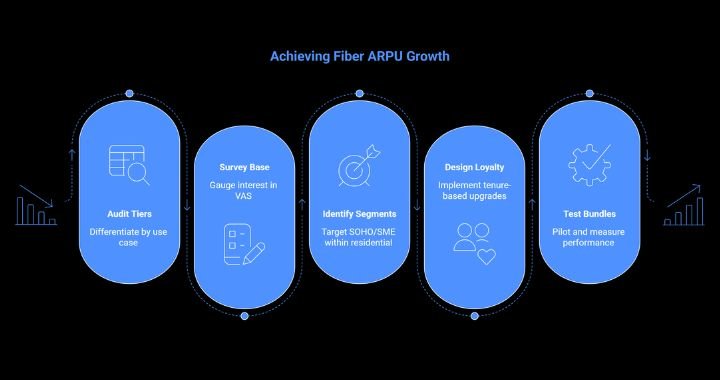
If you’re looking to action this in Q3/Q4, here’s a sequenced approach:
- Audit your current tier architecture — are tiers differentiated by use case or just speed?
- Survey your base for VAS interest — a simple NPS follow-up question (“What would make your service worth 20% more?”) generates invaluable intelligence
- Identify your SOHO/SME segment within residential — this often requires nothing more than usage pattern analysis
- Design a loyalty program structure — even a basic tenure-based upgrade pathway moves the needle
- Test one bundle and measure — pick your highest-potential segment and run a 90-day bundle pilot before full rollout
Fiber ARPU growth is not a single lever — it’s a system. And the operators building that system deliberately are the ones separating themselves from the pack.
Frequently Asked Questions (FAQ)
What is a realistic fiber ARPU growth target for an established FTTH operator?
Best-in-class FTTH operators are targeting 3–7% annual ARPU growth through a combination of tier upgrades, VAS attachment, and bundling — without price increases on base tiers. Markets with strong SME upsell potential may see higher trajectories. The key is measuring ARPU growth per customer cohort, not just blended average, to understand which segments are driving or dragging performance.
How do you grow ARPU without triggering churn in price-sensitive segments?
The answer is value-led growth, not price-led growth. Introduce optional upgrades and VAS add-ons rather than mandatory base price increases. Ensure that every pricing communication is framed around what the customer gains.
For the most price-sensitive segments, consider usage-based upsells (“you’re regularly hitting your speed tier ceiling — here’s an upgrade”) which frame the upsell as a customer insight, not a sales pitch.
Which value-added services deliver the best ARPU lift for FTTH operators?
Based on operator deployment data, managed Wi-Fi and home network security consistently deliver the best combination of attachment rate and ARPU premium (typically $6–10/month per subscriber). OTT bundle partnerships and smart home integrations follow.
The optimal VAS mix varies by market demographics and competitive context — operators in markets with high smart home adoption see stronger results from connected home services than those in less tech-savvy segments.
What’s the relationship between bundle depth and churn reduction?
Research consistently shows that each additional service added to a bundle reduces monthly churn probability by 30–50%. A triple-play fiber subscriber (broadband + managed Wi-Fi + security, for example) is dramatically stickier than a standalone broadband subscriber. The mechanism is switching cost — not in the punitive sense, but in the genuine inconvenience of having to replicate an integrated service stack elsewhere.
How should FTTH operators approach ARPU growth in markets with heavy price competition?
In hyper-competitive markets, ARPU growth strategy needs to focus almost entirely on the service layer rather than connectivity pricing. This means aggressive VAS development, differentiated business-tier offerings for SOHO/SME customers, and loyalty programs that reward tenure.
Competing on connectivity price in a commodity broadband market is a race to the bottom — competing on the service experience above the pipe is where sustainable margin lives.
The Bottom Line: ARPU Growth Is a Strategy, Not a Price Decision
The operators that will win the next five years of FTTH competition aren’t the ones who find creative ways to charge more for the same service. They’re the ones who build genuine service ecosystems that make the idea of switching feel like a significant downgrade.
Fiber ARPU growth done right is invisible to the customer — they’re just getting more value and paying a fair price for it. That’s the difference between churn-safe revenue expansion and a subscriber revolt waiting to happen.
Start with your tier architecture. Add one VAS. Build your loyalty pathway. Then measure, iterate, and scale. The infrastructure is already in the ground — now it’s time to make it work harder commercially.
Ready to develop your ARPU growth strategy? Connect with FTTH thought leaders and operators on LinkedIn who are sharing real-world implementation insights from deployments across Southeast Asia, Europe, and North America.
Joen — TheWriter.id
Specialized ghostwriter for the FTTH and Telecommunications industry. I help ISPs, network architects, and telecom vendors translate technical complexity into executive-level business value.
joen@thewriter.id →