Stop Sending Boring Newsletters. Build an Educational Email Sequence That Actually Teaches.
The Shift to Proof Content in FTTH (2024-2026)
Metadata Confirmations:
Palette: Vibrant Teals, Oranges, and Indigos (Hex: #0d9488, #f97316, #6366f1)
Plan Summary:
1. Intro to FTTH Proof Content shift.
2. Big KPIs showing ROI.
3. Line Chart (Chart.js) showing budget shift over time.
4. Grouped Bar (Chart.js) comparing Services vs Manufacturers.
5. Bubble Chart (Plotly WebGL) showing Trust vs Evidence.
6. Process Flow (HTML/CSS) for thewriter.id Educational Email Course.
Constraint Checks: NO SVG used. NO MERMAID JS used.
Chart Justifications:
– Budget Shift -> Change over time -> Line Chart (Chart.js) -> Best for temporal trends.
– Preferences -> Compare categories -> Grouped Bar (Chart.js) -> Best for side-by-side B2B comparison.
– Trust vs Evidence -> Relationships -> ScatterGL Bubble (Plotly) -> Best for 3-variable correlation using WebGL.
Market Research 2024-2026
The Shift to “Proof Content”
How the Telecommunication Industry (FTTH) is abandoning generic marketing for verifiable, data-driven educational email courses.
Prepared by thewriter.id
315%
Increase in B2B Engagement
When utilizing localized FTTH deployment case studies over standard brochures.
72%
Budget Reallocation
Expected marketing spend shifted to evidence-based assets by 2026.
FTTH buyers are highly technical. Consequently, the share of marketing budgets dedicated to generating technical whitepapers, verifiable benchmarks, and multi-day educational email courses is skyrocketing.
B2B Services vs. Manufacturers
The definition of “Proof Content” varies significantly by segment. Manufacturers (selling OLTs/ONTs and fiber cables) must prove physical reliability and interoperability. Services (ISPs, network designers) must prove long-term ROI, deployment speed, and customer satisfaction.
Analysis of 500+ FTTH B2B transactions shows a direct correlation between the depth of educational proof provided before the sales call and the final vendor trust score. Larger bubbles represent higher average contract values (ACV).
The Solution: The Educational Email Course Framework
By leveraging thewriter.id, telecommunication firms can automate the delivery of “Proof Content” through structured, high-value email sequences that convert cold technical leads into educated buyers.
1
The Hook (Day 1)
A high-level thesis challenging a common FTTH deployment myth, backed by a single striking data point.
Deliverable: Problem Awareness
➞
⬇
2
The Proof Injection (Days 2-4)
Detailed delivery of manufacturer lab results or service deployment case studies. Heavy use of benchmarks.
Deliverable: Technical Validation
➞
⬇
3
The ROI Calculator (Day 5)
Shifting from technical specs to business outcomes. Providing models for CapEx/OpEx reduction.
Deliverable: Financial Justification
The Telecom Whitepaper Ghostwriter for Hire: What ISP Vendors Get Wrong About B2B Content
Your whitepaper took three months to produce. Your engineering team contributed weekends. Your marketing director approved every paragraph. And the procurement committee at your target operator? They skimmed the executive summary, didn’t forward it to the CFO, and moved on.
This is the pattern that costs ISP vendors deals they should have won. The problem isn’t effort — it’s architecture. And it starts with a fundamental misunderstanding of who B2B content is actually written for.
If you’re evaluating a ghostwriter for hire to fix your content pipeline, this breakdown is for you.
Why Telecom Whitepapers Fail to Move Decision-Makers
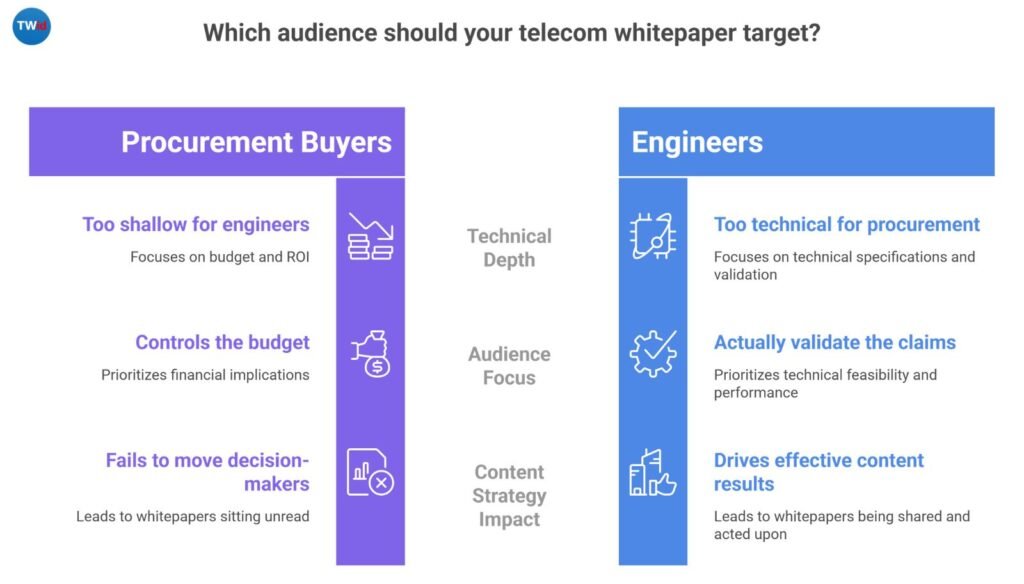
Most telecom whitepapers sit in a painful middle ground: too technical for procurement buyers who control the budget, and too shallow for engineers who actually validate the claims.
That’s not a writing problem. That’s a strategy problem.
According to the Content Marketing Institute’s B2B benchmarks research, 51% of B2B marketers say thought leadership whitepapers and e-books deliver their best content results — but only 29% rate their overall content strategy as “extremely or very effective.” The gap between producing whitepapers and producing effective whitepapers is where most vendors lose.
In FTTH specifically, the stakes are higher. You’re competing for attention from operators running $200M–$500M capex programs, with procurement committees that include engineers, CFOs, and C-suite executives simultaneously. A document that satisfies one audience and alienates the other is a document that doesn’t get shared internally — which means it never reaches the person who signs the contract.
Mistake 1 — Writing for Internal Audiences Instead of Procurement Decision-Makers
The most common whitepaper mistake in telecom isn’t factual error — it’s audience confusion.
ISP vendors typically have their engineering or product teams drive whitepaper content. The result reads like an internal architecture review: precise, thorough, and entirely unreadable to a procurement VP whose primary concern is vendor risk and ROI.
The engineer who validates your XGS-PON claims is not the same person who approves your vendor status. A whitepaper that only speaks to the technical reviewer never reaches the decision-maker — because the technical reviewer has no reason to forward it up the chain.
The fix is structural, not cosmetic. Every section of a well-written vendor whitepaper should answer two questions simultaneously: What does this mean technically? and Why does this matter commercially? That dual-layer architecture is what separates documents that get filed from documents that get presented in board rooms.
Mistake 2 — No Narrative Arc (Data Dump vs. Problem-Solution-Proof Structure)
Here’s a test. Open your last whitepaper to page three. If you see a table, a spec comparison, and two paragraphs of product description — you have a data dump, not a business document.
Procurement teams read for narrative, not inventory. They want to understand the problem you’re solving, see the evidence that your approach works, and feel confident that the proof maps to their specific situation. That’s problem-solution-proof structure, and it’s almost entirely absent from vendor-produced telecom content.
The instinct to lead with product specs is understandable — your engineering team built something impressive, and they want that work recognized. But a whitepaper structured around your product architecture, rather than your buyer’s deployment challenge, signals immediately that the document was written for internal validation, not external persuasion.
A skilled ghostwriter for hire with FTTH domain knowledge restructures this instinctively. The product doesn’t lead — the operator problem leads. The specs follow as proof, not premise.
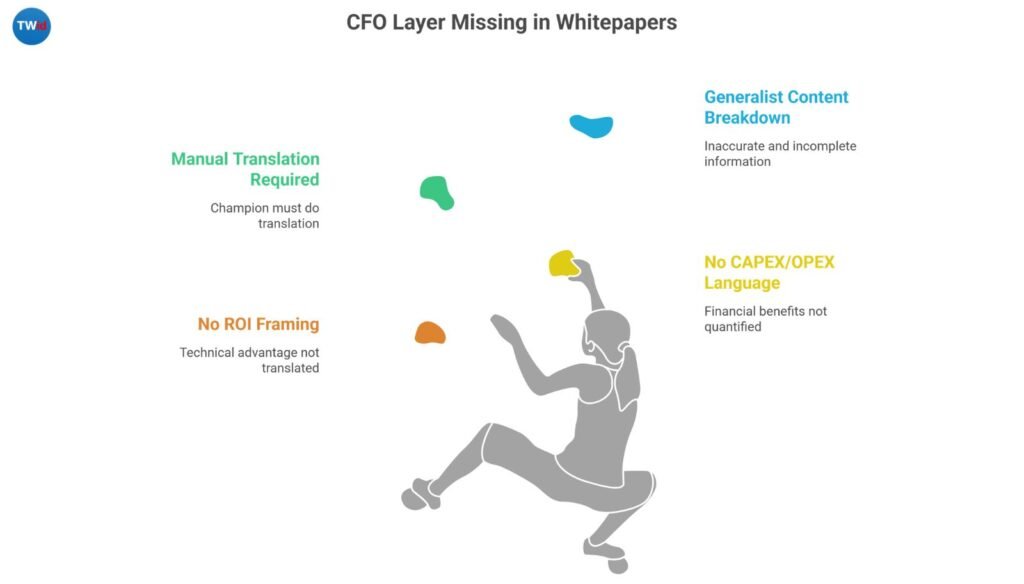
Mistake 3 — Missing the CFO Layer (No ROI Framing, No CAPEX/OPEX Language)
The CFO is rarely in the room when your whitepaper is first reviewed. But they’re almost always in the room when the contract gets approved.
If your whitepaper doesn’t translate technical advantage into financial language — IRR, ARPU uplift, OPEX reduction per subscriber, payback period — it forces your internal champion to do that translation manually. Most won’t. They’ll champion a competitor’s document that already speaks CFO.
This is where generalist content completely breaks down. Writing “our solution reduces installation time by 40%” is accurate but incomplete. A telecom-literate ghostwriter translates that to: “a 40% reduction in average installation time across a 50,000-home passings build reduces direct labor costs by approximately $X and pulls forward subscription revenue by 3–5 months, improving project IRR by an estimated Y basis points.”
That’s what CFOs forward to the deal team.
Mistake 4 — Using a Generalist Ghostwriter Who Can’t Verify the Technical Claims
This is the mistake that compounds all the others.
Bringing in a generalist content writer — or a broad-scope marketing agency — to write telecom whitepapers creates a specific kind of failure: content that sounds credible but can’t withstand scrutiny from an operator’s technical team.
Generalists default to surface framing. They write that “FTTH delivers superior bandwidth and lower latency” without engaging the real procurement question: which passive optical network architecture fits this operator’s density profile, competitive environment, and upgrade roadmap? They can’t, because they haven’t spent years in the space.
The consequence isn’t just weak content — it’s reputational risk. An operator’s network planning engineer who finds a technical claim that doesn’t hold up under verification will flag your entire document as unreliable. That’s not a content problem. That’s a vendor trust problem.
What a Specialized Telecom Ghostwriter for Hire Brings That a Marketing Agency Can’t
A specialized ghostwriter for hire in the FTTH space isn’t just a better researcher. They operate differently from the first brief.
They ask different questions. A generalist asks about tone and word count. A telecom specialist asks whether your target operator is pursuing a greenfield build or an overbuilder position, what their take-rate assumptions are, and whether their procurement committee has previously evaluated open-access models. Those questions shape every structural decision in the document.
They carry the vocabulary without the learning curve. Terms like XGS-PON, OSS/BSS integration, wholesale open-access, IRR on passive infrastructure, and ARPU leakage don’t need explaining — and more importantly, they don’t get used incorrectly. The operator’s technical team notices when they’re used wrong.
They write at the right layer for each audience simultaneously. Technical credibility for engineers. Commercial logic for procurement. Financial translation for CFOs. That multi-layer structure is what makes a whitepaper travel internally — which is the only way it reaches the actual decision-maker.
According to SeoProfy’s B2B marketing research, 52% of B2B marketers are increasing investment in thought leadership content in the coming year. In FTTH — where deal cycles are long, trust is the primary buying signal, and a single operator contract can represent eight figures of revenue — that investment only pays off if the content is built for the right audience.
You can learn more about how open-access economics and the financial arguments that actually move fiber investors in our breakdown of FTTH network utilization and revenue yield — the kind of framing that belongs in your next whitepaper.
Checklist: How to Evaluate a Whitepaper Ghostwriter Before You Hire
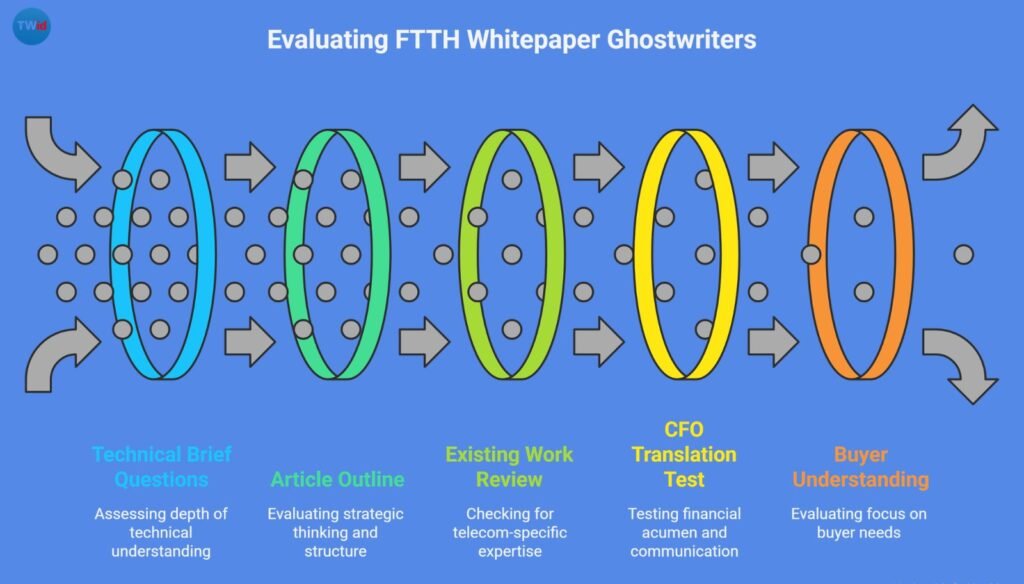
Before you engage a ghostwriter for hire on your next FTTH vendor whitepaper, run them through this filter:
1. Give them a technical brief — read the questions they ask back. A generalist asks about tone, length, and deadline. A specialist asks about your target operator’s network topology, your deployment model, and whether the primary reader is operator-side or investor-side.
2. Ask them to outline an article cold. Request an outline on “the business case for open-access FTTH in a competitive overbuild market.” A generalist produces a generic structure. A specialist immediately maps stakeholder incentives, revenue share mechanics, and regulatory framing.
3. Check for technical specificity in their existing work. Not telecom-adjacent work — telecom-specific work. Look for precise industry figures, engagement with real market debates, and content structured for senior audiences, not general technology readers.
4. Test their CFO translation instinct. Give them one technical spec — say, a 35% reduction in truck rolls. Ask them to translate it into financial language. If they can’t move from the operational metric to IRR, OPEX, and payback period without prompting, they’re not the right fit.
5. Evaluate the questions they ask about your buyer. The best ghostwriters spend more time understanding your buyer than your product. If they haven’t asked about the operator’s procurement structure, decision timeline, or competitive pressures within the first conversation, treat that as a signal.
Frequently Asked Questions
What’s the difference between a telecom ghostwriter for hire and a general B2B content writer? A general B2B writer understands content structure, tone, and SEO mechanics. A telecom ghostwriter for hire brings applied industry knowledge — they understand PON architectures, CAPEX/OPEX dynamics, operator procurement logic, and the regulatory environment that shapes fiber investment decisions.
In practice, this means technical accuracy, CFO-ready framing, and content that travels inside an operator organization rather than stalling at the first technical reviewer.
How long does it typically take to produce a vendor whitepaper with a specialized ghostwriter? A well-structured FTTH vendor whitepaper typically takes three to five weeks from brief to final draft — one week for discovery and outline alignment, two to three weeks for drafting and internal review cycles, and one week for revisions. Compressed timelines are possible but tend to reduce the depth of the CFO-layer framing, which is usually where the most value sits.
Should ISP vendors produce whitepapers or case studies as a priority?
Both serve different stages of the procurement cycle. Whitepapers build positioning and technical credibility at the top of the funnel.
Case studies close the gap between credibility and trust at the bottom of the funnel, where operators need proof that a comparable network actually delivered the promised results. The strongest content programs in FTTH use whitepapers to open the conversation and case studies to win the final evaluation.
Can a ghostwriter maintain technical accuracy without deep engineering access?
Yes — but it requires a structured process. A qualified telecom ghostwriter for hire will typically conduct two to three subject matter expert interviews, review internal technical documentation, validate key claims against publicly available operator data or analyst benchmarks, and flag assertions that require verification before publication.
The ghostwriter’s role isn’t to invent technical claims — it’s to translate validated claims into language that moves multiple audiences.
What’s the ROI case for hiring a specialized ghostwriter versus using an in-house marketing team?
In-house marketing teams in ISP vendor organizations are typically strong on campaign execution, brand consistency, and product positioning. They are rarely equipped to write at the technical depth required for operator-facing whitepapers, and the time cost of bridging that gap — through extended review cycles with engineering and product teams — is often higher than the cost of a specialist ghostwriter.
More importantly, a whitepaper that stalls in internal review for eight weeks and reaches procurement two months after your competitor’s is a whitepaper that loses regardless of its quality.
The Bottom Line
Most ISP vendor whitepapers fail for three compounding reasons: wrong audience targeting, absent narrative architecture, and a ghostwriter who couldn’t verify the technical claims being made. The fix isn’t producing more content — it’s producing content built for the specific procurement reality of FTTH operator deals.
If your next whitepaper needs to survive technical scrutiny, move through a procurement committee, land on a CFO’s desk, and influence a contract decision — the ghostwriter you hire needs to understand the industry well enough to have written the brief themselves.
Ready to build FTTH content that actually reaches decision-makers?Contact TheWriter.id to discuss your next whitepaper or thought leadership project.
How to Hire a Ghostwriter in the Telecommunication Industry (Without Wasting Your Budget)
If you’re running an FTTH rollout, managing a fiber operator, or advising infrastructure investors — you already know the stakes. The market is moving fast, competition is scaling, and every board deck, LinkedIn article, and white paper you publish either builds your authority or quietly erodes it.
The problem? Most executives don’t have time to write. And when they try to hire a ghostwriter, they end up with someone who confuses PON architecture with a podcast network.
This guide is for FTTH leaders who want to get thought leadership right — without spending months on trial and error. We’ll walk through what to look for, where to find specialized writers, and exactly how to structure the engagement so your ghostwriter sounds like you at your sharpest.
Why Generic Ghostwriters Fail in Telecommunications
Let’s start with the expensive truth most content agencies won’t tell you.
The global FTTH/B market is projected to exceed $115 billion by 2030, growing at a CAGR of over 12% (IMARC Group, 2024). Decision-makers in this space — from C-suite operators to PE infrastructure funds — are reading content that reflects deep technical and commercial understanding.
When you publish something that gets the terminology wrong, or worse, stays surface-level on topics your audience has been living for a decade, you don’t just miss an opportunity. You signal that you’re not the expert in the room.
A generalist ghostwriter can write. A telecom ghostwriter can write and understand what ARPU pressure actually means for a rural fiber deployment. That distinction is everything.
Before you post a job listing or reach out to a freelancer, get clear on what you’re actually buying.
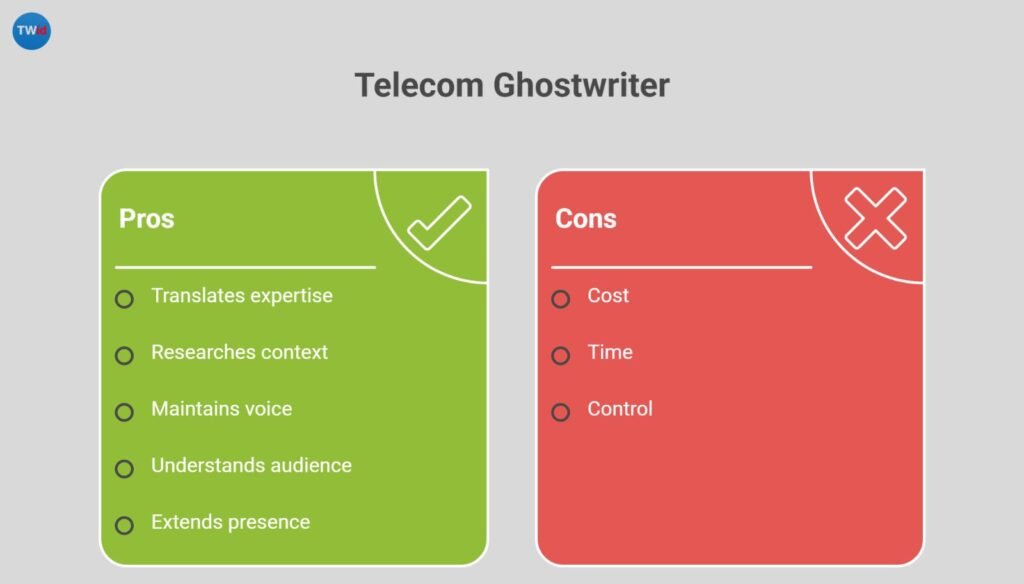
A ghostwriter in the telecom space isn’t just a “content writer.” They are a strategic communication partner who:
Translates your expertise into articles, LinkedIn posts, white papers, and executive speeches
Researches industry context so your content references real market dynamics (not just Wikipedia-level overviews)
Maintains your voice consistently across formats and platforms
Understands your audience — whether that’s a procurement VP evaluating vendors or an investor assessing a fiber asset
The best telecom ghostwriters have either worked in the industry, covered it as analysts/journalists, or spent years exclusively writing for telco and infrastructure clients. You’re not hiring someone to “make content.” You’re hiring someone to extend your intellectual presence.
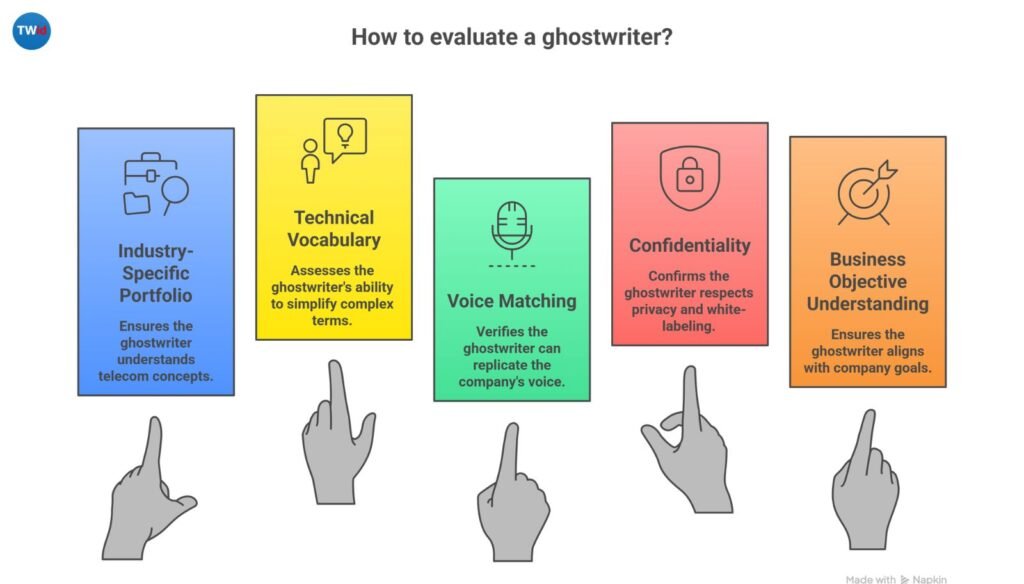
5 Criteria to Evaluate a Ghostwriter Before You Sign Anything
This is the vetting framework that separates a $500 mistake from a long-term asset.
1. Industry-Specific Portfolio
Ask for writing samples that are specifically from the telecom, fiber, or infrastructure space. Not “technology” broadly. Not “B2B SaaS.” Fiber. If they can’t show you at least two pieces that discuss concepts like last-mile connectivity, CapEx deployment models, or regulatory frameworks — keep looking.
2. Technical Vocabulary Without the Jargon Wall
The best ghostwriters know when to use technical terms and when to simplify. Ask them to explain GPON vs. XGS-PON to a non-technical CFO. If they write a coherent, accurate paragraph in plain language — they’re a strong candidate.
3. Voice Matching Ability
Send them a 200-word sample of your own writing — a past email, an internal memo, a LinkedIn comment. Ask them to write a 150-word LinkedIn intro in your voice. This single exercise will tell you more than any portfolio.
4. Confidentiality and White-Label Experience
Executive ghostwriting requires complete discretion. Confirm they have experience with confidential engagements and are comfortable with NDAs. If they hesitate or seem unclear on “white-label” writing — that’s a flag.
5. Understanding of Your Business Objective
A strong ghostwriter will ask you questions before pitching. They’ll want to know your positioning goals, your target audience segments, and what outcomes matter (thought leadership? inbound leads? speaking invitations?). If they just quote you a price without asking context — they’re treating you like a content factory, not a strategic client.
Where to Find Specialized Telecom Ghostwriters
You won’t find the best telecom ghostwriters on generic content marketplaces. Here’s where to look:
LinkedIn is still the most reliable channel. Search for “FTTH writer,” “telecom content strategist,” or “fiber optic copywriter.” Review their own content — do they publish original insights on the industry? If their own profile is a ghost town, that tells you something.
Industry-specific platforms and referrals are underrated. Ask peers in your telecom network who handles their content. Many top ghostwriters work exclusively through referrals because they’re already at capacity.
Boutique telecom content agencies combine specialist knowledge with process. The trade-off is higher cost — but if you need consistent volume (weekly LinkedIn posts, quarterly white papers, speaking scripts), the investment pays back fast.
Even the best ghostwriter will underperform if you give them a bad brief. Here’s how to set up the relationship for success from day one.
Start With a Discovery Session
Block 60–90 minutes for a deep-dive conversation. Share your positioning, your core beliefs about the FTTH market, your controversial opinions (yes, those matter — they’re what make thought leadership interesting), and the audience you’re writing for.
According to the Content Marketing Institute’s 2024 B2B report, 72% of the most successful B2B content marketers say documenting their content strategy is a key differentiator (CMI, 2024). That strategy starts with a proper brief — not just a vague topic list.
Create a Voice Document
A voice document captures how you write, speak, and think. Include:
5–10 phrases or expressions you use naturally
Tone preferences (do you prefer “operators” or “telcos”?)
Topics you consider off-limits or overly commoditized
Examples of content you admire (doesn’t have to be yours)
This becomes the ghostwriter’s operating manual. Update it as your positioning evolves.
Agree on a Review and Approval Workflow
Define upfront: How many revision rounds are included? What’s the turnaround time? Who else reviews content before it goes live? Ghostwriting relationships break down most often over unclear processes, not talent mismatches.
Start With a Pilot Project
Before committing to a 3-month retainer, assign a single pilot piece — a LinkedIn article, a short white paper, or a 500-word thought leadership post. Evaluate it on accuracy, voice match, and whether it says something genuinely useful to your audience.
The Cost Question: What Should You Budget?
Ghostwriting rates in the telecom space vary widely depending on format, depth, and experience level.
Format
Typical Range
LinkedIn post (single)
$150–$400
Long-form article (1,500+ words)
$500–$1,500
White paper (6–10 pages)
$2,000–$6,000
Monthly retainer (content strategy + writing)
$2,500–$8,000/month
Rates at the higher end reflect writers with genuine industry knowledge, strategic input, and consistent output quality. For a senior FTTH executive whose time is worth $500–$1,000/hour, even a $5,000/month ghostwriter is a high-leverage investment.
The right question isn’t “how do I pay less?” — it’s “what’s the cost of publishing weak content for 12 more months?”
5 FAQs: How to Hire a Ghostwriter in the Telecom Industry
Will the content still sound like me if someone else writes it?
Yes — if you onboard them properly. The voice document, discovery session, and pilot project all exist to ensure your ghostwriter captures your perspective accurately. The best ghostwriters become invisibly integrated into your communication style within 2–3 pieces.
Do I need to provide technical content, or will the ghostwriter research everything?
A specialist ghostwriter will do deep research, but your insight is irreplaceable. Plan to spend 30–60 minutes per major piece sharing your point of view, key arguments, and examples from your experience. You provide the executive perspective; they provide the structure, language, and SEO optimization.
Is it ethical for executives to use ghostwriters?
Absolutely. Ghostwriting has been standard practice in executive communications, publishing, and journalism for decades. Your name on the content signals that the ideas are yours — the writing is simply the delivery mechanism. What matters is that the content authentically represents your thinking.
How long does it take to see results from thought leadership content?
Expect a 60–90 day runway before you see meaningful engagement growth, inbound connection requests, or speaking inquiries. LinkedIn’s algorithm rewards consistency, and authority builds through accumulated impression. Set a 12-week minimum commitment before evaluating ROI.
What’s the biggest mistake executives make when hiring a ghostwriter?
Treating it like a one-off transaction. The highest-value ghostwriting relationships are ongoing partnerships. A writer who has 6 months of context on your voice, your market positions, and your strategic goals will produce dramatically better content than someone working from a single brief.
The Bottom Line
The FTTH industry is growing too fast, and the executive attention landscape is too competitive, to keep deprioritizing your content presence.
Knowing how to hire a ghostwriter isn’t just a writing decision — it’s a strategic one. The right writer becomes a force multiplier for your expertise, turning your ideas into assets that attract opportunities while you focus on running the business.
Do the vetting properly. Start with a pilot. Invest in the onboarding. And give it time.
The executives who own the FTTH conversation in 2025 and beyond aren’t necessarily the ones with the most experience. They’re the ones who found the best way to make their experience visible.
Why a Fiber Optic Copywriter Is the Competitive Edge FTTH Executives Are Overlooking
The global FTTH market was valued at $56 billion in 2024 and is racing toward $110 billion by 2030. Deployment records are being broken every year. Capital is flowing in. Infrastructure is scaling fast.
And yet — most fiber operators still sound exactly the same when they talk to investors, partners, and prospective customers.
That’s the gap a skilled fiber optic copywriter closes. Not a generalist content vendor who learns the industry from a Wikipedia article, but a specialist who understands passive optical networks, take-rate economics, and the competitive dynamics of overbuilding markets — and can translate all of it into words that move the right people to act.
If you’re a C-suite executive or infrastructure investment lead navigating FTTH growth, this post breaks down exactly what this role involves, why it matters now more than ever, and how to find or evaluate one.
What a Fiber Optic Copywriter Actually Does (And What They Don’t)
Let’s clear something up: a fiber optic copywriter is not a technical writer producing installation manuals. And they’re not a general marketing copywriter who can be briefed on PON architecture in a 30-minute call.
This is a specialist who operates at the intersection of technical fluency and strategic communication. Their core job is to take complex FTTH concepts — deployment frameworks, open-access economics, ROI models — and transform them into clear, credible, and compelling content that resonates with your target audience.
What they typically produce:
Executive thought leadership articles and LinkedIn content
Investor decks and white papers explaining FTTH business cases
Website copy for ISPs, network operators, and infrastructure funds
Case studies and deal narratives for RFPs and procurement processes
Email campaigns targeting enterprise and government buyers
Technical blog posts that build authority with engineering and procurement audiences
The key differentiator is credibility. When your content accurately references XGS-PON upgrade paths, discusses the economics of open-access versus retail models, or addresses real deployment cost pressures — readers who know the industry feel it. That trust converts.
Why Generalist Copywriters Can’t Fill This Role?
Here’s the honest reality: most copywriters will agree to write about FTTH, then deliver content that’s structurally fine and factually hollow.
They’ll write “fiber optic networks deliver faster speeds” when your audience already knows that. They won’t write about the trade-offs between GPON and XGS-PON when upgrading capacity in a dense urban deployment. They won’t frame a funding pitch in terms of BEAD compliance and IRR sensitivities.
The FTTH industry has a sophisticated readership. Your buyers — whether they’re telecom procurement teams, PE fund managers, or municipal broadband leads — can spot surface-level content immediately. And when they do, it reflects on your brand’s credibility, not just your marketing department.
A fiber optic copywriter brings domain knowledge that eliminates this risk. They’ve absorbed the regulatory landscape, understand the vendor ecosystem, and know why take rates matter more than homes passed when evaluating a deployment’s commercial success.
The Market Opportunity That Makes Specialized FTTH Content Critical Right Now
The numbers explain the urgency.
According to the Fiber Broadband Association’s 2025 Annual Deployment Survey, the U.S. fiber industry passed 11.8 million additional homes in 2025 alone — bringing the national total to 98.3 million passings. Fiber now reaches over 60% of U.S. households.
Meanwhile, Grand View Research projects the global FTTH market to grow at a 12.4% CAGR from 2025 to 2030, reaching $110.44 billion. The restoration of 100% bonus depreciation in 2026 is expected to fuel a 5–15% increase in FTTH capital expenditure.
What this means in practical terms: competition for capital, talent, partnerships, and customers is intensifying at every level of the fiber stack. Operators that communicate their value clearly — to investors, to municipalities, to enterprise buyers — will command better terms, faster deal cycles, and stronger brand positioning.
Content is no longer a “nice to have” in this environment. It’s a commercial tool. And a fiber optic copywriter who understands how to frame your competitive positioning is the person who makes that tool sharp.
Four Qualities That Separate Elite FTTH Copywriters From Average Ones
When you’re evaluating a fiber optic copywriter — whether to hire one, contract one, or work with a ghostwriter who specializes in the space — here’s what to look for:
1. Demonstrated technical fluency They should be able to discuss the difference between GPON and XGS-PON without prompting, understand what open-access means for revenue yield, and know what ARPU optimization looks like in a mature fiber market. Ask them a technical question early in your evaluation. If they can’t go deep, they’ll produce shallow content.
2. Audience awareness at the executive level Strong FTTH copywriters write differently for a CFO than for a network operations director. They understand that an investment committee wants IRR and payback period framing, while a CTO wants architectural clarity. Tone, vocabulary, and emphasis shift accordingly.
3. A track record in regulated or capital-intensive industries FTTH isn’t just a technology play — it’s infrastructure, regulation, and capital allocation. Writers with backgrounds in energy infrastructure, regulated utilities, or structured finance often make the transition well. Their instincts for precision and risk-framing are already calibrated.
4. The ability to build narrative, not just explain features The best FTTH copywriters don’t just describe your product or service. They build a story about market inevitability, competitive moat, and strategic timing. This is the difference between content that informs and content that motivates.
How FTTH Operators Are Using Specialized Content Today?
This isn’t theoretical. Operators and infrastructure investors are already using specialized content as a strategic lever — here’s how it typically plays out across the business:
Investor relations and capital raising: Detailed white papers and market positioning decks help PE firms and infrastructure funds understand why a specific operator’s deployment model, geography, or technology choices justify premium valuation.
Partnership development: ISPs entering open-access networks need to make a compelling case to network operators. Well-written partnership briefs and model explanations accelerate deal structuring. If you’re thinking through that dynamic, this breakdown of how to structure FTTH ISP partnerships on open-access networks is worth reviewing before your next conversation with a prospective partner.
Customer acquisition in overbuilt markets: As overbuild scenarios become more common, take-rate competition is real. Content that clearly communicates service quality differences, community investment, and long-term reliability — aimed at residential and enterprise buyers — directly influences subscriber adoption. This is especially relevant given the five strategic moves that win in overbuilt markets, where brand differentiation through content plays a measurable role.
Regulatory and government relations: Municipal broadband initiatives, BEAD grant applications, and state broadband office presentations all require clear, structured narrative. A fiber optic copywriter who understands government procurement language is an underutilized asset here.
What to Expect When You Engage a Fiber Optic Copywriter?
If you haven’t worked with a specialist FTTH writer before, here’s a realistic picture of the engagement:
Onboarding takes depth. A good fiber optic copywriter will ask detailed questions about your network architecture, target markets, competitive environment, and strategic priorities. This isn’t inefficiency — it’s how they produce content that sounds like it came from your organization, not a vendor.
Output cadence matters. For thought leadership programs, consistency beats volume. Three high-quality executive posts per month on LinkedIn, paired with one long-form article or white paper per quarter, typically outperforms a burst-and-fade content strategy.
Ghostwriting is the norm. Most senior executives in the FTTH space don’t write their own content — but they do own their ideas and positioning. A skilled fiber optic copywriter functions as a strategic ghostwriter: they interview you, extract your perspective, and produce content that reflects your voice at the quality level your reputation demands.
Measurement is possible. Unlike general PR, specialized content in FTTH produces trackable outcomes: inbound investor inquiries, speaking invitations, partnership conversations initiated by your content, and talent attraction from candidates who followed your thought leadership.
5 FAQs: Fiber Optic Copywriter
What’s the difference between a fiber optic copywriter and a telecom content writer?
A telecom content writer often covers the full spectrum of communications technology — mobile, cable, satellite, enterprise networking. A fiber optic copywriter is specifically focused on fiber infrastructure, which means deeper expertise in FTTH/FTTP deployment, passive optical networks, broadband economics, and the regulatory environment that governs fiber rollout. For FTTH executives and investors, this specialization produces materially better content outcomes.
Do I need a fiber optic copywriter on staff, or can I use a freelancer or ghostwriting service?
Most FTTH operators don’t need a full-time copywriter on staff. A specialized freelance ghostwriter or boutique content service that focuses on fiber and telecom infrastructure will typically deliver higher quality at better cost efficiency than a generalist marketing hire. The key is finding someone with verifiable FTTH knowledge — not just a content agency claiming “we work with tech clients.”
How does a fiber optic copywriter handle technical accuracy?
A strong specialist will establish a review process with your technical or product team before content goes live. They’ll flag assumptions, source claims from credible industry data, and build a fact-check step into the workflow. Many also maintain ongoing relationships with subject matter experts in network engineering and regulatory affairs to keep their knowledge current.
What budget should an FTTH operator expect for a specialized copywriter?
Rates vary by scope, but quality specialists who understand fiber infrastructure typically charge $150–$350 per hour for ghostwriting and strategic advisory work, or project rates starting around $1,500–$3,000 for a comprehensive white paper. Thought leadership retainers (monthly content packages) typically run $2,500–$6,000/month depending on volume and complexity. This is executive-level strategic communication — price accordingly.
How quickly can a fiber optic copywriter get up to speed on our specific operation?
A copywriter with existing FTTH expertise typically needs two to four weeks to understand your specific deployment model, competitive positioning, and voice before producing publication-ready content. This ramp period should include structured interviews with your technical leads and access to existing presentations or pitch materials. Don’t shortcut this — the onboarding investment pays back in content quality throughout the engagement.
Final Thought: The Fiber Industry Is Moving Fast. Your Communication Should Match.
The infrastructure race is real. Capital is competing for the best operators. Communities are evaluating which broadband provider to trust. Investors are comparing narratives as much as they’re comparing financials.
A fiber optic copywriter doesn’t just help you create content — they help you articulate why your approach to FTTH deployment, partnership structuring, and long-term network strategy is the right one for the market moment.
If your communication still sounds generic, it’s not reflecting what you actually know. And that gap is costing you opportunities.
Ready to build a content strategy that matches your infrastructure ambitions?Reach out to TheWriter.id and let’s talk about what specialized FTTH ghostwriting looks like for your organization.
Why a Generalist Copywriter Is Costing Your Telecom Brand Millions (And What to Look for Instead)
You hired a content writer. They write well. Sentences are clean, headlines are punchy, deadlines are met.
And yet — your white papers feel shallow. Your LinkedIn posts don’t spark conversations with fiber investors. Your thought leadership articles could have been written about any industry, by anyone, last Tuesday.
The problem isn’t the writer’s craft. It’s their context.
A generalist copywriter can describe what FTTH is. A specialist telecom content writer understands why an operator chose GPON over XGS-PON, what that decision cost, and how to frame it as a competitive moat for a PE firm doing due diligence. That gap — between describing and understanding — is where telecom brands silently lose deals, partnerships, and market credibility.
The Generalist Writer Problem in Telecom
Most content writers are excellent researchers. They will read your brief, study your website, and produce something accurate. For consumer brands, that’s enough.
Telecom is different.
Your buyers — C-suite executives, infrastructure investors, procurement directors — live inside this industry. They read the IDATE reports. They’ve sat through FTTH Council Europe presentations. They know what a CapEx-per-home-passed figure should look like in Southeast Asia vs. Western Europe.
When your content doesn’t reflect that depth, they notice immediately. Not because a fact is wrong, but because the framing is wrong. A generalist writes about fiber. A specialist writes from inside fiber.
What a Generalist Gets Wrong (That You’ll Never Catch in Editing)
Here’s the hidden cost: most of the damage from a generalist telecom content writer isn’t obvious. You won’t find a factual error to redline. What you’ll find instead is content that reads right but lands wrong.
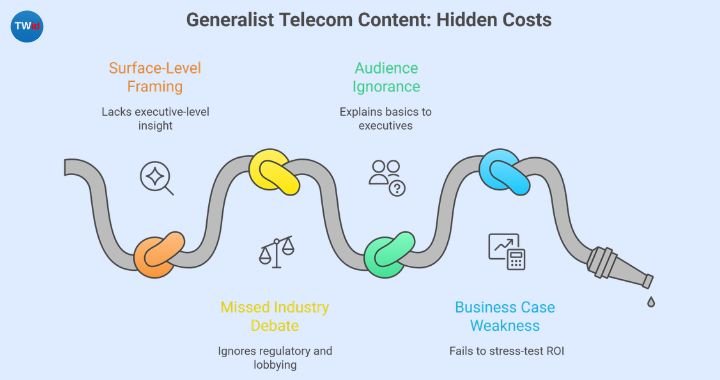
They default to safe, surface-level framing. “FTTH offers faster speeds and higher reliability” is technically true and completely useless to an executive who needs to justify a $400M infrastructure rollout to a board. A specialist would write about take-rate economics, churn reduction at 18 months post-activation, or the ARPU uplift from business service bundling.
They miss the subtext of industry debate. The fiber vs. 5G positioning war isn’t just a technology question — it’s a regulatory, lobbying, and capital allocation battle. A generalist will present “both sides.” A specialist knows which argument wins in which market context, and why.
They don’t know what your audience already knows. Telecom executives don’t need FTTH defined for them. They need their specific dilemmas — overbuild risk, open-access model tradeoffs, vendor lock-in — addressed directly. Content that explains the basics signals immediately that the writer (and by extension, the brand) is not a peer. For a deep look at how this plays out strategically, the analysis on FTTH overbuild strategy illustrates exactly the kind of nuanced thinking your content needs to reflect.
They can’t stress-test a business case. A white paper on FTTH ROI written by a generalist will cite industry averages and stop there. A specialist will stress-test the model — adjusting for homes-passed density, construction cost variance by terrain, and the difference between anchor tenant and open-access revenue assumptions.
The Real Cost: Authority Erosion and Missed Opportunities
Weak content doesn’t just fail to generate leads. It actively damages your brand’s positioning.
In the FTTH sector, thought leadership is a trust currency. Investors, regulators, and potential partners use your public content — LinkedIn posts, white papers, bylined articles — to assess whether your leadership team truly understands the market. Content that sounds generic signals one thing: you hired a generalist.
The compounding effect is significant. Every surface-level post is a missed opportunity to own a positioning angle. Every vague white paper is a conversation your competitor is having instead. Over 12 months of consistent generalist content, you’ve produced volume — but not authority.
What a Specialist Telecom Content Writer Actually Brings?
A specialist telecom content writer isn’t just a better researcher. They bring applied knowledge that changes the quality of strategic output.
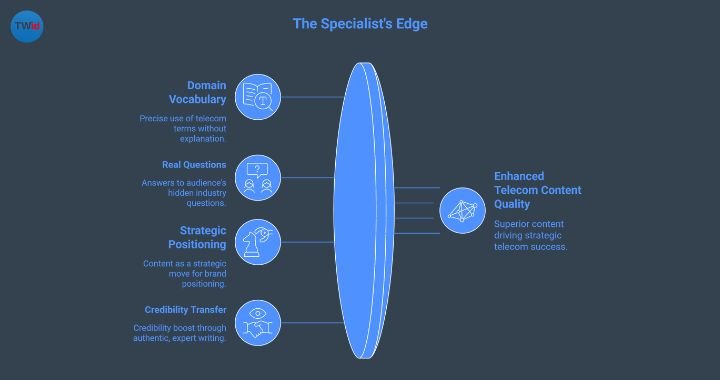
Domain vocabulary without the learning curve. Terms like XGS-PON, OSS/BSS integration, IRR on passive infrastructure, or wholesale open-access models don’t need explaining. They need to be deployed precisely, in context, in a way that signals fluency to a technical audience.
Access to the real questions. The most valuable content answers questions your audience is actually asking behind closed doors: Is open-access FTTH economics viable in a competitive market? What’s the break-even take-rate for a Tier 2 operator in a greenfield deployment?
These questions require a writer who has absorbed the industry’s real debates — not just its press releases. The economics around models like open-access FTTH are nuanced enough that getting them wrong in a published piece is worse than not publishing at all.
Strategic positioning, not just information delivery. A specialist writer understands that every piece of content is a positioning move. A post on CapEx optimization isn’t just informational — it positions your firm as the operator that controls costs without compromising on network quality. That’s the difference between content that generates impressions and content that generates inbound interest from investors.
Credibility transfer. When a bylined article from your CEO reads like it was written by someone who has sat in the room during an FTTH deployment decision — not someone who Googled “what is fiber optic cable” before drafting — it transfers credibility to your brand at scale.
How to Identify a Specialist Telecom Content Writer
Not every writer who claims telecom expertise has it. Here’s how to filter effectively:
Give them a technical brief and read the questions they ask. A generalist will ask about tone and word count. A specialist will ask about your deployment model, your target investor profile, and whether your audience is operator-side or investor-side.
Test with a real scenario. Ask them to outline an article on “the business case for open-access FTTH in a competitive overbuild market.” A generalist will produce a generic structure. A specialist will immediately start mapping stakeholder incentives, revenue share models, and regulatory context.
Check their existing work for technical specificity. Look for content that uses precise industry figures, engages with real market debates, and is structured for a senior audience — not a general technology readership.
Ask about their industry sources. Do they follow FTTH Council publications? Are they familiar with IDATE Digiworld reports, or Analysys Mason research? Do they track regulatory developments in your target market? These signals separate writers who have studied the industry from those who are willing to study it.
The Positioning Advantage of Getting This Right
The telecom brands that will dominate thought leadership over the next three years are the ones building content authority now — before the market matures and the noise increases.
A specialist telecom content writer isn’t a line item. They’re a competitive asset. They help your executives sound like the recognized voices they need to be. They turn technical depth into market credibility. And they produce content that your audience — investors, operators, procurement teams — actually reads, shares, and cites.
The generalist option costs less upfront. Over 12 months of compounding brand positioning, it costs significantly more.
If your content strategy is built around writers who describe your industry instead of writers who understand it — it’s time to reconsider the brief.
What Does an FTTH Ghostwriter Actually Do? (And Why Telecom Brands Are Hiring One Now)
Most fiber executives have more domain knowledge than any content agency they’ll ever hire. They’ve lived through deployment nightmares, CapEx battles, and regulatory rewrites. They know the difference between GPON and XGS-PON — and why it matters.
Yet their LinkedIn sits empty. Their insights never reach the investors, operators, or procurement teams who are actively searching for credible voices in the FTTH space.
That gap — between deep expertise and public visibility — is exactly what an FTTH ghostwriter is built to close. This article explains what that role actually involves, what it doesn’t, and why a growing number of telecom brands are making it a strategic priority right now.
The Problem No One in FTTH Talks About
There is no shortage of FTTH expertise in the market. What’s missing is the translation of that expertise into content that builds authority, attracts deals, and positions a professional as a go-to voice in the industry.
The challenge has three layers:
Generic writers can’t speak the language. A content generalist handed a brief on passive optical network architecture, CapEx optimization, or regulatory compliance frameworks will produce surface-level content that educated FTTH audiences will see through immediately. Credibility requires technical fluency — not just a willingness to Google.
Executives don’t have time to write. A CEO overseeing a multi-region fiber rollout isn’t sitting down on Wednesday afternoon to draft a 1,500-word LinkedIn article on deployment frameworks. The insight exists; the bandwidth to communicate it doesn’t.
The credibility gap has real commercial consequences. When decision-makers — investors, procurement leads, board members — can’t find your thinking online, they default to whoever they can find. In a sector growing as fast as FTTH, the window to establish a visible position is narrowing.
What Is an FTTH Ghostwriter — A Clear Definition
An FTTH ghostwriter is a specialist writer with deep knowledge of the fiber-to-the-home industry who creates authoritative content under another person’s name or brand — translating technical expertise into strategic narratives that build thought leadership, attract business opportunities, and influence industry conversations.
They are not a generalist copywriter who can “research any topic.” They are not a PR agency producing press releases. They are not a content mill generating keyword-stuffed blog posts.
The role sits at the intersection of three capabilities:
Strategic communications — knowing which insights matter to which audience (C-suite vs. investor vs. operator vs. regulator) and how to frame them
Content craft — producing writing that is clear, credible, and compelling enough to hold the attention of busy executives who read a lot
Remove any one of these three, and what you have is not an FTTH ghostwriter — it’s something cheaper that will produce cheaper results.
The 4 Core Things an FTTH Ghostwriter Actually Does
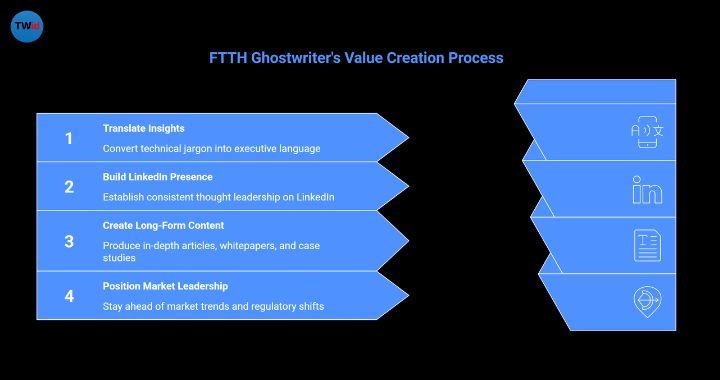
1. Translates Technical Depth Into Executive-Ready Narratives
The most valuable insights in the FTTH industry live inside the heads of people who are too close to them to communicate them clearly to outsiders.
An FTTH ghostwriter extracts that knowledge through structured conversations, interviews, or written briefings — and turns it into content that lands with an executive audience. That means stripping out the internal jargon, adding strategic context, and building arguments that connect technical decisions to business outcomes.
A piece about network design optimization becomes a post about how the right architecture decisions today protect margin over a 10-year asset horizon. A comment about vendor selection becomes an article about the hidden costs of procurement shortcuts that don’t show up until year three of deployment.
2. Builds a Consistent LinkedIn Thought Leadership Presence
LinkedIn is where FTTH decision-makers are spending attention right now. According to the 2024 Edelman–LinkedIn B2B Thought Leadership Impact Report, 73% of B2B decision-makers say an organization’s thought leadership is a more trustworthy basis for assessing its capabilities than its marketing materials. Another 75% say a piece of thought leadership has directly led them to research a product or service they were not previously considering.
That is not a content marketing statistic. That is a pipeline statistic.
An FTTH ghostwriter develops and executes a LinkedIn content strategy: consistent posting cadence, format variation (long-form posts, carousels, short takes, industry commentary), and an editorial angle that builds a recognizable point of view over time. Consistency is what converts visibility into authority.
3. Creates Long-Form Authority Content — Articles, Whitepapers, Case Studies
Not all thought leadership lives in social posts. Some of the highest-value content in the FTTH space takes longer form:
In-depth LinkedIn articles that anchor a subject matter position
Whitepapers used in investor relations or enterprise sales conversations
Case studies that demonstrate deployment or strategy outcomes
Industry commentary pieces submitted to trade publications
An FTTH ghostwriter manages the full production of these assets — from structuring the argument to final copy — while keeping the voice and perspective unmistakably the client’s.
The FTTH market is moving fast. The global market was valued at USD 12.5 billion in 2024 and is forecast to reach USD 41.3 billion by 2033 — a 14.2% CAGR (Market Size and Trends, 2024). Capital is flowing in. Competition for operator mindshare, investor attention, and partnership opportunities is intensifying.
An FTTH ghostwriter tracks what’s happening in the market — regulatory shifts, overbuild dynamics, technology evolution, M&A activity — and turns it into content that positions their client as a forward-thinking voice rather than a reactive one. The goal is to be the person others cite when these topics come up, not the person who comments after the conversation has already happened.
Why Telecom Brands Are Hiring FTTH Ghostwriters Now?
Several forces have converged to make this a particularly high-priority investment in 2025 and 2026.
The infrastructure boom has created a content demand surge. As more capital enters the fiber space — from infrastructure funds, sovereign wealth vehicles, and strategic operators — buyers at every level are looking for credible insight to guide decisions. The voices that fill that demand now will hold their positions for years.
LinkedIn’s algorithm is rewarding personal executive content. Platform-level reach for personal profiles significantly outperforms company page content on LinkedIn. Executives who publish consistently are reaching audiences their corporate communications teams never could.
The AI content flood has raised the premium on genuine expertise. As generic AI-generated content proliferates, audiences are becoming better at identifying — and discounting — surface-level takes. Authentic, technically grounded content from someone who has actually navigated FTTH deployment, financing, or regulation stands out precisely because it cannot be replicated by a prompt.
The competitive window is not permanent. A handful of FTTH professionals are already building visible platforms. For operators evaluating their competitive positioning against overbuilders, this dynamic is worth understanding — see FTTH Overbuild Strategy — And the Five Moves That Win.
What Separates a True FTTH Ghostwriter From a Generic Writer?
If you are evaluating whether a writer has what it takes to produce credible FTTH content, the following questions will tell you quickly:
Technical depth: Can they explain the difference between GPON and XGS-PON without looking it up? Do they understand why CapEx per home passed varies so dramatically across deployment environments? Can they speak credibly about the tradeoffs in choosing between a retail, wholesale, or open-access FTTH model?
Audience fluency: Can they write the same topic differently for an infrastructure investor, a local government procurement lead, and a telecom operator CFO — because those audiences have fundamentally different priorities?
Thought leadership track record: Have they produced content that builds someone’s position, not just their visibility? There is a meaningful difference between writing that generates likes and writing that generates inbound conversations from qualified buyers.
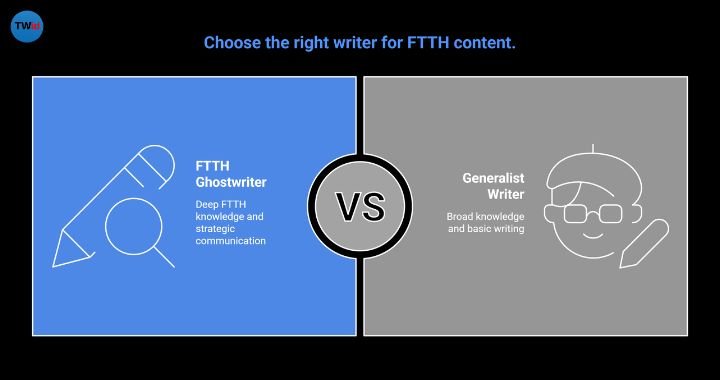
A generalist writer can be trained on FTTH basics. A true FTTH ghostwriter brings the technical and strategic context that makes content credible to an expert audience — and that distinction shows up immediately in the quality of the output.
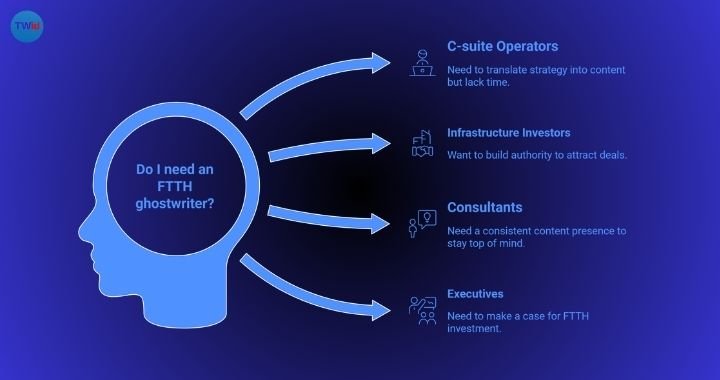
Who Actually Needs an FTTH Ghostwriter?
The answer is more specific than “anyone in telecom.” The clients who get the most value from this engagement share a common profile:
C-suite operators managing rollout or scale who have clear thinking on strategy, deployment, or market positioning but zero time to translate that thinking into content.
Infrastructure investors and fund managers who want to build personal authority in the fiber space to attract deal flow and LP confidence.
Consultants and advisors who monetize expertise but need a consistent content presence to stay top of mind between engagements.
Executives making the case internally or externally for FTTH investment — whether that’s a business case for the board, a market positioning piece for investors, or public commentary on topics like how to grow fiber ARPU without spiking churn.
The common thread: they have the knowledge. What they need is someone who can turn that knowledge into content that works.
Frequently Asked Questions
Is ghostwriting ethical in the B2B space?
Ghostwriting has been standard practice in publishing, politics, and business communications for decades. In B2B, the convention is well established — executives work with speechwriters, communications advisors, and content specialists routinely. What matters is that the ideas and perspectives are genuinely the client’s. A good FTTH ghostwriter surfaces and articulates the client’s actual thinking; they do not fabricate positions.
How does an FTTH ghostwriter learn my voice?
Through an onboarding process that typically involves structured interviews, review of existing written or spoken material (presentations, emails, past articles), and iterative drafting where feedback calibrates tone, depth, and preferred framing. After three to five pieces, the voice alignment is usually tight.
What content formats does an FTTH ghostwriter produce?
LinkedIn posts (short-form, long-form, and carousel scripts), LinkedIn articles, whitepapers, industry commentary, trade publication submissions, executive bios, and speaking proposal abstracts. The format mix depends on the client’s goals and audience.
Get 2 Free Pieces of FTTH Content — No Commitment
The fastest way to evaluate whether this approach works for your situation is to see it in action with your own ideas and voice.
Here’s the offer: Share your perspective on one FTTH topic — a trend you’re watching, a deployment challenge you’ve navigated, a strategic position you hold — and receive two fully developed content pieces, written in your voice, ready to publish.
No pitch. No retainer conversation unless you want one. Just content that demonstrates what’s possible.