8 Ways FTTH Operators Can Increase Take-Rate in Homes Passed
Homes Passed is a deployment milestone. It is not a growth strategy.
For FTTH operators, the real commercial test begins after the network is live: converting homes passed into active, revenue-generating subscribers at a rate that supports payback, margin, and long-term network expansion.
That is where many operators encounter a performance gap. The footprint is in place, the addressable base is real, and service is technically available, yet subscriber uptake lags expectations. In most cases, the problem is not coverage. It is a conversion.
Low take-rate in already homes passed typically reflects a mix of commercial, operational, and go-to-market issues. Households may not know that fiber internet is available. They may not see enough economic or service value to switch. They may begin the purchase journey and drop out because the digital path or installation process introduces too much friction.
For operators, this is one of the highest-leverage opportunities in the business. Increasing take-rate within the existing footprint usually delivers a better near-term return than pursuing incremental build in new areas. It improves capital efficiency, strengthens the business case for future deployment, and drives better monetization from infrastructure that has already been funded and built.
This article outlines why homes passed fail to convert and how FTTH operators can systematically improve take-rate through better segmentation, sharper positioning, cleaner offer design, stronger conversion paths, and tighter install execution.
What take-rate mean in FTTH
In FTTH, the take-rate is the percentage of homes passed by the network that become active subscribers.
If an operator passes 20,000 homes and 7,000 subscribe, the take-rate is 35%.
From an operator standpoint, take-rate is not just a commercial KPI. It is a core measure of network monetization. Homes passed indicate reach. Take-rate indicates whether that reach is translating into cash flow, customer base growth, and a viable return on invested capital.
This distinction matters. Network build metrics can create the appearance of momentum, but they do not by themselves improve unit economics. A stronger take-rate does. It raises revenue density within the footprint, improves capital productivity, and can materially shorten payback periods at the cohort or market level.
For that reason, operators looking to improve growth performance should treat take-rate improvement in already homes passed as a strategic priority rather than a secondary sales metric.
Why already homes passed still not convert
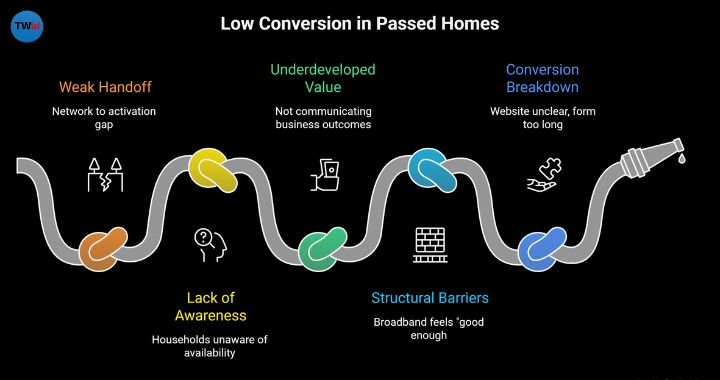
Most low-conversion footprints do not suffer from a single problem. They suffer from a weak handoff between network availability and customer activation.
In some markets, the issue is awareness. Fiber is available, but the household either does not know it or does not fully understand that service is available at their exact address. In others, awareness exists, but the value proposition is underdeveloped. The operator communicates speed, but not business outcomes or everyday customer relevance.
There are also structural barriers to switching. Households may already have broadband that feels “good enough.” Without a clear trigger, price advantage, service differentiation, or trust signal, inertia wins. This is especially true in markets where incumbents have strong brand familiarity or where operators rely on generic messaging such as “faster internet” without making the operational superiority of fiber tangible.
Conversion often breaks down even later in the funnel. The address is serviceable, the lead is interested, and the order journey begins, but the website is unclear, the form is too long, or installation introduces delay and uncertainty. In those cases, demand exists, but the operator fails to capture it.
The result is a monetization shortfall inside a footprint that should be producing more value.
How FTTH operators can increase take-rate in already passed homes
1. Move from footprint-wide marketing to micro-market prioritization
One of the most common commercial mistakes in FTTH is treating all homes passed as equally convertible.
They are not.
Conversion propensity varies significantly by neighborhood, housing type, competitive dynamics, household profile, previous campaign response, service pain points, and even local word-of-mouth. Operators that market uniformly across the entire footprint often dilute budget and message precision.
A better approach is micro-market prioritization.
Identify the pockets with the highest probability of conversion and allocate acquisition resources accordingly. That may include neighborhoods with weak incumbent satisfaction, strong upload-related use cases, recent move-in activity, high remote-work concentration, or stronger historical response to fiber availability campaigns.
This improves more than efficiency. It creates a better operating model for learning. Instead of asking which general campaign worked, operators can measure which combination of segment, message, offer, and channel produced the strongest lift in a specific cluster and then scale that logic across the footprint.
2. Position fiber internet around customer outcomes, not network terminology
Operators understand the technical value of fiber. Most households do not buy on technical architecture.
They buy on outcomes.
That means the commercial message should begin with confirmed availability and quickly translate that availability into practical value: higher reliability, better upload performance, smoother streaming, stronger work-from-home performance, and less service degradation under multi-device usage.
Too many FTTH campaigns still sound like product sheets.
They emphasize infrastructure language that may be accurate but does little to change behavior. Stronger-performing operators frame the offer around why switching improves the customer’s daily experience and why it is worth making the move now.
In commercial terms, this is a positioning issue. If the message does not create a meaningful perception gap between fiber and current service, the take-rate will remain below potential even in fully passed areas.
3. Simplify plan architecture and reduce decision friction
A passed home does not need more options. It needs a clear reason to convert.
Complex plan structures, layered promotional language, installation disclaimers, and too many speed-tier decisions can reduce response rates even when the product is highly competitive. Every extra decision introduces delay and increases the chance that the prospect defers action.
Operators generally perform better when they streamline plan presentation and lead with one clearly positioned hero offer. That offer should make three things immediately obvious: what the customer gets, what it costs, and what is required to get started.
This does not mean sacrificing segmentation or ARPU strategy. It means reducing early-stage friction in the acquisition funnel. Once the household is engaged, upsell logic and packaging flexibility can still play a role. But at the point of conversion, simplicity is often a commercial advantage.
4. Treat installation as a conversion lever, not a downstream function
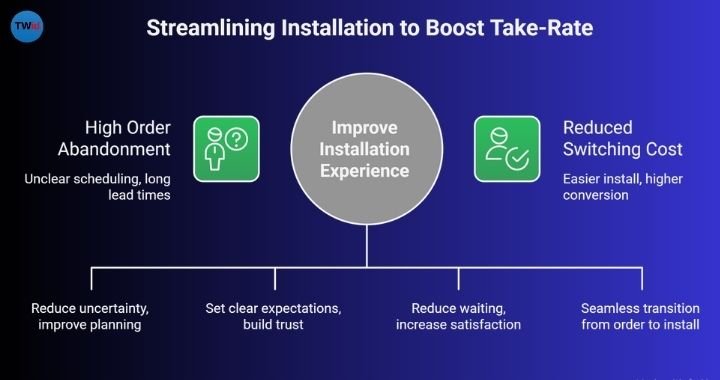
Operators often think about installation as a service delivery issue. In reality, it is also a sales issue.
A household that submits an order but faces unclear scheduling, long lead times, poor communication, or multiple reschedules is still at risk of non-conversion. In many footprints, the gap between order intent and service activation is where take-rate underperforms.
Operators that improve take-rate tend to reduce friction between order and install. That includes tighter appointment windows, better pre-install communication, clearer customer expectations, faster activation timelines, and stronger coordination between sales and field operations.
The operational logic is straightforward: the easier the install experience feels, the lower the perceived switching cost. When switching cost drops, conversion tends to rise.
This is especially important in competitive markets where the incumbent can retain a customer simply because changing providers looks inconvenient.
5. Build local proof and neighborhood credibility
Fiber adoption is often hyperlocal. Trust is built at the neighborhood level before it scales at the market level.
For already passed homes, that makes local proof a significant commercial asset. Households are more likely to convert when the service feels established nearby, not merely available in theory. Testimonials, neighborhood-specific case studies, local signage, community references, and “now live on your street” messaging all help reduce perceived risk.
This is not just branding. It directly affects conversion behavior. In many cases, households hesitate not because they object to fiber internet, but because they do not yet feel confident enough to switch from a known provider. Local validation shortens that trust gap.
Operators that succeed here create a sense of momentum within the footprint. The offer becomes less about a new utility choice and more about an upgrade already being adopted by nearby households.
6. Align acquisition efforts with switch-ready moments
Demand for fiber internet is not evenly distributed across time.
Households become more receptive to switching during specific moments: a move, a lease renewal, back-to-school, a work-from-home change, a service outage with the incumbent, or a billing increase from the current provider. Operators that identify and act on these triggers typically see stronger conversion than those running static messaging year-round.
This is where lifecycle thinking becomes important. Homes Passed should not be treated as a one-time launch audience. They should be managed as an addressable conversion base with varying readiness states.
An operator that tracks and re-engages prior non-converters, availability-check users, abandoned orders, and recently homes passed can create much more relevant outreach sequences. That increases acquisition efficiency and often improves take-rate without meaningfully increasing market-level spend.
7. Improve the digital path from availability check to order
In many FTTH footprints, digital execution is an overlooked bottleneck.
The address checker is slow. The availability message is ambiguous. The landing page introduces too much copy before confirming relevance. The form requests too much information upfront. The call to action is weak. Each of these points increases drop-off.
From an operator perspective, this is a conversion-rate optimization problem. Once a household is aware that fiber is available, the path to order needs to be fast, credible, and low-friction. The core digital journey should confirm serviceability, communicate value quickly, show straightforward pricing, and move the prospect toward order completion with minimal distraction.
Mobile performance matters as well. A meaningful share of availability searches and initial consideration happens on mobile devices. If that experience is poor, the funnel will underperform even when upstream marketing is effective.
8. Continue marketing to non-converted passed homes
Low initial response should not be interpreted as zero demand.
Many operators underinvest after the launch window. They send one or two awareness pushes, measure early take-rate, and then shift focus elsewhere. That leaves a large amount of value in the existing footprint.
Homes passed that did not convert on first exposure remain highly relevant prospects. They may have had no immediate trigger, they may have lacked confidence in switching, or they may simply have needed a better message, offer, or reminder. Follow-up through direct mail, retargeting, email, field sales, or localized digital campaigns can materially improve cumulative take-rate over time.
From a unit-economics standpoint, this is attractive. The network is already in place. The address is known. The main challenge is conversion timing and execution.
Operators that treat passed-home acquisition as an ongoing program rather than a launch event generally extract more value from the same footprint.
A 90-day operating plan to improve take-rate
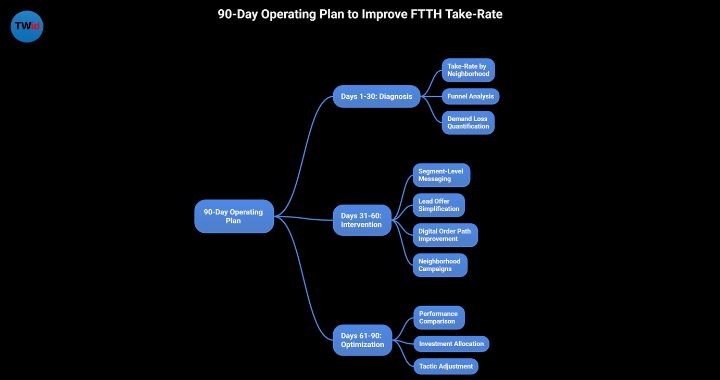
For operators looking to improve performance quickly, a structured 90-day approach is often more effective than broad transformation language.
In the first 30 days, the objective is diagnosis. Analyze take-rate by neighborhood, identify the highest and lowest converting segments, review the funnel from awareness to install, and quantify where demand is being lost. This includes digital drop-off, order abandonment, install delays, and segment-specific underperformance.
In days 31 through 60, operators should activate targeted interventions. Refine segment-level messaging, simplify the lead offer, improve the digital order path, and address major installation pain points. At the same time, launch neighborhood-based campaigns where conversion lift is most likely.
In days 61 through 90, the focus should shift to optimization and scale. Compare performance by message, offer, geography, and channel. Increase investment behind the highest-converting plays. Pull back from tactics that are not producing movement in take-rate or downstream activation metrics.
This type of program creates operational discipline around what is otherwise often treated as a marketing problem alone.
The KPIs operators should track
To improve take-rate, operators need to measure more than coverage and gross adds.
The relevant KPI set should include take-rate by cluster, availability-check-to-order conversion, order-to-install completion rate, install lead time, channel-level acquisition cost, cohort-level payback signals, and early churn.
These metrics help isolate whether the core constraint is awareness, value proposition, funnel friction, or service delivery. Without that visibility, operators risk overspending on top-of-funnel acquisition while the actual conversion bottleneck remains unresolved.
A high-performing FTTH commercial model depends on linking these metrics across the full path from passed home to active subscriber.
Common operator mistakes that suppress take-rate
Several issues consistently show up in underperforming footprints.
The first is overreliance on generic broadband messaging that fails to differentiate fiber internet in a meaningful way. The second is weak segmentation, where operators spread acquisition effort evenly across the entire footprint instead of concentrating on higher-propensity clusters.
The third is excessive offer complexity. The fourth is operational misalignment between sales and installation. The fifth is underinvestment in follow-up after launch, which leaves passed but non-converted homes under-addressed for too long.
In most cases, low take-rate is not the result of insufficient network quality. It is the result of insufficient commercial precision and execution discipline.
Conclusion
For FTTH operators, the most attractive growth opportunity is not always outside the current footprint. Very often, it is inside it.
Already-homes passed represent sunk deployment costs and unrealized revenue potential. Improving take-rate in that base can strengthen network economics faster than incremental expansion alone, particularly in markets where the commercial infrastructure for conversion is weaker than the physical infrastructure for delivery.
Operators that outperform on take-rate usually do the same few things well. They prioritize the right neighborhoods, sharpen the value proposition, simplify the acquisition journey, reduce installation friction, and keep working homes passed beyond the initial launch period.
The commercial objective is clear: convert coverage into cash flow. The operators that do that consistently will build stronger economics, better market credibility, and more flexibility for future expansion.
FAQ
What is a good FTTH take-rate in passed homes?
A good FTTH take-rate varies by market structure, incumbent competition, price positioning, time since launch, and execution quality. From an operator perspective, the more useful question is whether take-rate is tracking in line with the original business case and improving over time within each cohort, neighborhood, or build phase. Sustainable improvement matters more than a single benchmark number viewed in isolation.
Why do homes passed fail to convert to fiber subscribers?
Homes passed typically fail to convert because of a mix of low awareness, weak differentiation, customer inertia, poor timing, digital drop-off, or installation friction. In many cases, the issue is not the demand for better broadband. It is that the operator has not yet made the switching decision feel urgent, simple, and low-risk.
How can FTTH operators market fiber more effectively in competitive areas?
Operators tend to perform better when they move away from generic speed claims and focus on localized, outcome-based positioning. Confirmed address availability, neighborhood relevance, proof from nearby subscribers, and simple offers generally perform better than broad technical messaging. In competitive areas, the goal is not just awareness. It is perceived superiority plus ease of switching.
Does installation speed affect FTTH take-rate?
Yes. Installation speed and predictability can materially affect conversion performance. The longer and less certain the activation process feels, the greater the risk that a household will delay or cancel the switch. Operators that reduce install lead time and improve customer communication often see better completion rates and stronger overall take-rate.
What channels work best for increasing fiber adoption?
The highest-performing channel mix varies by market, but strong FTTH acquisition programs usually combine direct mail, paid digital, retargeting, localized landing pages, lifecycle email, and neighborhood-level field or community activity. The most effective programs are coordinated across channels and built around a consistent message tied to address-level availability and clear customer value.