Why a Fiber Optic Copywriter Is the Competitive Edge FTTH Executives Are Overlooking
The global FTTH market was valued at $56 billion in 2024 and is racing toward $110 billion by 2030. Deployment records are being broken every year. Capital is flowing in. Infrastructure is scaling fast.
And yet — most fiber operators still sound exactly the same when they talk to investors, partners, and prospective customers.
That’s the gap a skilled fiber optic copywriter closes. Not a generalist content vendor who learns the industry from a Wikipedia article, but a specialist who understands passive optical networks, take-rate economics, and the competitive dynamics of overbuilding markets — and can translate all of it into words that move the right people to act.
If you’re a C-suite executive or infrastructure investment lead navigating FTTH growth, this post breaks down exactly what this role involves, why it matters now more than ever, and how to find or evaluate one.
What a Fiber Optic Copywriter Actually Does (And What They Don’t)
Let’s clear something up: a fiber optic copywriter is not a technical writer producing installation manuals. And they’re not a general marketing copywriter who can be briefed on PON architecture in a 30-minute call.
This is a specialist who operates at the intersection of technical fluency and strategic communication. Their core job is to take complex FTTH concepts — deployment frameworks, open-access economics, ROI models — and transform them into clear, credible, and compelling content that resonates with your target audience.
What they typically produce:
- Executive thought leadership articles and LinkedIn content
- Investor decks and white papers explaining FTTH business cases
- Website copy for ISPs, network operators, and infrastructure funds
- Case studies and deal narratives for RFPs and procurement processes
- Email campaigns targeting enterprise and government buyers
- Technical blog posts that build authority with engineering and procurement audiences
The key differentiator is credibility. When your content accurately references XGS-PON upgrade paths, discusses the economics of open-access versus retail models, or addresses real deployment cost pressures — readers who know the industry feel it. That trust converts.
Why Generalist Copywriters Can’t Fill This Role?

Here’s the honest reality: most copywriters will agree to write about FTTH, then deliver content that’s structurally fine and factually hollow.
They’ll write “fiber optic networks deliver faster speeds” when your audience already knows that. They won’t write about the trade-offs between GPON and XGS-PON when upgrading capacity in a dense urban deployment. They won’t frame a funding pitch in terms of BEAD compliance and IRR sensitivities.
The FTTH industry has a sophisticated readership. Your buyers — whether they’re telecom procurement teams, PE fund managers, or municipal broadband leads — can spot surface-level content immediately. And when they do, it reflects on your brand’s credibility, not just your marketing department.
A fiber optic copywriter brings domain knowledge that eliminates this risk. They’ve absorbed the regulatory landscape, understand the vendor ecosystem, and know why take rates matter more than homes passed when evaluating a deployment’s commercial success.
The Market Opportunity That Makes Specialized FTTH Content Critical Right Now
The numbers explain the urgency.
According to the Fiber Broadband Association’s 2025 Annual Deployment Survey, the U.S. fiber industry passed 11.8 million additional homes in 2025 alone — bringing the national total to 98.3 million passings. Fiber now reaches over 60% of U.S. households.
Meanwhile, Grand View Research projects the global FTTH market to grow at a 12.4% CAGR from 2025 to 2030, reaching $110.44 billion. The restoration of 100% bonus depreciation in 2026 is expected to fuel a 5–15% increase in FTTH capital expenditure.
What this means in practical terms: competition for capital, talent, partnerships, and customers is intensifying at every level of the fiber stack. Operators that communicate their value clearly — to investors, to municipalities, to enterprise buyers — will command better terms, faster deal cycles, and stronger brand positioning.
Content is no longer a “nice to have” in this environment. It’s a commercial tool. And a fiber optic copywriter who understands how to frame your competitive positioning is the person who makes that tool sharp.
Four Qualities That Separate Elite FTTH Copywriters From Average Ones
When you’re evaluating a fiber optic copywriter — whether to hire one, contract one, or work with a ghostwriter who specializes in the space — here’s what to look for:
1. Demonstrated technical fluency They should be able to discuss the difference between GPON and XGS-PON without prompting, understand what open-access means for revenue yield, and know what ARPU optimization looks like in a mature fiber market. Ask them a technical question early in your evaluation. If they can’t go deep, they’ll produce shallow content.
2. Audience awareness at the executive level Strong FTTH copywriters write differently for a CFO than for a network operations director. They understand that an investment committee wants IRR and payback period framing, while a CTO wants architectural clarity. Tone, vocabulary, and emphasis shift accordingly.
3. A track record in regulated or capital-intensive industries FTTH isn’t just a technology play — it’s infrastructure, regulation, and capital allocation. Writers with backgrounds in energy infrastructure, regulated utilities, or structured finance often make the transition well. Their instincts for precision and risk-framing are already calibrated.
4. The ability to build narrative, not just explain features The best FTTH copywriters don’t just describe your product or service. They build a story about market inevitability, competitive moat, and strategic timing. This is the difference between content that informs and content that motivates.
How FTTH Operators Are Using Specialized Content Today?
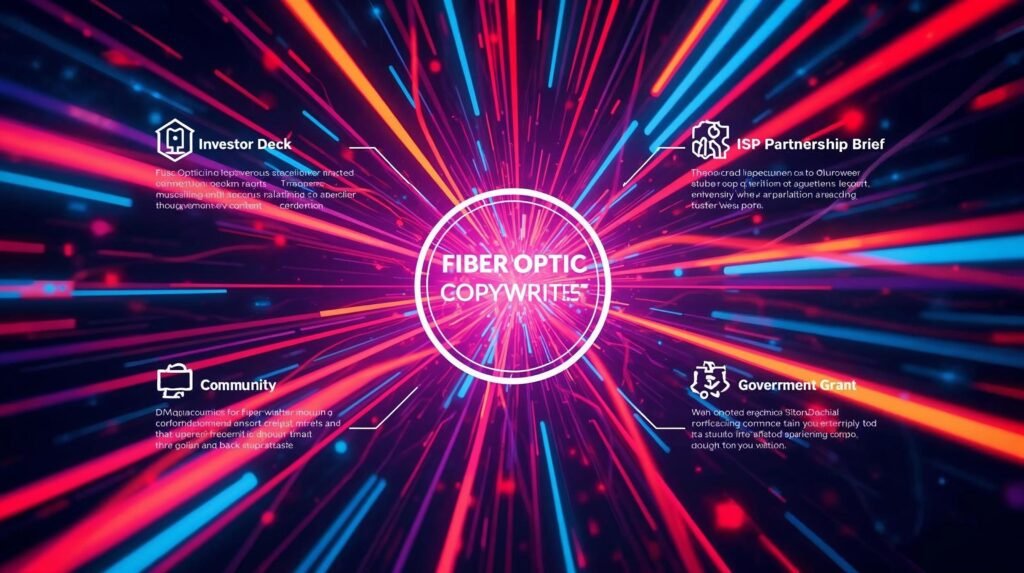
This isn’t theoretical. Operators and infrastructure investors are already using specialized content as a strategic lever — here’s how it typically plays out across the business:
Investor relations and capital raising: Detailed white papers and market positioning decks help PE firms and infrastructure funds understand why a specific operator’s deployment model, geography, or technology choices justify premium valuation.
Partnership development: ISPs entering open-access networks need to make a compelling case to network operators. Well-written partnership briefs and model explanations accelerate deal structuring. If you’re thinking through that dynamic, this breakdown of how to structure FTTH ISP partnerships on open-access networks is worth reviewing before your next conversation with a prospective partner.
Customer acquisition in overbuilt markets: As overbuild scenarios become more common, take-rate competition is real. Content that clearly communicates service quality differences, community investment, and long-term reliability — aimed at residential and enterprise buyers — directly influences subscriber adoption. This is especially relevant given the five strategic moves that win in overbuilt markets, where brand differentiation through content plays a measurable role.
Regulatory and government relations: Municipal broadband initiatives, BEAD grant applications, and state broadband office presentations all require clear, structured narrative. A fiber optic copywriter who understands government procurement language is an underutilized asset here.
What to Expect When You Engage a Fiber Optic Copywriter?
If you haven’t worked with a specialist FTTH writer before, here’s a realistic picture of the engagement:
Onboarding takes depth. A good fiber optic copywriter will ask detailed questions about your network architecture, target markets, competitive environment, and strategic priorities. This isn’t inefficiency — it’s how they produce content that sounds like it came from your organization, not a vendor.
Output cadence matters. For thought leadership programs, consistency beats volume. Three high-quality executive posts per month on LinkedIn, paired with one long-form article or white paper per quarter, typically outperforms a burst-and-fade content strategy.
Ghostwriting is the norm. Most senior executives in the FTTH space don’t write their own content — but they do own their ideas and positioning. A skilled fiber optic copywriter functions as a strategic ghostwriter: they interview you, extract your perspective, and produce content that reflects your voice at the quality level your reputation demands.
Measurement is possible. Unlike general PR, specialized content in FTTH produces trackable outcomes: inbound investor inquiries, speaking invitations, partnership conversations initiated by your content, and talent attraction from candidates who followed your thought leadership.
5 FAQs: Fiber Optic Copywriter
What’s the difference between a fiber optic copywriter and a telecom content writer?
A telecom content writer often covers the full spectrum of communications technology — mobile, cable, satellite, enterprise networking. A fiber optic copywriter is specifically focused on fiber infrastructure, which means deeper expertise in FTTH/FTTP deployment, passive optical networks, broadband economics, and the regulatory environment that governs fiber rollout. For FTTH executives and investors, this specialization produces materially better content outcomes.
Do I need a fiber optic copywriter on staff, or can I use a freelancer or ghostwriting service?
Most FTTH operators don’t need a full-time copywriter on staff. A specialized freelance ghostwriter or boutique content service that focuses on fiber and telecom infrastructure will typically deliver higher quality at better cost efficiency than a generalist marketing hire. The key is finding someone with verifiable FTTH knowledge — not just a content agency claiming “we work with tech clients.”
How does a fiber optic copywriter handle technical accuracy?
A strong specialist will establish a review process with your technical or product team before content goes live. They’ll flag assumptions, source claims from credible industry data, and build a fact-check step into the workflow. Many also maintain ongoing relationships with subject matter experts in network engineering and regulatory affairs to keep their knowledge current.
What budget should an FTTH operator expect for a specialized copywriter?
Rates vary by scope, but quality specialists who understand fiber infrastructure typically charge $150–$350 per hour for ghostwriting and strategic advisory work, or project rates starting around $1,500–$3,000 for a comprehensive white paper. Thought leadership retainers (monthly content packages) typically run $2,500–$6,000/month depending on volume and complexity. This is executive-level strategic communication — price accordingly.
How quickly can a fiber optic copywriter get up to speed on our specific operation?
A copywriter with existing FTTH expertise typically needs two to four weeks to understand your specific deployment model, competitive positioning, and voice before producing publication-ready content. This ramp period should include structured interviews with your technical leads and access to existing presentations or pitch materials. Don’t shortcut this — the onboarding investment pays back in content quality throughout the engagement.
Final Thought: The Fiber Industry Is Moving Fast. Your Communication Should Match.
The infrastructure race is real. Capital is competing for the best operators. Communities are evaluating which broadband provider to trust. Investors are comparing narratives as much as they’re comparing financials.
A fiber optic copywriter doesn’t just help you create content — they help you articulate why your approach to FTTH deployment, partnership structuring, and long-term network strategy is the right one for the market moment.
If your communication still sounds generic, it’s not reflecting what you actually know. And that gap is costing you opportunities.
Ready to build a content strategy that matches your infrastructure ambitions? Reach out to TheWriter.id and let’s talk about what specialized FTTH ghostwriting looks like for your organization.