Why a Generalist Copywriter Is Costing Your Telecom Brand Millions (And What to Look for Instead)
You hired a content writer. They write well. Sentences are clean, headlines are punchy, deadlines are met.
And yet — your white papers feel shallow. Your LinkedIn posts don’t spark conversations with fiber investors. Your thought leadership articles could have been written about any industry, by anyone, last Tuesday.
The problem isn’t the writer’s craft. It’s their context.
A generalist copywriter can describe what FTTH is. A specialist telecom content writer understands why an operator chose GPON over XGS-PON, what that decision cost, and how to frame it as a competitive moat for a PE firm doing due diligence. That gap — between describing and understanding — is where telecom brands silently lose deals, partnerships, and market credibility.
The Generalist Writer Problem in Telecom
Most content writers are excellent researchers. They will read your brief, study your website, and produce something accurate. For consumer brands, that’s enough.
Telecom is different.
Your buyers — C-suite executives, infrastructure investors, procurement directors — live inside this industry. They read the IDATE reports. They’ve sat through FTTH Council Europe presentations. They know what a CapEx-per-home-passed figure should look like in Southeast Asia vs. Western Europe.
When your content doesn’t reflect that depth, they notice immediately. Not because a fact is wrong, but because the framing is wrong. A generalist writes about fiber. A specialist writes from inside fiber.
According to nDash, a B2B content platform that matches brands with specialist writers, generalist writers simply cannot provide the level of technical detail that B2B tech audiences expect — and for industries like telecom, that gap directly undermines engagement, leads, and revenue.
What a Generalist Gets Wrong (That You’ll Never Catch in Editing)
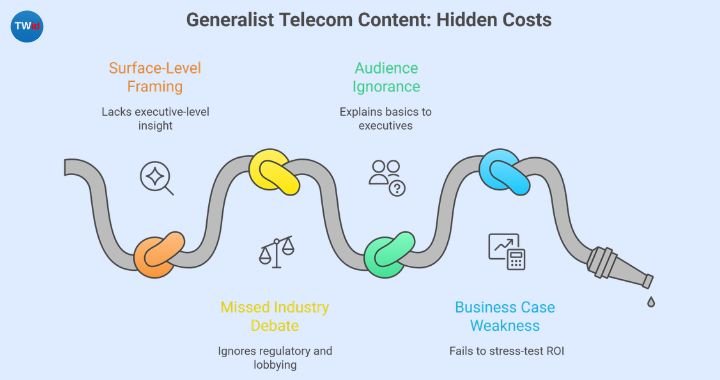
Here’s the hidden cost: most of the damage from a generalist telecom content writer isn’t obvious. You won’t find a factual error to redline. What you’ll find instead is content that reads right but lands wrong.
They default to safe, surface-level framing. “FTTH offers faster speeds and higher reliability” is technically true and completely useless to an executive who needs to justify a $400M infrastructure rollout to a board. A specialist would write about take-rate economics, churn reduction at 18 months post-activation, or the ARPU uplift from business service bundling.
They miss the subtext of industry debate. The fiber vs. 5G positioning war isn’t just a technology question — it’s a regulatory, lobbying, and capital allocation battle. A generalist will present “both sides.” A specialist knows which argument wins in which market context, and why.
They don’t know what your audience already knows. Telecom executives don’t need FTTH defined for them. They need their specific dilemmas — overbuild risk, open-access model tradeoffs, vendor lock-in — addressed directly. Content that explains the basics signals immediately that the writer (and by extension, the brand) is not a peer. For a deep look at how this plays out strategically, the analysis on FTTH overbuild strategy illustrates exactly the kind of nuanced thinking your content needs to reflect.
They can’t stress-test a business case. A white paper on FTTH ROI written by a generalist will cite industry averages and stop there. A specialist will stress-test the model — adjusting for homes-passed density, construction cost variance by terrain, and the difference between anchor tenant and open-access revenue assumptions.
The Real Cost: Authority Erosion and Missed Opportunities
Weak content doesn’t just fail to generate leads. It actively damages your brand’s positioning.
In the FTTH sector, thought leadership is a trust currency. Investors, regulators, and potential partners use your public content — LinkedIn posts, white papers, bylined articles — to assess whether your leadership team truly understands the market. Content that sounds generic signals one thing: you hired a generalist.
IMPACT’s research on specialist vs. generalist content strategy puts it directly: depth beats breadth every time when building content that creates real market traction. In telecom, where deal cycles are long and trust is the primary buying signal, that principle is even more pronounced.
The compounding effect is significant. Every surface-level post is a missed opportunity to own a positioning angle. Every vague white paper is a conversation your competitor is having instead. Over 12 months of consistent generalist content, you’ve produced volume — but not authority.
What a Specialist Telecom Content Writer Actually Brings?
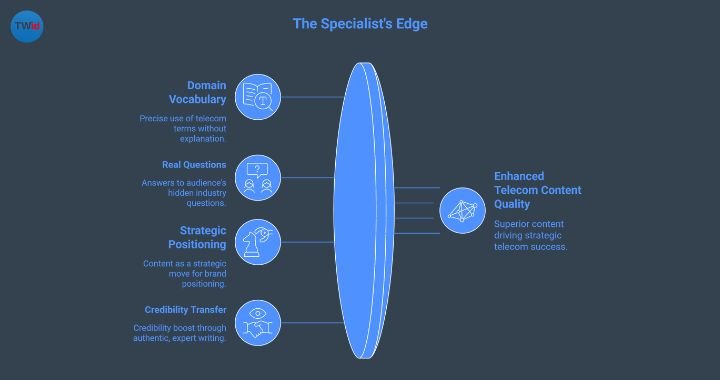
A specialist telecom content writer isn’t just a better researcher. They bring applied knowledge that changes the quality of strategic output.
Domain vocabulary without the learning curve. Terms like XGS-PON, OSS/BSS integration, IRR on passive infrastructure, or wholesale open-access models don’t need explaining. They need to be deployed precisely, in context, in a way that signals fluency to a technical audience.
Access to the real questions. The most valuable content answers questions your audience is actually asking behind closed doors: Is open-access FTTH economics viable in a competitive market? What’s the break-even take-rate for a Tier 2 operator in a greenfield deployment?
These questions require a writer who has absorbed the industry’s real debates — not just its press releases. The economics around models like open-access FTTH are nuanced enough that getting them wrong in a published piece is worse than not publishing at all.
Strategic positioning, not just information delivery. A specialist writer understands that every piece of content is a positioning move. A post on CapEx optimization isn’t just informational — it positions your firm as the operator that controls costs without compromising on network quality. That’s the difference between content that generates impressions and content that generates inbound interest from investors.
Credibility transfer. When a bylined article from your CEO reads like it was written by someone who has sat in the room during an FTTH deployment decision — not someone who Googled “what is fiber optic cable” before drafting — it transfers credibility to your brand at scale.
How to Identify a Specialist Telecom Content Writer
Not every writer who claims telecom expertise has it. Here’s how to filter effectively:
Give them a technical brief and read the questions they ask. A generalist will ask about tone and word count. A specialist will ask about your deployment model, your target investor profile, and whether your audience is operator-side or investor-side.
Test with a real scenario. Ask them to outline an article on “the business case for open-access FTTH in a competitive overbuild market.” A generalist will produce a generic structure. A specialist will immediately start mapping stakeholder incentives, revenue share models, and regulatory context.
Check their existing work for technical specificity. Look for content that uses precise industry figures, engages with real market debates, and is structured for a senior audience — not a general technology readership.
Ask about their industry sources. Do they follow FTTH Council publications? Are they familiar with IDATE Digiworld reports, or Analysys Mason research? Do they track regulatory developments in your target market? These signals separate writers who have studied the industry from those who are willing to study it.
The Positioning Advantage of Getting This Right
The telecom brands that will dominate thought leadership over the next three years are the ones building content authority now — before the market matures and the noise increases.
A specialist telecom content writer isn’t a line item. They’re a competitive asset. They help your executives sound like the recognized voices they need to be. They turn technical depth into market credibility. And they produce content that your audience — investors, operators, procurement teams — actually reads, shares, and cites.
The generalist option costs less upfront. Over 12 months of compounding brand positioning, it costs significantly more.
If your content strategy is built around writers who describe your industry instead of writers who understand it — it’s time to reconsider the brief.